


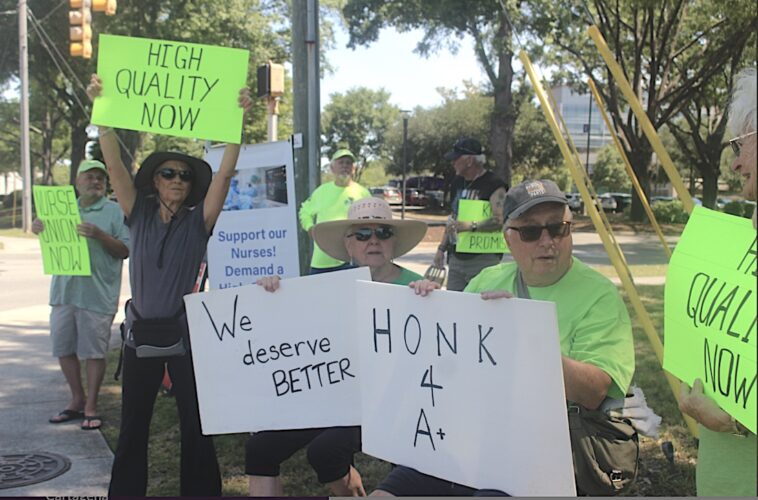
WILMINGTON — After scoring a “C” grade in hospital safety once again, members and friends of the Cape Fear Five Star Project gathered at Novant New Hanover Regional Medical Center’s entrance on 17th Street. Roughly two dozen people turned out on Saturday, May 16, to criticize the quality of patient care and ensure their loved ones — whose deaths many tie to the hospital — are remembered.
Denise Henning, a professor of education and indigenous studies at the University of North Carolina at Wilmington, lost her husband, John, in 2023. He went into the NHRMC with pneumonia, but ended up receiving a heart catheter to ensure there was no blockage in his arteries. Henning explained her husband endured cardiac arrest three times during his procedure, and the doctor ended up perforating his artery. John had to be put on life support as a result, but was removed as his heart was about to rupture.
“They just lied. They lied about everything,” Henning said, noting the complications were revealed after the procedure and after he died. “And then when we were trying to do an investigation and talk to the Novant Patient Advocacy, they sent a very nasty letter to me … they found nothing wrong.”
READ MORE: ‘Same old-same old’: Novant NHRMC receives another ‘C’ Leapfrog grade
ALSO: UNC Health plans community hospital in Wilmington, public hearing could come this summer
CATCH UP: UNCW announces plans to open medical school
Port City Daily reached out to the hospital to inquire about standard procedure for documenting and communicating complications that arise during surgery or treatment.
“Our physicians and care teams communicate directly with patients and offer explanation and support while determining the best plan of care together,” a NHRMC spokesperson said.
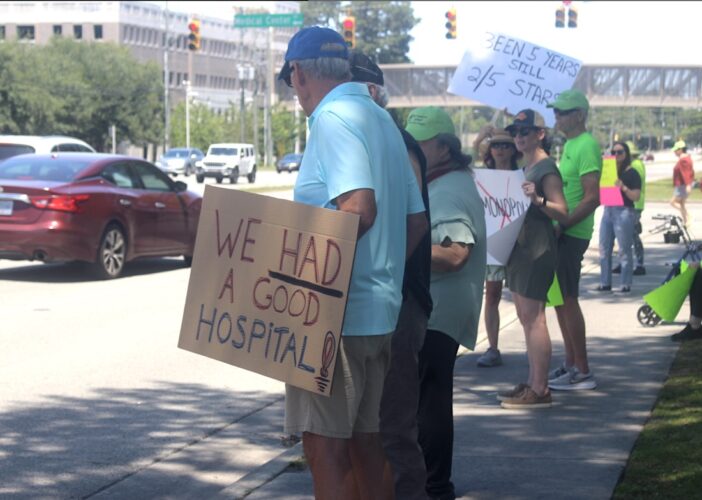
Along 17th Street, in front of the hospital, Henning held a sign alongside 20 other members and friends of the Five Star Project, demanding better safety” and for Novant to keep its “promise” of quality care.
It’s the Cape Fear Five Star Project’s third protest. The local patient advocacy group was founded by former physician Jon Martell, prompted by his own poor experience at the hospital. Following a procedure in 2024, he began bleeding profusely and ended up going into shock for three-and-a-half hours. Despite attempting to get timely care by communicating to staff, his requests for aid went unheard for hours, Martell claimed.
Five-star — named for the grade that community members hope to see the hospital earn — aims to hold Novant Health New Hanover Regional Medical Center accountable by demanding better communication, transparency and quality improvement for patients and staff alike.
Saturday’s protest was scheduled around the release of the latest “C” safety grade from Leapfrog. The nonprofit organization reviews and documents hospital safety and quality nationwide, with grades based on data from the Center for Medicaid and Medicare Services and Leapfrog-provided hospital surveys.
“Novant, whenever the report comes out, says: ‘We realized that we’ve got improvements. We’re on it. Things are turning around,’” Martell said, noting communication from the hospital still needed more work. “And every six months, the Leapfrog report comes back, and not only is it not improving, there are some things that significantly deteriorate.
The Leapfrog report shows NHRMC is just below national average in communication about medication and discharge at a score of 72 and 84 respectively, compared to the average hospital scores of 74.83 and 85.65. Its communication with doctors and nurses rating meets the national average at 90 and 91 respectively compared to the average of 90.11 and 90.55.
Novant repeatedly has said improvements are being made and Leapfrog’s grades are based on data from one-and-half to five years ago. The hospital’s “Vision 2030 plan” involves enhancing care teams, improving safety, improving patient experience, improving operational performance and expanding care.
The hospital earned a “C” grade for safety — for the fourth consecutive cycle. The report comes out every six months and the last time NHRMC received a higher grade of a “B” was in 2023. Other Novant hospitals have fared better in the Leapfrog report; for instance, Brunswick County Regional Medical Center rose from a grade “B” to an “A.”
The Leapfrog grading system includes a breakdown of data in measured categories — such as communication and infection rates. There are more than 30 categories. For example, “dangerous objects” being left in patients was eight times more likely to happen at NHRMC than at the average hospital; but the hospital scored better than the national average for nursing and bedside care at 100 compared to 79.73.
NHRMC also earned a three-star rating from CMS, up from its two-star designation, in February. The star rating from CMS measures the quality of care from medical providers who service Medicare and Medicaid patients. Novant scored better than and met the national average on rate of complications — its knee surgery complications were only at a rate of 2.3%, which is better than the national average at 3.6%.
Rates of infections were overall better than the national average in three treatment/disease categories and at the benchmark for the remaining three. However, the hospital performed worse on timely and effective care, with only 50% of patients receiving appropriate care for sepsis compared to the national average of 64%.
Martell said Novant promised the community after the November Leapfrog results that a dashboard would be published on the hospital’s website to show improvement plans in place. WHQR reported hospital president Laurie Whalin said Novant would publish on its website a “microsite” dashboard to track safety metrics using the hospital’s internal data. At that time she suggested it would be published by December, though it went live in February.
The hospital posted a three-page downloadable PDF with a few metrics laid out as graphs and tables. It shows improvement in communication from doctors and nurses, cleanliness, retention rates and C. difficile infection rates, among other items.
Martell said he and others requested the hospital include a comprehensive list of quality metrics and improvement plans that would be updated as needed — which he believes remains unfulfilled.
Port City Daily reached out to Novant to ask about its dashboard; a spokesperson for the hospital explained a new set of data with Q1 metrics will be published soon. The publication also inquired about its quality improvement plan and how quality is reviewed in order to understand how the metrics for improvement are measured. A Novant Health spokesperson explained the hospital maintains what it calls a “HeRO quality management system,” a framework for reviewing and improving the quality of care.
“This work is guided by three core pillars that are principles of high reliability organizations: leadership commitment, a culture of safety and process improvement,” the spokesperson explained. “In practice, that means focusing on the areas where we can make the greatest difference, using real-time data to better understand performance trends early, bringing together the right expertise, and applying proven methods to strengthen care over time.”
CMS’s rating also includes two stars for Novant NHRMC based on 394 patient surveys, which rank NHRMC below the national average — sometimes by a large margin — in every category. It scored lowest on cleanliness with 50% of people reporting their rooms and bathrooms were up to snuff, though it falls below the national average by 24%. The surveys ranked the hospital highest on communication regarding home recovery at 83%, falling below the national average by 4%.
One complaint attendees of the protest had in common was the inadequacy of the patient advocacy line; patient complaints are fielded through a third party organization, DNV Healthcare USA Inc., hired by the hospital. A portal online is used when requesting an investigation into possible malpractice.
A NHRMC spokesperson further explained the investigation process, saying the team reviews both the information from the loved ones or patients and the care providers. The team also references the medical chart’s record.
“After teams have completed an analysis, our teams will follow up with the individual and share a written response, to include the steps taken to look into the matter and the results of the review,” the spokesperson said.
Protestors reported issues of medical records inadequately representing patient complaints. They also described the department’s investigations into potential malpractice as surface-level and unhelpful.
Henning said she received no information about complications with her husband’s treatment until after his condition worsened. Others at Saturday’s protest, who realized in the moment something was wrong, reported issues with records being kept about their complaints and complications.
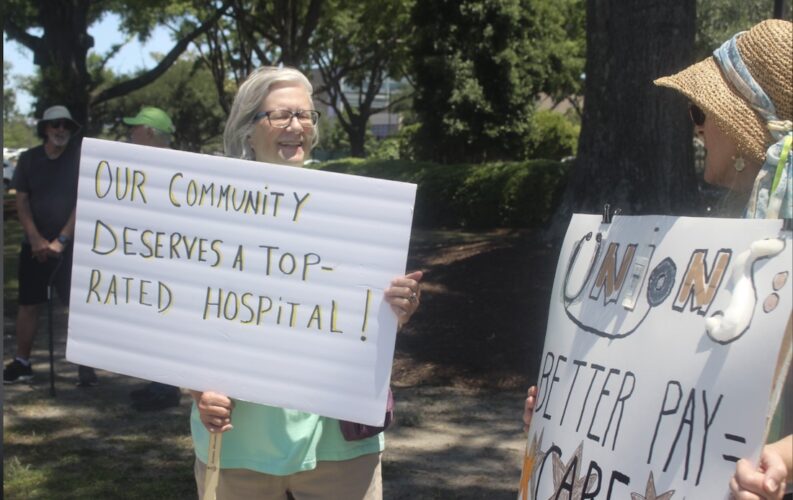
Tamara Agnelli advocated for a community deserving of better healthcare. In 2025, Agnelli needed a cardiac ablation, a minimally invasive procedure to treat irregular heartbeats. After the procedure, she said she explained feeling unwell to her nurse — numb hands and vomiting. Her concerns never made it to her chart, though, and the hospital sent her home.
The weekend after her procedure, Agnelli was back in the hospital after suffering two strokes. An MRI confirmed she suffered four strokes, including two while at the hospital. She told Port City Daily her MyChart, the patient portal used for communicating with providers, indicated nothing was wrong during or after surgery.
“When we went to visit my cardiologist, he asked if I’m gonna sue him,” Agnelli recalled.
Robert Jahn attended the protest representing his mother, Jacqueline, who experienced post-surgical complications. In 2023, she went into the hospital for a small intestine resection.
“And she never came home,” Jahn said.
Jacqueline ended up needing two more surgeries. After the first, Jahn explained, her surgical wounds opened, releasing stool and blood. During the second surgery, she endured cardiac arrest.
None of the complications were communicated to his family and Jacqueline died in hospice care shortly after.
The Leapfrog results show the hospital was above the national average in deaths from serious treatable complications at about 188 compared to 173. The rates of surgical wounds splitting open and serious breathing complications after surgery both increased from November’s results.
Though Saturday protestors want to see improvements at Novant, they also expressed hope in the form of the healthcare network receiving potential competition. UNC Health has announced tentative plans to bring a community hospital and specialized care to Wilmington, with a projected opening date of 2030. The 62-acre site is within a mile from Novant’s location on 17th Street and is proposed to fill in a healthcare infrastructure gap in the city. The state has reported a need of 225 acute care beds by 2028.
Jahn welcomes competition.
“They’re gonna have to do better because they’re gonna lose patients,” he asserted of Novant.
The Agnellis are hopeful about not driving out of town for specialized care. Standing alongside her husband, who wore a dog tag with their deceased son’s photograph on it, Tamra Agnelli explained how Daniel passed away in 2021 after battling kidney failure. He was unable to receive dialysis in Wilmington while he was a minor because Novant didn’t offer it for pediatric patients. They had to drive north for his treatment.
UNC Health would also provide more options of doctors and nurses for patients to choose from, Martell and others explained. Many expressed an eagerness to see Wilmington bring in more skilled providers that could also come from UNCW’s medical school — should the board of governors agree to a proposal put forth currently.
“For those that have already been impacted, though, there’s no way of erasing the past,” Henning said.

Have tips or suggestions for Emily Sawaked? Email [email protected]
At Port City Daily, we aim to keep locals informed on top-of-mind news facing the tri-county region. To support our work and help us reach more people in 2026, please, consider helping one of two ways: Subscribe here or make a one-time contribution here.
We appreciate your ongoing support.
