


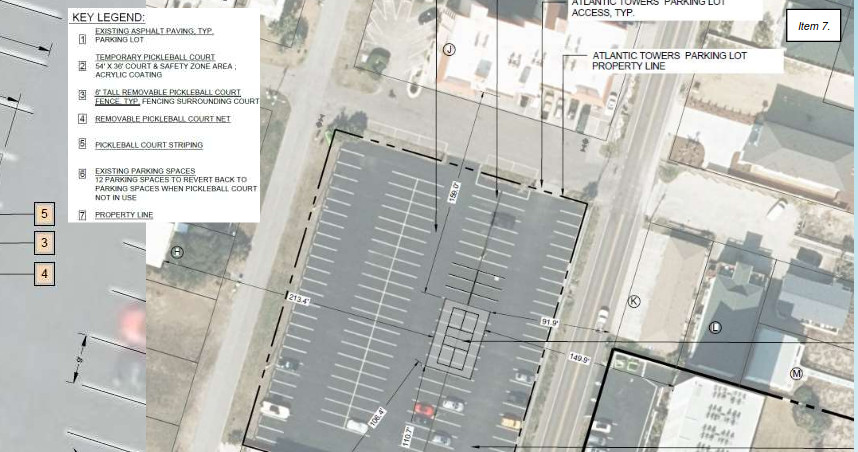
CAROLINA BEACH — Despite resident criticism, Atlantic Towers guests will have the opportunity to engage in paddle sports — not in their backyard, but rather their parking lot. The court will be installed for a one-year stint; at the end, council will review whether the nuisance caused by the sounds of playing, as critiqued by property neighbors, outweighs the benefit.
This week Carolina Beach council approved a one-year trial for a conditional zoning permit to allow a pickleball court in the parking lot of oceanfront condo rentals and a hotel business. On May 12, the board voted 4-1, with Mayor Pro Tem Deb LeCompte the only dissenter because of concerns regarding neighboring property owners’ rights to a quiet neighborhood.
“I like pickleball too, but I don’t want it next door to my house,” she said. “I didn’t move to an area where it’s allowed for that reason.”
READ MORE: CB budget: Residents weigh costs and benefits, including $12M Boardwalk buy
ALSO: Carolina Beach eyes 3.5-cent tax rate increase in next budget
CATCH UP: Carolina Beach Boardwalk properties decreased by $3M in town settlement
A four-lane pickleball court is allowed as a yearlong trial in the 1.15 acre parking lot of Atlantic Towers on 1608 Bowfin Lane. The yearlong trial is to allow for a review period of the temporary court to assess impact versus benefit before a final decision is made on the matter.
The approval was recommended by Carolina Beach’s Planning and Zoning Commission in early April, with seven conditions in addition to the trial-run. For instance, hours are limited from 9 a.m. to 6 p.m. and usage to only renters and hotel guests, as well as installation of a 6-foot fence to block the sound.
Also, the court must close at the height of summer season, between Memorial and Labor days. Michael Alford, the homeowners association president for Atlantic Towers, noted the condition was to accommodate the influx of people vacationing in Carolina Beach; the company wanted to ensure renters had enough space for guests and the like.
The conditional zoning permit will expire on May 12, 2027, and the applicant — Alford — will need to go through the permitting process again if he is interested in making the court a permanent fixture.
According to Alford, the desire for a pickleball court came because of two reasons. The first was the additional amenity would increase the marketability of the property. He noted Atlantic Towers would be the only oceanfront condominiums and hotel property with its own court. Alford also noticed a demand.
“I noticed that some of our guests were actually playing pickleball in our parking lot across the street,” he said, “just knocking them around with the paddles.”
He asked if they would be interested in having a court, to which the guests answered in the affirmative.
However, Alford had to ask for the conditional zoning because Atlantic Towers is in a mixed-use zoning district and does not permit pickleball or tennis courts by-right. Though the town’s unified development ordinance doesn’t list pickleball courts specifically, staff used the tennis court categorization as the closest reference point permissible by conditional zoning.
“We don’t actually have a use for pickle ball itself. But we do have some guidance in the ordinance that says, the administrator of the ordinance shall consider the use that closely matches,” senior planner Gloria Abbotts said. “For that, we’ve got private tennis courts, which require a conditional zoning.”
As required by town ordinance, the applicant held a public meeting for feedback on Jan. 29. Alford changed the original plans, which had the court closer to the Casa Del Playa community and Snapper Lane residences. By the time it went before council, it was moved further away from the condominiums and neighbors on Snapper Lane and closer to the actual hotel.
The court will take up 12 parking spots on the east side of the 1.15 acre parking lot, but the 12 spaces will revert back into parking when not in use — so after 6 p.m. and before 9 a.m. or during the summer. To ensure customers and residents still have a space to park their vehicles, the spots to be taken up by the court will be strictly employee parking. The applicant called the court temporary because he is able to remove the net, surrounding fence, and wind screens as needed.
Alford explained the parking lot was a prime location for the temporary court because the lot was already made of asphalt, ideal for building a pickleball court. If Atlantic Towers wanted to use other property spaces, he added, it would be a much bigger undertaking than the current proposal.
Though a fence and wind screen will also act as a barrier for the court, its placement was hotly debated, as residents were against its location.
“There is no location in that parking lot where you can put a pickle ball court that it will be quiet,” resident Megan McRoberts said.
Most of the council agreed with staff that the applicant attempted to move the courts as far from residents as possible, all in good faith, and the applicant was pleased with the results.
“The fact that the court is closer to Lake Park Boulevard will actually help our marketing,” Alford said, noting he’s interested in putting signage on the property so drivers and passersby on the often busy street will notice the company has a court of its own. He considered the new location on the parking lot a positive change.
Since the town currently operates its own public pickleball courts at Mike Chappell Park and the recreation center, residents questioned why another one was needed or appropriate.
“A satellite parking lot in our residential neighborhood is not the only option,” resident Carol Stewart said to council Tuesday.
The parking lot is situated just behind Atlantic Towers, but the applicant also boasts a large front yard facing the beach, which Stewart implied could be used to house the court instead.
Stewart, whose back porch faces where the pickleball court is slated to be installed, said the applicant did not necessarily explain why it had to be in the parking lot. She did not think the relocation of the court to the other side of the property was enough to mitigate noise.
Moreover, to suggest it is “temporary,” Stewart said, is a misnomer, noting the paint used to draw out the court’s shape was more permanent than the fence and netting.
“It makes this a permanent court with detachable accessories,” Stewart said.
In particular, Stewart was concerned about the noise the court would produce, citing numbers listed in the application. Documents suggest hitting the ball with the paddle could produce a noise level between 60 and 70 decibels. Stewart presumed the noise level could reach 80 decibels; research from Tennis Warehouse University backs this up. Research co-authored by the founder of Pickleball Sound Mitigation LLC explains pickleball sounds result in a noise level up to 70 decibels and a frequency of about 1,200 Hz, equivalent to beeping sounds made by a garbage truck backing up.
Stewart pointed to the “pop” of the paddle hitting the ball more disruptive than anything.
She also presumed the noise would also bring down her property market value by 10% to 20% since her home is immediately adjacent to the court and referenced an article written by a seasoned realtor from California. The pros and cons of being near a pickleball court has been a hotly debated topic in the real estate industry according to Realtor News; experts in the article explained the courts also can be a benefit seen as an amenity and community building activity. However, no definitive, reputable research exists to confirm either claim.
Another resident, and president of Casa Del Playa’s homeowners association, June Martin, was concerned about the disruption the noise from the court would cause. Casa Del Playa is situated adjacent to the parking lot and hosts permanent residents or second home owners, not short term rentals. Martin contested that disallowing the court during peak season benefited her community, since residents, still there during the off-season, would be bothered by the noise so close to their homes.
“Would you want a pickleball court in your backyard?” she asked council.
McRoberts, whose family has owned their Bowfin Lane home for 70 years, said her parents were also among the first to oppose the conditional zoning application and she was at the meeting on their behalf.
Like Stewart, McRoberts added pickleball is available at summer camp, the recreation center, area parks, and elsewhere. She noted communities with built in pickleball courts were chosen by residents with the noise in mind; McRoberts emphasized the importance of autonomy.
“Everyone who sits in this room today who is opposing this does not have a choice unless you help us have that,” McRoberts said.
LeCompte noted while she was a “property rights person”, there are limits to what she would accept.
“If my rights infringe on my neighbors’, where do my rights end and theirs begin?” she asked, noting people in the communities surrounding the proposed site.
However, she was alone in her vote. Other council members could not find a concrete reason to deny the application.
Councilman Wayne Rouse noted the proposal was in “general conformity” with the town’s land use plan and it was just a trial period. Further, he pointed out traffic already produced in the area from cars and food trucks meant the neighborhood was not exactly quiet to begin with.
Councilman Vince Losito agreed. He added the applicant already moved the court further back to accommodate residential concerns.
“I can’t come up with a reason to say no to it,” he concluded.
Healy and Mayor Lynn Barbee, while not fans of the concept entirely, were willing to see through the results of the trial period and gave a stamp of approval.
“Let’s give it a shot, and if it doesn’t work, it doesn’t work,” councilman Healy said, noting if it doesn’t: “We’ll scrap it.”
Have tips or suggestions for Emily Sawaked? Email [email protected]
At Port City Daily, we aim to keep locals informed on top-of-mind news facing the tri-county region. To support our work and help us reach more people in 2026, please, consider helping one of two ways: Subscribe here or make a one-time contribution here.
We appreciate your ongoing support.
