


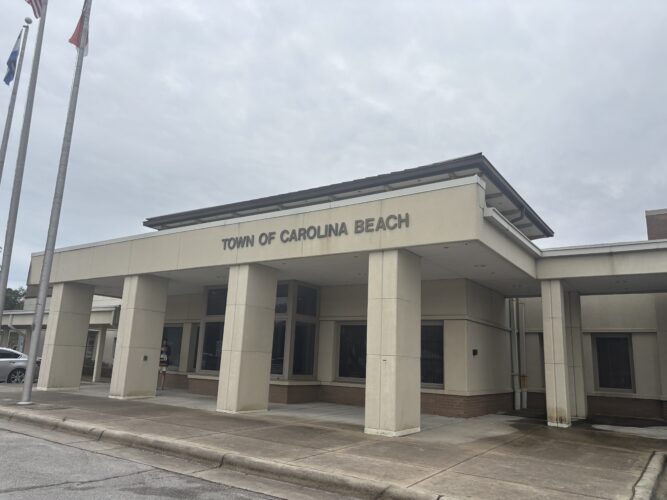
CAROLINA BEACH — At a budget open house, three days after Carolina Beach’s town manager unveiled its detailed $27.1-million general fund and $12.7-million utility fund reports, attendees expressed interest and concern about two items: the town’s $12-million purchase of nine parcels on the boardwalk and flooding along northern Canal Drive.
“I do think that the land purchase is a really good thing,” resident Bob Ponzoni said. “But it’s a lot of money and we just lost a bunch of money to a scam.”
READ MORE: Carolina Beach eyes 3.5-cent tax rate increase in next budget
ALSO: Carolina Beach Boardwalk properties decreased by $3M in town settlement
Town Manager Bruce Oakley explained to council last week he squared up the roughly half-million-dollar cyberattack scam by cost-cutting, delayed hiring, project-shifting and more; the money was recouped in the current budget and isn’t impacting fiscal year 2026-2027. Oakley was at the open house, too, along with town department heads and Mayor Lynn Barbee, Mayor Pro Tem Deb LeCompte, Vince Losito, Jay Healy and Wayne Rouse to answer questions.
The town is currently proposing a 2.95-cent tax increase to next fiscal year’s budget to supplement a $3-million deficit from significant increases in wages and healthcare costs. To do so, Oakley suggested increasing the tax rate from 14.2 to about 17.2 cents per $100.
Part of the tax rate increase will cover $1 million out of the total $12 million boardwalk land purchase the town plans to finance through loans and offset with grants, though none have been submitted yet.
“There have been conversations with the bank about: ‘Are we in good shape? Is this going to be doable?’” Barbee explained to Port City Daily, noting the town has received a “verbal ‘yes.’”
The boardwalk land purchase came in a lawsuit settlement between the town and Carolina Beach Holdings, LLC from November 2023 to January 2025 over code enforcement violations and an easement for the public sidewalk next to the Ferris wheel. The closing date for the purchase is in September, and once the town secures a loan, it will need to be approved by the Local Government Commission, the state authority on municipalities’ debt financing.
“As soon as we close on whatever financing we get, we’re gonna start looking for outside sources, whether it’s state funding or grants,” Oakley explained, pinpointing the Parks and Recreation Trust Fund and Land and Water Conservation Fund as examples.
Because the preliminary plans for the land parcels involve making the area publicly accessible, either with public parking, fairgrounds, or an outdoor venue, Oakley explained the PARTF grant could be viable. The Land and Water Conservation Fund is a state-federal matching grant for public outdoor recreation, including land acquisition, and provides typically up to 50% reimbursement to local governments.
“I know a long-term goal for this council and many other councils has been to push the stage back and have a big public area right in the middle of the boardwalk,” Oakley explained.
Barbee told Port City Daily the properties will be able to draw in revenue and could help to pay for themselves in the long run. The town will not be taking out revenue bonds through the LGC, just a regular loan.
The purchase has received mixed feedback from residents who are both concerned about the budget implications but also eager to see the land become public use.
Residents Debi and Stephen Taylor, each a part of the Northend Flood Mitigation Alliance executive board for Canal Drive, favored the ownership transfer to the town. They thought it would both save the town money, not having to lease any of the property to use it for boardwalk rides.
The lots were previously used as private parking during the off-season.
“If the town could make that our own parking lot, now it’s revenue,” Debi suggested. “I would rather see the town purchase the land than to see another developer come in here and put in a five-story building.”
No plans have been explicitly made yet, as Oakley said the town needs to meet with designers first.
However, the couple and Ponzoni, also a member of Northend Flood Mitigation Alliance, were disappointed in the fact the town hadn’t factored in projects to improve north Canal Drive.
“The north end is what you think of when you’re going to Carolina Beach,” Ponzoni said, calling the region the “money maker” as it leads to Freeman Park, a popular gathering spot for cars to pay for passes to drive onto the beach.
However, that portion of Canal Drive is also known most for its extreme flooding from King Tides and stormwater, due to drainage and systemic issues.
Barbee noted, despite not having a specific line item in the 2027 budget to address the area, the north end has been a priority to the town for years.
“We have consistently been investing in north end flood mitigation and stormwater projects for at least the five years or so I’ve been on council,” he said. “It’s expensive and I feel for them. I’m certainly sympathetic to their calls, but we’re fighting nature here.”
There were already projects in progress to improve stormwater drainage by the north end, which were started prior to the upcoming budget year and covered by a FEMA grant.
Already, about $1.5-million has been invested in the north end over the last four years and will spend likely an additional $100,000 on the roadway this next year.
The town is covering other roadway projects next budget year. First, Carolina Beach plans to turn the south end of Canal Drive into a one-way permanently, which will cost roughly $25,000. The town will also be adding a multi-use path to St. Joseph Street, estimated at $1.8 million.
Ponzoni argued a flooded Canal Drive also presents problems with polluting the ocean, as runoff and excess water seeped into the local environment.
“Every time it flows, it’s an environmental disaster,” he said.
Ponzoni hoped to see storm valve replacements and bulkhead repairs to help mitigate flooding — part of an “awful lot of work” Debi said was left to complete.
Barbee said replacements and improvements are being done over the next year based on priority and the town plans to continue working on improving the flooding situation on the north end with resources it has available, including funds and maintenance equipment.
Public works director Brian Stanberry explained to residents at the open house stormwater drainage issues around town and on the south end of Canal Drive, opposite where the Taylors live, would be tackled.
In February, Carolina Beach issued debt via revenue bonds for stormwater drainage and wastewater treatment improvements, like an additional wastewater treatment well and a new stormwater force main. The bonds will be paid off by the revenue made from the projects the debt is paying for. The cost to LGC documents noted the bonds cost roughly $33-million and were not to exceed $35-million. In order to pay the loans back, the town is proposing increasing utility costs by 9% — a requirement in the bond covenants. There will be an annual 9% increase until 2030.
Oakley also noted the town planned to replace the bulkhead on Delaware Avenue because of flooding.
Capital improvements under the water and sewer enterprise fund total a little more than $900,000 in the recommended budget, with stormwater drainage and wastewater treatment as the highest expense for the utility fund.
Other capital improvement projects include the purchase of new air packs for the fire department, new security cameras for the police department and office remodeling for the fire department. The tax rate increase will also cover the future purchase of a new fire engine for the department.
However, the bulk of the town’s expenses, as previously reported by Port City Daily, are employee wages, which have risen by a maximum of 12%. The increase ensures all town staff are paid a minimum of $23 an hour to accommodate cost-of-living adjustments and improve employee recruitment and retention, a topic first discussed by council and staff in January.
The fire department had the largest increase in wages — a $300,000 difference between the past budget year and the upcoming one, totalling now $1.7 million. There are 22 people working in the department, with four administrative employees.
The police department followed closely behind with a roughly $200,000 difference; however, the police department wages are the highest expense across the departments at $2.6 million. There are 35 people employed within the police department.
The biggest jump in expenses, aside from wages, was healthcare and family coverage, with an increased 30%.
Town council is expected to vote to adopt the budget in June following two public hearings, and Oakley’s recommended budget will be officially presented to the elected officials on May 12.
[The article has been updated upon response and amended to note the proposed tax rate increase is 2.95 cents. Port City Daily regrets this error.]
Have tips or suggestions for Emily Sawaked? Email [email protected]
At Port City Daily, we aim to keep locals informed on top-of-mind news facing the tri-county region. To support our work and help us reach more people in 2026, please, consider helping one of two ways: Subscribe here or make a one-time contribution here.
We appreciate your ongoing support.
