


NEW HANOVER COUNTY — The New Hanover County manager’s recommended budget will not include a tax rate increase after three Republican commissioners indicated they would not support raising property taxes to balance finances in the 2026-2027 fiscal year. The recommended budget is scheduled for a public hearing on May 18.
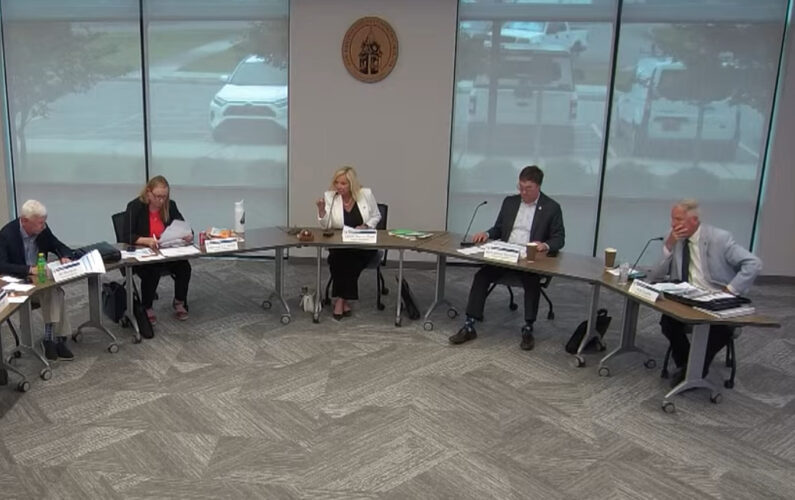
After several budget workshops weighing budget options with polite debate, the county commissioners laid their cards on the table at Thursday’s meeting.
READ MORE: NHC backing away from Revenue Stabilization Fund, tax increase to be reviewed
“Our citizens are being hit from all sides, and there isn’t a lot that you and I can do about what the City of Wilmington does or what Duke Energy does, but we can set the tax rate for this county, and I think that our citizens are looking for us to be the one institution, the one body, that says we’re not going to contribute to the pressure that you’re under from every other direction,” Commissioner Dane Scalise said.
County budget staff presented two funding scenarios to the commissioners at the meeting to meet inflationary pressures and the restoration or previously cut funding lines: Keep the tax rate at 30.6 cents but use savings to balance the budget or raise the tax rate to 32.6 cents.
Staying at 30.6 cents would require tapping into almost $4 million from the county’s fund balance, on top of another $2 million in fund balance that had been transferred to the capital outlay fund.
County Manager Chris Coudriet indicated in prior workshops the danger of continuing to pull from the fund balance; roughly $8 million was used for the current fiscal year’s budget. If the county violates its fund balance policy by dipping below the 16.67% threshold, it could affect the county’s credit rating, even though the state only recommends municipalities retain 8% in fund balance.
Coudriet said Thursday the county should steer clear of a policy violation in the 2026-2027 budget if it kept its fund balance at $3.98 million and “not a dollar more.”
However, Coudriet indicated it would still be his preference to use the Revenue Stabilization Fund to balance the budget because it has no bearing on the county’s credit rating. The fund was established with $300 million from the sale of New Hanover Regional Medical Center in 2021; it has broad uses, inclusive of balancing budgets, though commissioners Stephanie Walker, Rob Zapple and LeAnn Pierce said they didn’t want to use the pot of money for recurring expenses.
Though it would take a while at the current rate, the fund would eventually deplete. Zapple indicated this week he would like to see the fund be reserved for emergencies, such as hurricanes; the county paid upward of $30 million in the aftermath of Hurricane Florence though was eventually reimbursed by FEMA.
Both budget scenarios include using interest gleaned from the Revenue Stabilization Fund, which can be taken off the top of the fund without affecting the corpus amount.
County staff’s 30.6-cent proposal included funding for New Hanover County Schools at the district’s full ask — $836,321 in additional capital funding and $2.5 million in capital funding.
It also includes the restoration of $916,500 in former pre-K funding, though Superintendent Chris Barnes did not explicitly request the county restore this funding; he was able to balance pre-K at the same classroom level. However, he indicated last week the district would be pleased to receive the money, which it could put toward other board priorities.
Commissioner Zapple was critical of how the district communicated what the $916,500 would be used for at last week’s NHCS finance committee meeting, which he took some flack for from some community members online.
“I’ve been a strong advocate for pre-K for the past 12 years,” Zapple said. “Indeed, I have helped grow that program from to the point where it is today. And, so, I’m delighted to hear that we will have it again in any scenario.”
However, the 30.6-cent scenario would not include funding for the Community Justice Center, arts and economic development funding or workforce housing. Walker and Zapple had pushed for the restoration of the county’s mulit-million commitment to workforce housing in particular.
Walker and Zapple were more critical about the continued use of fund balance.
“I’m not suggesting making it harder on people [with a tax increase,] but I’m trying to be a realist here,” Walker said. “At some point it’s going to catch up to us, this rate that we have right now that was set last year — it is not covering our bills.”
Like she has done in past budget sessions, Chair Pierce pushed back on this narrative. Pierce argues the commissioners — her, Scalise and Bill Rivenbark — did not cut the budget when they voted on it last year; on Thursday, she claimed the media “repeatedly reported things that was not exactly the case.”
It is true that, compared to the 2024-2025 budget the commissioners approved in the spring of 2024, the 2025-2026 budget increased by 11%.
However, the commissioners had approved nearly $36-million more in spending between the two budget cycles. When it came time to review expenses last spring, the county’s baseline was much higher than what commissioners originally approved; the county manager recommended a tax rate that would retain that level of service. Pierce, Scalise and Rivenbark chose a revenue-neutral rate based on the originally approved amount, not their actual spending, forcing the county to lay off dozens of employees and funding lines, such as pre-K funding.
Walker and Zapple’s argument was commissioners would have to contend with needing additional funding every year — unless they raised the tax rate to cover its needs without using savings or the Revenue Stabilization Fund.
Zapple suggested the commissioners explore a 1.5-cent increase rather than 2 cents; Coudriet said that, while within the commissioners’ purview, any budget with a rate less than 30.2 cents would need to utilize either the Revenue Stabilization or fund balance to keep expenses the same.
Seeing a consensus among the majority of the commissioners — Scalise asked if Rivenbark was on board with the 30.6-cent scenario, to which he said yes — Coudriet said he would present the recommended budget with that amount to commissioners early next week.
After hearing from the public on May 18, the commissioners could vote on the budget or they could wait until another meeting before July 1, when the new budget will take effect.
At Port City Daily, we aim to keep locals informed on top-of-mind news facing the tri-county region. To support our work and help us reach more people in 2026, please, consider helping one of two ways: Subscribe here or make a one-time contribution here.
We appreciate your ongoing support.
