


NEW HANOVER COUNTY — A subdivision poised for nearly 600 homes to break ground in a significant natural heritage area of old-growth forest and wetlands will have to wait up to three months after a county board granted a stay.
On Tuesday evening the New Hanover County Board of Adjustment voted unanimously to pause the issuing of county permits, for now, on the large-scale Hilton Bluffs development. At full build-out, the development will consist of 1,800 units planned across roughly 1,800 acres. Earlier in the year, the county’s technical review committee gave conditional approval for 580 homes to be built, as Copper Builders’ plans complied with the county’s development rules and granted conditional approval for the project’s initial phase.
READ MORE: Hilton Bluffs development appealed in 2 separate filings to county
ALSO: Hilton Bluffs poised for first 580 homes to break ground in phased build-out
As first reported by Port City Daily, separate appeals to overturn TRC’s approval were filed in early April — one by attorney Grady Richardson on behalf of residents in the Wooden Shoe and Marathon Colony subdivisions, and another by the Southern Environmental Law Center representing additional Castle Hayne residents. Each argued the county misapplied development rules in granting approval for the project’s first phase, and asked the board to overturn the decision and halt the project as currently proposed.
The county’s adjustment board agreed at granting a stay on development until the appeals are ruled on or by July 31 at the latest; the hearings are tentatively scheduled for either June 23 or 24.
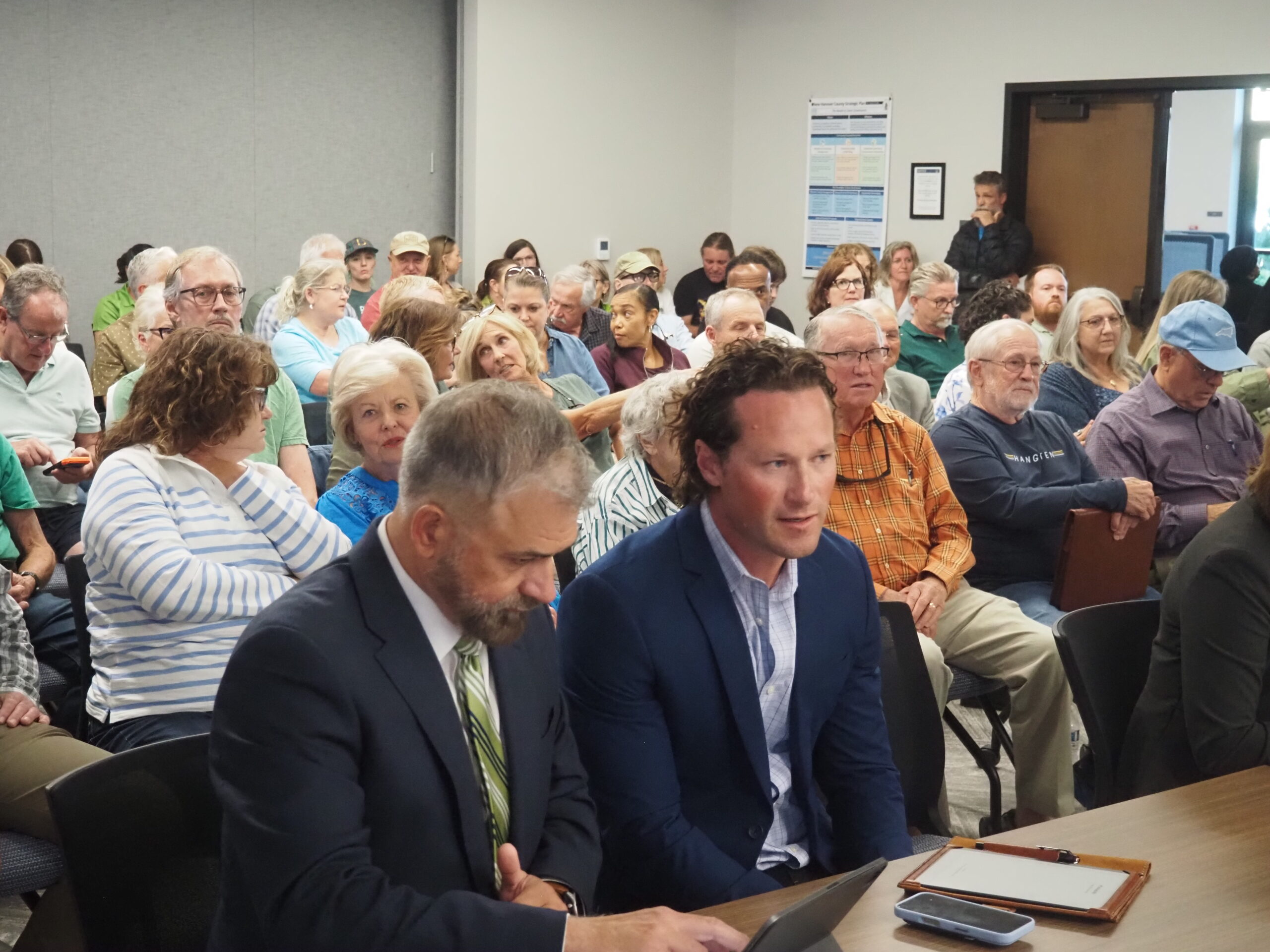
The room was packed with more than 70 people, many concerned by the Castle Hayne project and its impact on the environment, increased traffic on existing roadways, and the project size. Though there was no public comment during the stay hearing — the public will be allowed to speak during the appeals hearings — many more gathered in an overflow room to watch as the five-member New Hanover County Board of Adjustment took up the issue.
Board members acknowledged the scale of the case and the size of public turnout, with member Michael Sanclimenti noting: “This is a big deal. How many people are here? We’ve never had that many people before.”
The stay had to appear before the board of adjustment because it is the body responsible for hearing challenges to county development rules. Acting in a quasi-judicial role, meaning it was functioning as an impartial court, the board could only review evidence and hear sworn testimony in relation to the stay, to determine if not granting one would cause “irreparable harm” to appellants.
Fifteen minutes were allotted for both the SELC and Richardson to make arguments for the stay, as well as 15 minutes for Copper Builders’ attorney Sam Franck to rebut.
The board ultimately believed the stay was necessary.
“This project is too big, too important to get wrong,” Chair Caleb Rash said. “It seems intuitive to grant some sort of stay on the very items there is a dispute over.”
Copper Builders CEO Wade Miller told Port City Daily the stay would not disrupt the project’s timeline. It is unclear when ground will be broken on the site as permitting and final plat approval by the county are still required.
The project, overall, is allowed by-right, meaning it must be approved if it complies with applicable developmental rules in the county’s unified development ordinance and doesn’t need commissioners to vote on it. The property zoned Rural Agricultural generally allows up to one unit per acre and Copper Builders will fall within that density allowance.
“It doesn’t bother us,” Miller said after the board’s decision to grant the stay. “We’re still cruising along with our plans and we wouldn’t be achieving any permits in the next couple of months anyways.”
The hearing
The board of adjustment decided to hear from both Wooden Shoe and Southern Environmental Law Center representatives at the same time. First up was attorney Liz Rasheed with the SELC, who centered her remarks on environment and density.
Rasheed told the board she was worried if a stay wasn’t in place while the appeals were researched, Copper Builders could begin preparing and clearing land for the development. She stated environmental damage cannot be undone once that begins and that could harm area residents due to loss of flood protection.
“Environmental injury, by its nature, is permanent, or at least operationally irreparable,” Rasheed said. “Here, we’re talking about an area that is part of the Northeast Cape Fear River floodplain. It has been considered an area of national significance. So damages that would be done with any sort of construction or tree clearing would be significant.”
Her argument was tied directly to active permits that would allow clearing thousands of trees during the early phase of the project. A tree removal permit filed by Copper Builders on March 30 includes cutting down approximately 34,437 caliper inches, or about 1,629 significant trees. Across all phases of Hilton Bluffs, roughly 122,660 trees are expected to be cleared, with about 12,698 proposed to remain.
County rules require mitigation for 12,246 trees, which can be met either through replanting on-site or by paying into the county’s tree fund for off-site planting elsewhere in New Hanover County. The permit shows no specimen trees — large, mature trees such as live oaks — are expected to be removed.
Rasheed also challenged how the county calculated the project’s density. She argued land designated as an “Exceptional Significant Natural Heritage Area” — a protected classification under county rules, requiring 90% preservation — was improperly included in the development math.
Copper Builders is basing its plan on the full 1,800-acre tract — 1,200 of which is unbuildable wetlands. It wants to build 1,800 homes on 600 acres of uplands.
By counting wetlands as part of the buildable base, Rasheed argued, the county effectively allowed more homes to be approved on a smaller amount of developable land than the ordinance permits. The ordinance allows density to be calculated using the total property size, even if large portions cannot be constructed on.
Copper Builders’ attorney Sam Franck pushed back, contending county staff correctly applied the ordinance and the appellants were misreading how the rules are intended to function. He said the county’s approach allows development to be concentrated in buildable areas of a property, while unbuildable sections are set aside for permanent conservation.
“The code has to be twisted pretty substantially to reach the conclusion that this does not support the clustering of density that’s been approved on this plan,” Franck said. “The whole purpose of it is to reduce the amount of land used for a specific number of homes. Two-thirds of the land in this plan is designated for conservation.”
Attorney Susan Keelin, also representing the SELC appeal, disagreed with Franck’s determination because a conservation agreement has not yet been reached.
Copper Builders was working on an agreement with nonprofit Unique Places to Save that it would purchase unbuildable wetlands for conservation. However, it fell through in fall 2025 after the group did not secure a state grant to purchase the protected acreage. No new conservation partner has been secured yet, though Miller indicated previously to Port City Daily they are working to identify one.
However, Keelin argued without a binding conservation agreement in place, the land being treated as permanently preserved in the county’s density math is not legal. Thus, the project’s approved density depends on the land being protected.
Attorney Grady Richardson, representing the Wooden Shoe neighborhood, tackled property rights of residents who moved into a neighborhood, due to its quietude and surroundings of rural residential and agricultural properties. He said a massive development of this caliber would change that outcome.
More so, he focused on roadway networks and impacts on area residents. Richardson argued the project depends on existing small roads never intended to serve as entry points for a subdivision of this scale.
Under the current site plan, traffic from the first phase of Hilton Bluffs would utilize Marathon Avenue and Indian Corn Trail in the Marathon Colony and Wooden Shoe communities. Richardson said county approval treats Marathon Avenue as a 60-foot public road, while records he cited do not include documentation it was widened beyond a narrow private roadway.
“I cannot find anything in the state’s archives or the Register of Deeds today that shows that Marathon Avenue was ever changed lawfully from 25 feet to a 60-foot-wide,” Richardson said.
He argued the difference matters because major subdivisions are required to be served by roads built to public rights-of-way specifications, including sufficient width for drainage, utilities, and emergency access. In his view, the existing network does not meet the standards and was never designed to handle subdivision-level traffic.
Richardson also pointed to the physical design of the roads beyond narrow lanes, including 90-degree turns, arguing they were not engineered to accommodate the development’s projected numbers of daily vehicles. The project’s traffic impact analysis shows Hilton Bluffs would generate 990 daily trips for the first phase, escalating to 14,795 trips per day at full build-out.
Franck also rejected Richardson’s argument, saying questions about roadway classification and access fall outside the board’s role in reviewing a conditional approval for a stay only — he added specifics of appeals are to be heard later. Moreover, he explained county staff evaluated the application based on the assumption that required access could be secured, and preliminary approval does not resolve underlying infrastructure or property arrangements.
After hearing from both sides, BOA members weighed whether development should be paused as appeals are considered. Members pointed to the size of the appeal record — nearly 500 pages — and said the complexity of the issues warranted more time for review.
Member Greg Uhl said he was in favor of the stay, as were other board members, Laura King and Will Daube.
“I fully agree that this is not something I think we should rush into,” board member Sanclimenti stated. “I fully sympathize with the developers in their approach, I’m very much a fan of private property rights and all of you are here with your private property rights. I don’t think there is any major problem or any harm to come through voting for a stay.”
Discussion turned to timing, with members considering how long any stay should remain in place. Appellants had requested one until the board reached a final decision on the merits of appeals. Board members wanted to have a specific end date for the stay, concerned that without one the delay could go on indefinitely.
Ultimately, the board voted to keep all county permits for Hilton Bluffs on hold until a final appeals decision or for the next three months at most.
Have tips or suggestions for Charlie Fossen? Email [email protected]
At Port City Daily, we aim to keep locals informed on top-of-mind news facing the tri-county region. To support our work and help us reach more people in 2026, please, consider helping one of two ways: Subscribe here or make a one-time contribution here.
We appreciate your ongoing support.
