


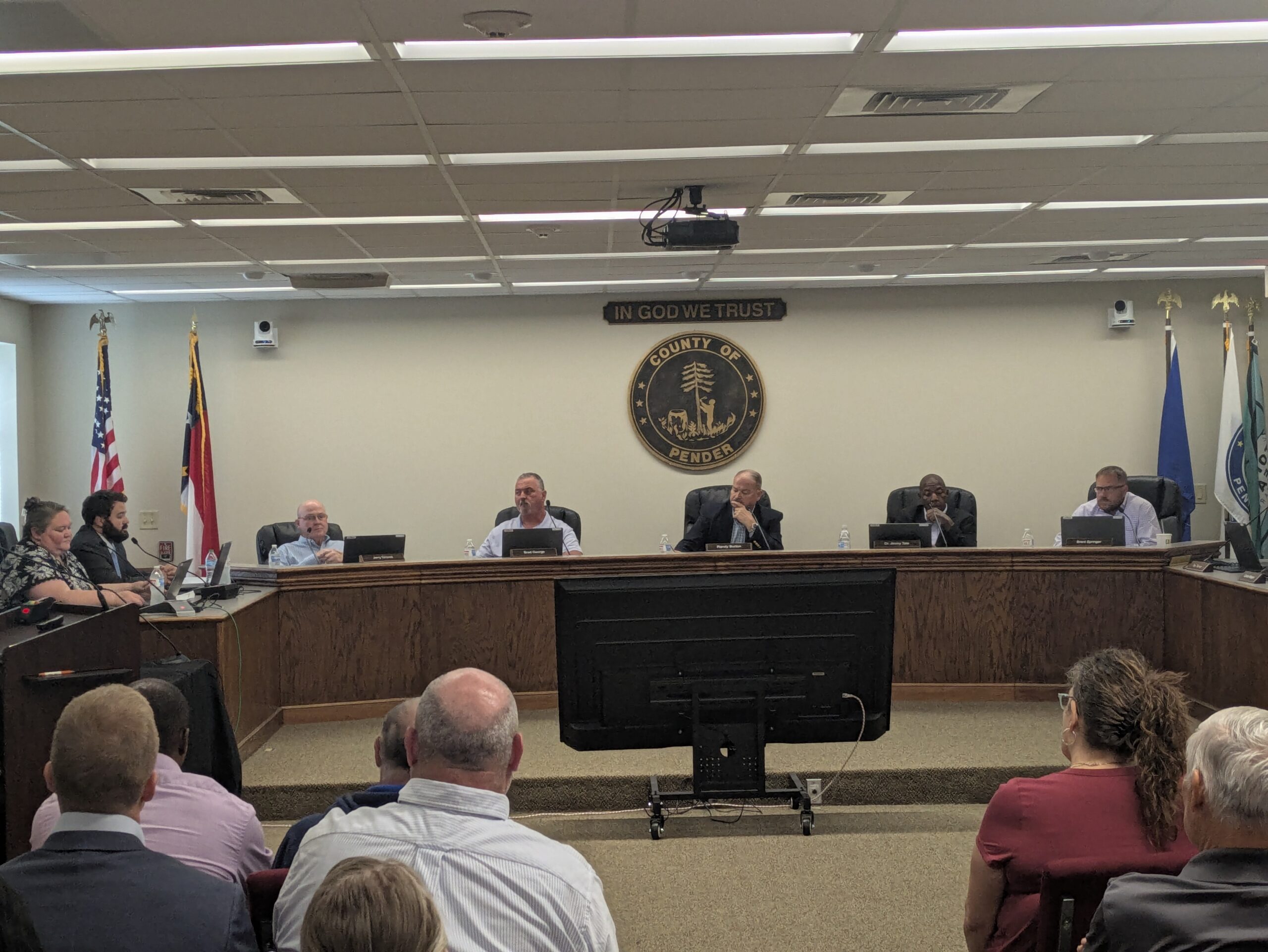
PENDER COUNTY — Pender County commissioners are holding the line on a legally disputed property revaluation freeze, defying state officials who warn the move may be unlawful and could jeopardize the validity of future tax bills.
During an April 13 special meeting, called to address mounting concerns over commissioners suspending the county’s 2026 revaluation, the elected board left their decision in place. Commissioners voted April 7 to halt revals over concerns with inconsistent values.
READ MORE: ‘God save the next board’: Pender County suspends escalated reval data, in favor of audit
ALSO: Pender County revaluation pause may conflict with state law, emergency meeting set
However, the North Carolina Department of Revenue deemed the action outside the county’s purview.
“North Carolina’s property tax system is governed entirely by statute, and there is no authority to suspend or halt a reappraisal after the Jan. 1 effective date,” General Counsel for NCDOR Steve Pelfrey told commissioners at the meeting.
He explained Jan. 1 is the statutory effective date for reappraisal values; thus, once the date passes, the values are legally in effect for taxation purposes unless changed through the appeals process or legislative action.
Counties can only take actions on revaluations explicitly allowed under state law and there is no statute permitting a revaluation to be suspended once it takes effect.
Still, Pender commissioners didn’t budge and hope to find a legislative remedy through Raleigh. They directed residents to contact state lawmakers — including Senator Brent Jackson (R-9) and Representative Carson Smith (R-16) — to seek legislation permitting the county’s delay.
Port City Daily reached out to Sen. Brent Jackson and Rep. Carson Smith to ask whether they planned to introduce legislation allowing the county to continue to suspend its revaluation. A response was not received by press.
Additionally, NCDOR officials warned if commissioners take action outside what state law allows, it could raise questions about whether resulting tax bills are legally valid. Property values help commissioners determine the tax rate every budget season. It could also expose local officials to personal liability for acting beyond their legal authority, including being named in lawsuits tied to unlawful tax collection.
The department said no county in North Carolina has successfully halted a revaluation after Jan. 1 without legislative approval. In 2009, several counties — including Caldwell, Rockingham, and Stanly — attempted to rescind their reappraisals but were only able to do so after the General Assembly passed special legislation authorizing the move.
There was some confusion among the board of commissioners whether a local bill — legislation applying only to Pender County — would be sufficient to address the issue. While Commissioner Jimmy Tate called for the measure, Pelfrey indicated property tax law operates under a statewide statutory framework. Therefore, changes would likely need to apply uniformly across all counties.
To that effect, Senate Leader Phil Berger (R-Rockingham) has indicated plans to file legislation during the upcoming short session to pause property revaluations statewide for 12 months. This delay would allow a legislative study committee to examine broader property tax issues, including potential reforms to the state’s appraisal process and tax powers of municipalities.
Tate was frustrated staff didn’t speak up, indicating legal concerns, during his motion to suspend the revaluation earlier this month. He believed county staff had discussed potential issues with the move internally immediately following the April 7 commissioners’ vote, but did not directly advise the board at the meeting. Tate did not question — nor did anyone else on the board — whether the motion was legal.
“Why wasn’t that advised at the time versus discussing among your colleagues?” Tate asked staff at Monday’s emergency meeting. “I’m not Hitler — I’ve been on this board since 2007. If you stop me and tell me something’s not appropriate, tell me, because it was discussed in this building before now.”
In response, newly appointed County Manager Colby Sawyer — who left his position as communications and emergency management director for the town of Pittsboro for the Pender County role — said the legality of the suspension was complex and required additional review before definitive guidance could be provided to commissioners.
“We did not have verification that it was possible until we followed up with the School of Government and the Department of Revenue,” Sawyer said. “As complex — as rare as this is — I don’t believe that it is fair to ask us to be subject matter experts in every single area of law.”
Sawyer added uncommon or complex statutory questions oftentimes requires subject matter expertise before anyone advises the board, noting this type of situation was unprecedented for the county.
County attorney Trey Thurman was present at the April 7 meeting when commissioners suspended the revaluation as well, though did not immediately raise questions about the legality of the decision.
After Tate voiced frustration with staff Monday, Thurman said the situation was unprecedented and reiterated the North Carolina Department of Revenue’s position. However, his explanation appeared disjointed, circling back to general considerations about risk without directly clarifying how the board should legally proceed.
“Well, thank you,” Chair Randy Burton replied. “I’m totally confused, but it’s all right.”
Valuation methodology
The nearly two-hour special meeting drew a large and at times emotional crowd, with residents spilling into the hallway as the boardroom was at capacity. Throughout the discussion, attendees audibly disagreed with claims about the reappraisal process, one resident abruptly leaving the meeting room and loudly slamming the door on the way out.
Reappraisals on average in the county rose between 105% to 110% though some people claim their properties have tripled, even quadrupled, in value since the last reval in 2019.
Commissioners continually explained constituent concerns about rapidly changing property values and what they described as “inconsistencies” in assessment data.
“Nobody in this room is opposed to paying taxes, I believe,” Tate said. “What we are opposed to is inaccurate data being used to impose taxes.”
County staff and President Ryan Vincent of contracted appraisal firm Vincent Valuations also was present. The board cited specific resident complaints over steep increases in values for single- and double-wide trailers and large disparities between neighboring properties with otherwise similar characteristics.
“There’s probably some data errors out there and that is why there is an appeal process. You know your house better than we ever will,” Vincent said. “We want to get it correct. The appeal process is the way that we work with the public to correct the data.”
Vincent said concerns are intended to be addressed through appeals, which allows property owners to challenge assessments through the county and, if necessary, NCDOR. The county paid the firm $2.3 million to do the revaluations and during the meeting, Vincent revealed 623 appeals had already been filed. The board extended the deadline for property owners to file appeals through Oct. 1; originally, it was May 15.
Commissioners raised broader concerns about how property values were generated, questioning the consistency of underlying sales data and the accuracy of mass appraisal methods used in the revaluation process. Vincent defended the methodology, explaining values are derived from property sales data reviewed over multiple years to account for market trends rather than single-point valuations.
“In the appeals process, we are absolutely not perfect — we are appraising 55,000 properties, tens of thousands of structures as of one particular day,” Vincent said, noting NCDOR and the International Association of Assessing Officers — a worldwide group of appraisers — recommend cycles shorter than the legal guideline of every eight years, so property values stay closer to real-time market conditions.
Pender County is on a seven-year revaluation cycle, though the next one will take place in four years, 2030, per a previous board of commissioners’ vote. The current board voted for the county to go back to seven years after 2030, despite its former tax administrator advising against it.
Vincent stated the mass appraisal process is designed to standardize assessments across thousands of parcels, and the firm reviews qualified sales countywide to ensure consistency across varying property types. That equaled around 5,000 sales in the last two years.
Vincent acknowledged the system is built to capture broad market trends rather than individual property nuances, again adding discrepancies are intended to be addressed via appeals. Property owners can challenge valuations and submit supporting evidence for review, such as if the square footage, amount of stories, or floor plans are off.
Still, several commissioners pointed to what they described as wide disparities in property values, frequently presenting examples of properties they felt were given inaccurate values. Vincent said he would look at each property individually.
Tate in particular pressed Vincent on discrepancies, citing cases where properties with known flood history and comparable homes on the same road were assigned significantly different values despite similar square footage and land use.
“At this point, I have little trust in the assessment process of Pender County with Vincent Valuations,” Tate told the media after the meeting.
Commissioner Brent Springer questioned the county’s computer-assisted mass appraisal (CAMA) platform, provided through Tyler Technologies. Springer wondered if the system itself had issues and was the reason for perceived errors, suggesting the county possibly use a different platform in the future.
Appraisal firms like Vincent Valuations use CAMA systems to organize, analyze, and apply sales and property data across thousands of parcels. Appraisers individually input property data into the CAMA platform throughout the appraisal process.
Officials defended the use of these systems as a standard component of mass appraisal practices, explaining the software is widely used across North Carolina to ensure consistency and compliance with state valuation standards.
However, commissioners ultimately remained unconvinced the valuation system and mass appraisal process accurately captured local property values as they maintained the decision to suspend the revaluation.
Property taxes
Commissioners also broached the implications of property values on future tax rates. While property values have skyrocketed, the figures do not automatically dictate a higher tax bill. Should property values increase during a revaluation, local governments typically lower the tax rate to reach revenue-neutral — the rate required to collect the same amount of tax revenue as the previous year.
The current tax rate in Pender County is 73.75 cents per $100 of assessed value. Chair Burton emphasized the board would have to move toward a much lower rate to offset changes in assessed values.
“If we proceed with the current value of your property, your property tax rate will not be the same as it is now — it is substantially lower and you have my commitment,” he said. “I’d love to see your January tax check that you wrote be the same next January.”
Burton acknowledged the board would need to “sharpen their pencils” as they look to reduce spending in the upcoming FY 2026-2027 budget in order to meet a revenue-neutral rate. Commissioners will work on the budget throughout the spring and are statutorily required to pass it by July 1, though they have not yet indicated where potential cuts will be made.
Have tips or suggestions for Charlie Fossen? Email [email protected]
At Port City Daily, we aim to keep locals informed on top-of-mind news facing the tri-county region. To support our work and help us reach more people in 2026, please, consider helping one of two ways: Subscribe here or make a one-time contribution here.
We appreciate your ongoing support.
