


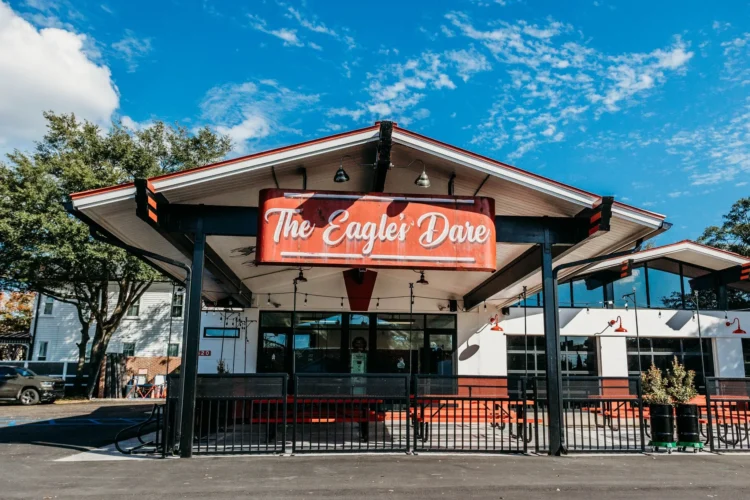
WILMINGTON — The Eagle’s Dare, a business on Third Street, is one step closer to keeping its cargo container functional as a secondary bar to serve drinks from during large events.
On April 1, the Wilmington Planning Commission voted 6-0, with Commissioner Thomas Cofer absent, in favor of approving a text amendment to the city’s land development code. If approved by city council as well, the amendment will add specific requirements and regulations for accessory or ancillary structures used by restaurants or nightclubs in the Central Business District.
READ MORE: NCDOT to demolish popular ‘yacht club’ along Carolina Beach Road, owners consider relocation
The proposal was presented by the city’s planning staff member Grace Lamay, on behalf of Joe Apkarian, owner of the Eagle’s Dare.
Eagle’s Dare has had a shipping container situated to the right of its front lot for three-and-half years. Apkarian typically uses his container for larger events, like free concert series every Friday during summer, in order to accommodate faster service and help alleviate overcrowding inside the building.
The shipping container has a service window for staff to serve beverages from; when the container is not in use, Apkarian turns it into a storage unit for dry stock.
“The inside of Eagle’s Dare, we don’t really have a lot of space to put stuff,” he told Port City Daily.
He explained they see large crowds during the Azalea Festival and on St. Patrick’s Day as well, so servicing events required a secondary bar, hence the shipping container.
The city’s current land development code for the Central Business District area establishments do not include definitions for semi-permanent structures, nor does it reference shipping containers. In current code regulations, the exterior of a building in the CBD cannot be made of metal, such as a shipping container, either.
Apkarian found that out the hard way.
In early 2025, he was hit with four violations for building height, fenestration or windows, material, and setback, as detailed first in a report by WHQR. He said he did not receive a financial penalty because he began working with the zoning department to address drafting a new text amendment within the 30-day window before fines would begin.
Because no regulations existed in the code for semi-permanent structures or cargo containers in the CBD, Apkarian’s container was held to the same standard as actual, full-sized buildings and developments. For example, the minimum height for a building in the CBD is 36 feet, which is not feasible for a shipping container refurbished into an ancillary structure. Apkarian’s container is 20-feet-by-8 feet.
He explained to the planning commission Wednesday evening he thought it was OK to add the shipping container to the lot.
“I thought we were in accordance with the rules of the CBD and Wilmington at large,” he said. “Also when in the absence of orders, make your own, right?”
Apkarian also thought adaptive reuse would be favored.
He originally took a variance request to the Board of Adjustment, in hopes it would allow him to keep the container. Instead, the board voted to table it because the members couldn’t answer whether Apkarian’s violation was a creation of his own volition; one of four criteria the board uses to approve variance requests.
They suggested he go the text amendment route instead.
The text amendment proposal defines a semi-permanent structure as “not permanently affixed to the ground,” yet also “not readily movable and is not attached to sewer or water services.” The text amendment proposal explicitly includes shipping containers but excludes recreational vehicles, mobile kitchens, food trucks, or mobile homes.
Should the amendment eventually pass, it will specify only one shipping container can be placed per establishment facing the front of a lot, matching the aesthetic of the property and can’t be used as a principal building. The container also can only be used to serve food and drinks or merchandise of the establishment or a performing artist.
The accessory unit cannot exceed 20-by-8-by-10 feet and can only be approved as an accompaniment to buildings or developments in place by the time council approves the amendment.
City staff at Wednesday’s meeting noted a growing trend in shipping container structures being reused as buildings and accessory structures. Cities like Charleston and Manhattan utilize them as restaurants or accessory structures. Staff also pointed to local neighborhoods as well, such as the Cargo District off Castle Street.
“This is an architectural style that we are seeing across the world — adaptive reuse, whether it be retail, restaurants, nightclubs,” Apkarian noted to the commission.
Commissioner Livian Jones was in favor and in agreement with Apkarian.
“Newland, who I work for, who developed Riverlights, had a project in Seattle, and they built a retail center out of container storage units,” she said, noting the material was affordable as well. “There’s a lot of uses.”
Commission Chair John Lennon addressed Apkarian directly: “Are you prepared to be the test case if this passes? And you realize the attention it will bear?”
Apkarian would be the first business owner in the CBD with a shipping container as an accessory unit permitted under city code. He assured commissioners he has dealt with scrutiny and being a guinea pig before, and referenced his temporary stage erected on Eagle’s Dare lot for 13 to 14 weeks to host his concert series.
In 2024, Apkarian received a violation for hosting Free Concert Fridays between May and June for putting up temporary stages on his property and hosting multiple shows. The original land design code detailed businesses in non-residential were limited to two outdoor concerts or events a year. However, he worked with the zoning department to change the ordinance; an amendment approved in 2024 increased the maximum from two to 20.
“So to answer your question, sir, yeah, I’m willing to take on anything that comes at me,” Apkarian concluded.
The commissioners were concerned about the containers being in the CBD because of two reasons: the orientation of the container on the lot and if it would ruin the aesthetic of the streetscape, particularly in areas with high foot traffic and passersby.
Commissioner Richard Collier, also a New Hanover County commissioner candidate in 2026, was concerned the broad side of the container would block the view of the principal building.
“I would suggest that we ask staff to tweak that language in the location just so there’s some flexibility in it not being directly in front, the broad side of that box being along the street face,” Collier said.
An amendment was added by the planning commission to specify the container cannot be too close to the sidewalk or the right-of-way. Also, the square end of the container would need to face the busier street.
Aside from questions about minute details, the primary concern from commissioners revolved around it being a separate semi-permanent accessory structure.
Staff also stipulated any semi-permanent structures intended for the historic district needed to be approved by the Historic Preservation Commission before it can be added to a property.
“If we wanna talk historical,” Apkarian said to concerns of ruining the CBD aesthetic with the new code, particularly in areas near or encroaching on the historical district, “I believe we’re known as the port city.”
With commissioner approval, city council will take up the proposal at its May 5 meeting. Should it pass, the new code addressing the use of shipping containers would only apply to current developments; newly constructed buildings will not be considered, as staff thought developers should plan accordingly to space needs.
Tips or comments? Email Emily Sawaked at [email protected]
At Port City Daily, we aim to keep locals informed on top-of-mind news facing the tri-county region. To support our work and help us reach more people in 2026, please, consider helping one of two ways: Subscribe here or make a one-time contribution here.
We appreciate your ongoing support.
