


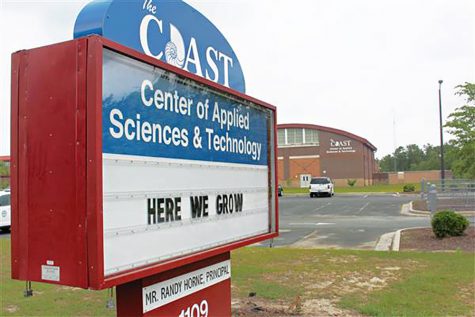
BRUNSWICK COUNTY — Brunswick County Schools could add another property to its ranks, but not a school; the district is using some of its acreage in Supply for affordable housing geared toward its employees.
The board of education voted unanimously in favor of the proposal at its meeting on March 24. County commissioners would need to sign off on the move.
“One of the biggest challenges we have in recruiting and retaining teachers, as well as other staff, is those folks being able to find affordable housing in Brunswick County on the salaries that they make,” Superintendent Dale Cole told the board at the meeting.
Cole went on to say his team has been exploring a way to build housing where the school district could control the rent for staff members that live there. There’s an opportunity to do so on two parcels in Supply on 98 acres of land already owned by the county and set aside for new school construction.
The housing proposal — most likely two-bedroom apartments, according to a district spokesperson — would take up 12 acres of the property, still leaving room for the district to build two schools onsite.
The current concept stipulates the board of education would retain ownership of the housing complex and partner with a construction company.
Port City Daily asked if the district would receive any revenue from its complex.
“From my understanding, any rent that is collected goes back into the repairs and maintaining the property,” BCS spokesperson Ben Strauss wrote in an email to PCD. “The intention is not to have another source of revenue for the district, but to provide beginning teachers and new employees a place to get started in a quickly growing area.”
Because the project is in early stages, rents have not been established, nor have restrictions on who will be allowed to live there.
Several school districts in the state have forged into housing development with the help of interest-free construction financing from The State Employee Credit Union.
Buncombe County Schools opened its 24-unit Williams-Baldwin Teacher apartment campus in 2017, located adjacent to Eblen Intermediate School. The apartments are offered to beginning teachers with less than three years of experience.
Bertie County, who had more than a 25% attrition rate in recent years, opened its own 24-unit complex to tenants in 2024, with similar housing projects supported in Hertford, Dare and Hoke counties.
“In very, very rural counties, there were no houses to buy or rent, and so that was their problem,” Cole said.
Strauss said the county plans to explore similar financing options with the credit union.
“We’re not reinventing the wheel here,” Cole said. “This is following a pretty tried-and-true program that has resulted in reduced teacher housing costs at no expense to the public — it’s coming from private funds.”
He did say there could be “minor impacts” on the school district’s budget but nothing that would have an impact on the county’s tax rate.
Though it is the fastest growing county in the state, a majority of Brunswick County’s housing development is single-family homes, with many of the multi-family offerings concentrated near Leland.
According to the North Carolina Housing Coalition, 26% of Brunswick County residents report being cost-burdened, meaning they spend more than 30% of their monthly income on their housing payment. Two-bedroom apartments average $1,426, which would require an annual income of $57,040 to afford.
Brunswick County Schools’ website states a 10-month salary scale for teachers with bachelor’s degrees doesn’t reach $57,040 for non-board certified teachers; the base amount is $41,000 for less than a year of experience and $55,950 for those with 25 or more years of experience. The range for board-certified teachers extends to $62,660, while those with master’s degrees are able to reach $68,260.
Reach journalist Brenna Flanagan at [email protected].
At Port City Daily, we aim to keep locals informed on top-of-mind news facing the tri-county region. To support our work and help us reach more people in 2026, please, consider helping one of two ways: Subscribe here or make a one-time contribution here.
We appreciate your ongoing support.
