


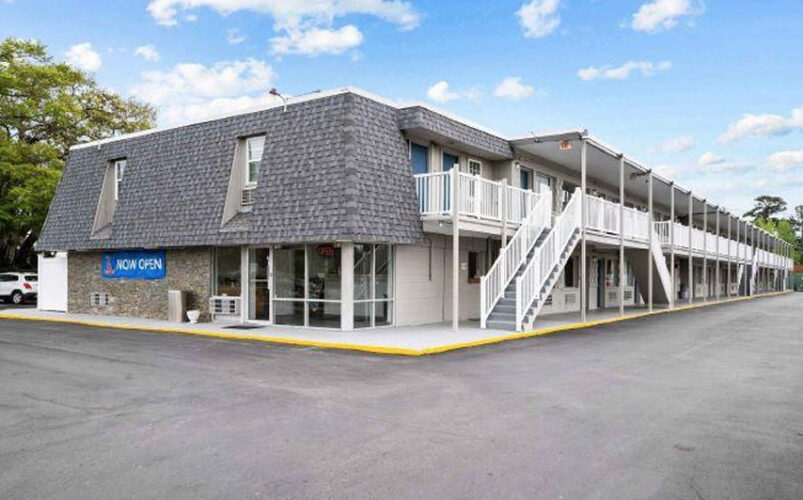
WILMINGTON — A proposal to convert a Market Street motel into affordable housing units received the go-ahead from the Wilmington Planning Commission last week despite staff’s disapproval, raising questions over the city’s ability to accommodate adaptive reuse cases.
Premier Hotels LLC is requesting a rezoning of the property at 4118 Market St. — currently the Studio 6 Motel — from regional business to MD-17, high-density multiple-dwelling residential district with a conditional district. Representing the applicant is Nicholas Silivanch and John Hinnant — New Hanover County GOP chair — of Eastern Carolinas Commercial Real Estate.
READ MORE: Wilmington council discuss multi-cent tax increase to accomplish wage, capital project goals
If the rezoning crosses its next hurdle with city council, the hotel’s 76 units will become studio apartments, 20 of which would be committed to workforce housing. However, Silivanch said he didn’t anticipate any of the unit rents being priced at more than $1,100, utilities included.
“I don’t think anybody’s going to pay more than $1,100 for 250 square feet — we’re not Manhattan yet,” he said at the March 4 meeting.
Because the suites already have in-unit kitchenettes, the applicant isn’t proposing major upfit work to convert the hotel rooms into residential units. Silivanch anticipates the units will come online within two to three months after rezoning approval.
Staff’s opposition to the project stems from the lack of site enhancements and amenities — a pool, gym, open space, updated rooms. However, adding 76 units to the city’s affordable housing stock, almost immediately, won over the planning commission, who voted unanimously in favor of approval (commissioners Ace Cofer, Livian Jones and Ron Woodruff were absent).
“The accessibility of 76 residential units right now, it may not be what I would want to live in, but I know there are folks that could use it, and it’s at a much more affordable rate,” planning commissioner Richard Collier said.
Still, the planning commissioner admitted he was not a fan of many of the project’s components, later pointing to the tight parking margins and lack of amenities.
“There’s nothing about it that’s perfect,” he said.
Commissioner Danny Adams said he thought the tension over the project was due to trying to fit a square peg into a round hole, noting the conversion from hotel to residential has required a conditional zoning and three variances from the board of adjustment to fit its high density and lack of parking.
“Yes, there is a need for this kind of housing,” Adams said. “But again prioritizing that over, some of these qualitative design things sets a bad precedent in my mind.”
Planning Commission Chair John Lennon thought the lack of amenities — a pool, gym, open space — was ultimately a business decision, as anyone could choose to reside there according to their living needs. Ultimately, Lennon said the rub for commissioners and staff was because of the land code’s lack of support for adaptive reuse; Adams agreed the city needed an adaptive reuse incentive or credit.
The city’s comprehensive plan does promote adaptive reuse, however, turning a non-residential use into residential often requires variances to the land code, as evidenced by Silivanch’s project. Without the variances for this project, it would not be able to move forward without tearing down some hotel units to meet the lower density requirement and adding more parking, virtually impossible on the current lot.
Ultimately, Lennon said he thought the hotel project was compatible with surrounding land uses. The adjacent North 17th Shopping Center is being redeveloped for mixed-use, along with the former AMC Theater property on Cinema Drive. The property will neighbor Capt’n Bills and a Planet Fitness, and residents will be able to readily access several restaurants and Food Lion, along with public transportation.
“I think this is needed, I think it will fill up quickly,” Lennon said.
Silivanch’s team has already converted two other hotels in the area to housing, including the River City Studio Homes at 5040 Market St., and Vivo Living (now the Flats at Market Street) at 4903 Market St. Both the Vivo site and the current project have been the targets of the former District Attorney Ben David’s criminal clean-up campaigns due to high incident reports at the establishments.
However, both Silivanch’s former projects had a commercial component, allowing his team to pursue a commercial district mixed use zoning to allow for both commercial and residential uses on the property. The case summary for the current rezoning request notes staff recommended the CDMU path to attain the density allowance needed for the project. Silivanch told the planning commission the current site has no room for a commercial enterprise nor the parking for it.
With the pursuit of the MD-17 zoning, the applicant needed several variances from the land code to allow conversion of the hotel to an apartment complex. The first was for density — the maximum density permitted within the proposed MD-17 zoning district is 17 units per acre, which would allow for up to 21 units on site. With the proposed workforce housing component, the density may be increased to 36 units per acre, for a total of 45 units. However, because the site already has 76 units, the density allowance required is 60 units per acre.
On Oct. 16, 2025, the applicant was granted a variance to exceed the allowable density. At that meeting, it was also granted a variance to the MD-17 open space requirement of 20% of the lot area; the site plan notes the property will only have 5.17%.
On Feb. 19, the board of adjustment also granted a variance to the 80 off-street parking spaces required in the zoning district. The applicant is providing a total of 68 spaces as part of this project, which would result in about 0.9 spaces per unit.
Collier questioned if less than 1 space per unit was smart, but Silivanch said the property wasn’t large enough to add more parking. He noted workforce housing tenants typically rely more on public transit; a bus stop is located by the Food Lion adjacent to the project.
Staff did push for the entire development to be workforce housing, with rents available for those making 80% or below of the area median income. For a one-person household, this would be $60,700 and studio rents would be capped at $1,083.
When Commissioner Jack Pollock asked Silivanch if he would be willing to do this, Stilivanch said no.
“What happens if HUD decides to turn around from $1,000 and drop it to $600?” he said.
Staff claimed the original site plan had parking calculations based on workforce housing requirements, leading them to believe the entire site was workforce housing until the applicant presented the case at the BOA.
Stilivanch said he was “surprised” to hear that, noting the applicant agreed to provide 20 units after negotiating with Kathryn Thurston, the city’s former planning and development zoning administrator who resigned in recent months. The original plan was only to provide eight workforce units, he said.
“It was never the intent for it to be all 100% restricted units,” Stilivanch said. “These are naturally occurring affordable units due to the fact that they’re 202, 125, 230 square foot units — we’re not going to really achieve rent higher than maybe $1,050 to $1,075 a month.
Stilivanch agreed to other staff conditions, including:
- The workforce units should remain so for a period of 15 years
- The developer will provide a connection from the sidewalk along Market Street and entrance to the development
- Street trees should be provided by the developer
- Streetscape landscaping should be provided in open area
- Signage pole should be removed
The final decision on whether the rezoning will be granted will go before the Wilmington City Council at an upcoming meeting.
Tips or comments? Reach out to journalist Brenna Flanagan here.
At Port City Daily, we aim to keep locals informed on top-of-mind news facing the tri-county region. To support our work and help us reach more people in 2026, please, consider helping one of two ways: Subscribe here or make a one-time contribution here.
We appreciate your ongoing support.
