


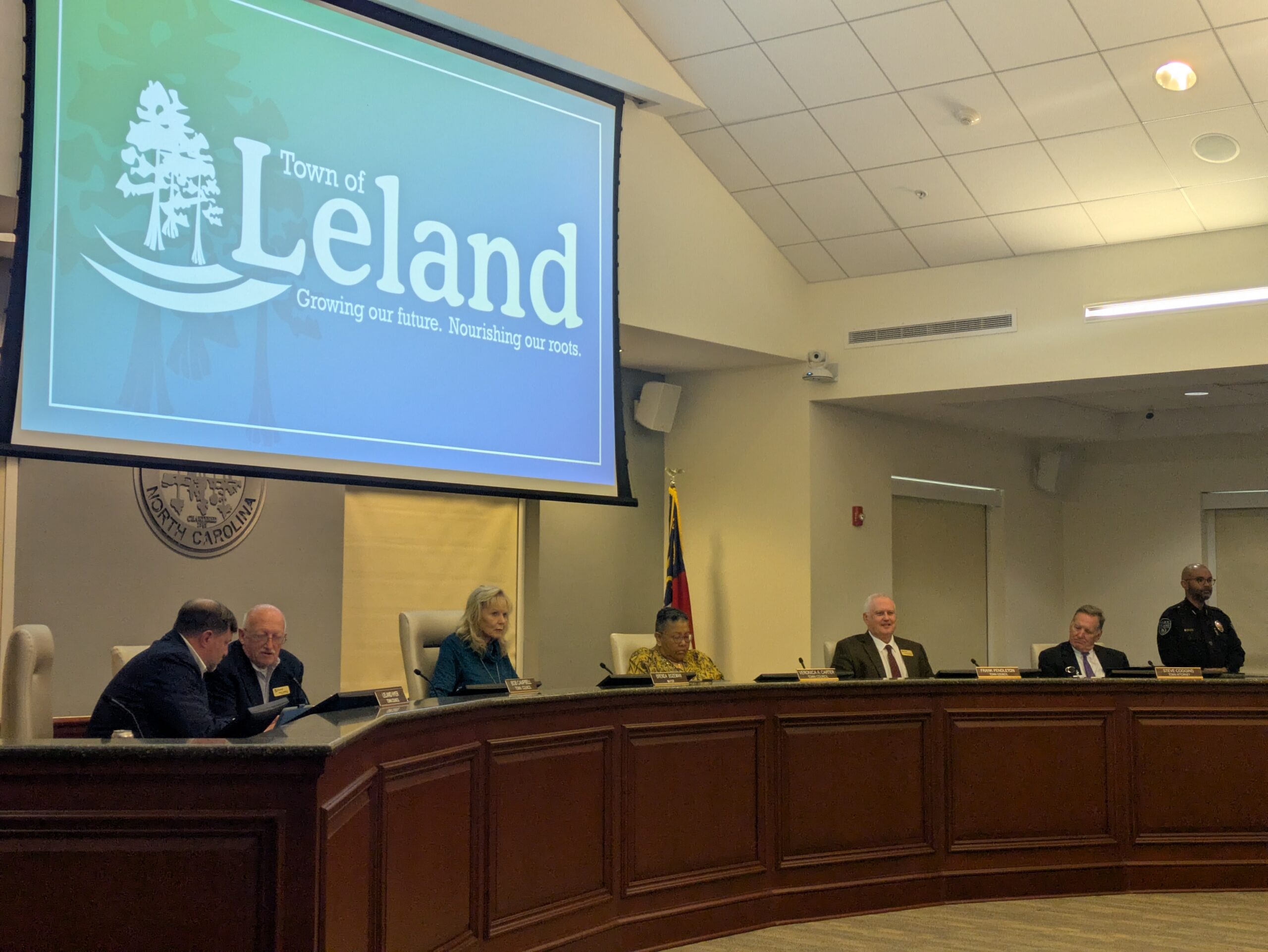
LELAND — After a lengthy and at times tense agenda review meeting Monday, Leland leaders faced vocal resistance from onlookers as they debated whether to change how council members are elected.
Currently, Leland leaders are elected under an at-large voting system where candidates do not represent a specific neighborhood or ward, but instead run for the council as a whole. But council is considering a switch to voting districts, which would divide the town into geographic areas of similar population, with residents from each area selecting its own council member.
READ MORE: ‘Blindsided’: Leland council member takes heat for allegedly breaking purchasing protocol
ALSO: As Leland growth surges, officials organize overhaul of zoning, development rules
The effort comes as the town has grown dramatically, prompting officials to assess whether the current at-large election system still meets the needs of the community.
Council member Veronica Carter told Port City Daily that council members have been discussing district-voting, in passing at least, for a few years. She contends districts could help bridge a representation gap particularly in high-growth areas, like the Brunswick Forest or Magnolia Greens neighborhoods, which can dominate council’s attention, leaving residents in outlying sectors without a dedicated voice.
“We’ve been the same structure since the town was incorporated,” Carter said. “When we started out, we probably had like 1,000 people, now we’re over 30,000 and still have four council members and a mayor. You know, maybe it’s time for us to look into this.”
However, critics, like newly elected council member Frank Pendleton, suggest district voting would lead to divided leadership where council members only advocate for their specific voters and not the town as a whole.
Though no vote was taken during its Feb. 16 agenda review meeting, the Leland Town Council asked staff to begin organizing public workshops and exploring how the changes would pan out.
While agenda review meetings typically don’t bring in as large a crowd as regular council meetings, more than 100 residents packed town hall Monday. Despite no public comment period offered at agenda meetings, the crowd was vocally opposed to the districting concept. Throughout the council’s discussion, frequent murmuring and groaning could be heard, prompting Mayor Brenda Bozeman to call for order a few times. Residents complained about the council even investigating the changes.
The at-large voting system has been a fixture since 1989. Under this model, every eligible voter in Leland casts a ballot for the entire pool of candidates and the top vote-getters win the available seats regardless of where in the town limits they reside.
In a district-based system, the town would be divided into five geographic areas with roughly equal populations and each district would elect its own representative to the council. District voting means people from a particular geographic region cast a ballot for their district seat only.
Town Manager David Hollis said staff began researching the legal statutes required to modify the town’s charter, should the council decide to move forward with changing the voting system. While the council has broadly used the district voting term, state statute offers two ways to organize districts, along with a hybrid option:
- Ward-based districts: The town is divided into roughly equal sections. Only the people living in a specific district can vote for that district’s representative.
- Residency districts: Candidates must live in a specific district to run for that seat, but the entire town still votes for every seat on the ballot.
- Mixed systems: A combination where some members represent specific districts and others remain at-large, representing the town as a whole.
At this point, the council has not leaned toward a specific model. Instead, the consensus was to keep options open for further scrutiny.
Council members would ultimately decide the boundaries of districts, though Hollis floated the idea of bringing in a third party — specifically Allen Serkin, executive director for the Cape Fear Council of Governments — to assist with drawing maps. Serkin has assisted municipalities previously with districting, including the city of Whiteville in 2021. Mapping entails using non-partisan demographic data to ensure districts are balanced by population. Split evenly for Leland’s five seats, this would result in about 6,600 residents per district.
The prospect of drawing boundary lines raised immediate concern for council member Pendleton, in regards to potential gerrymandering and the divisiveness of geographic boundaries. Pendleton argued creating districts could lead to fragmented representation where leaders only care about their district, rather than the community as a whole.
“We’re going to be accused as council people of manipulating these districts and I’m against that,” Pendleton stated. “I’d be remiss if I didn’t say that I’ve probably received maybe 50 emails in the last 10 days about district voting and I haven’t gotten one email that’s been for it.”
He suggested a numbered-seat system, wherein each council seat is assigned a number. Candidates must file for a specific “chair” rather than enter the general pool.
“I don’t think [the current system] is the fairest way to democratically elect people and I don’t think the voters have the truest voice in who gets elected,” Pendleton said.
However, Carter pushed back on the numbered-seat system not being an option currently in state statute. To use Pendleton’s method would require an act passed by the North Carolina General Assembly specifically for the Town of Leland, rather than a council-led charter amendment.
“To quote or paraphrase Donald Rumsfeld back in the Gulf Wars, go to war with the army you have, not the one you wish you had,” Carter said. “We have to be able to come up with a plan based on the laws of the state of North Carolina.”
Carter contended geographic districts would provide a “seat at the table” for underrepresented voices. She noted as the town grows, districts ensure residents in outlying areas have a better opportunity to vote for candidates who best understand their specific, localized concerns.
“While obviously, there are some people here who disagree,” Carter stated of district voting — with multiple residents shouting “yes” in response — “there are others who have presented their concerns about wanting to make sure that they feel that they have not just a voice, but a seat at the table in the future.”
Carter told Port City Daily her support for districts was cemented after conversations with her physical therapists, both Leland residents, who told her they thought their voices carried little weight in town-wide decisions. Carter noted residents in neighborhoods like Windsor Park often feel “too small” to influence the current at-large system, perceiving more densely populated areas as the town’s primary focus.
Responding to concerns Leland isn’t big enough to warrant a switch to voting districts, Mayor Pro Tem Bob Campbell said neighboring Navassa utilizes a district-based system despite having a population much smaller than Leland’s.
The comparison was met with an audible groan from many in the audience, one resident shouting: “That’s irrelevant.”
Pendleton acknowledged the current at-large system may leave some citizens feeling excluded, though he argued the issue lies with the town’s elected officials, not the election method.
“I don’t think this is a process issue, I think this is a people issue,” Pendleton said. “I think that people in this community that haven’t felt they’ve been represented, they’re probably right. I don’t think that we — I’ll be part of that ‘we’ — have done a good job representing the entire community.”
Pendleton suggested if representation was a primary concern, the town should consider adding more seats to the council to broaden the board’s reach without creating district maps.
Bringing the council together for a consensus, Bozeman advocated to hold public workshops on voting districts and prospective changes to the council’s election process.
Under General statute 160A-102, council holds the authority to initiate changes to its charter by adopting a resolution of intent considering a specific amendment — in this case, a shift in the town’s mode of election. Once a resolution is passed, the council must schedule a public hearing within 10 to 45 days to allow for community feedback on the proposed new voting structure.
Council would then vote to adopt the charter amendment to formally change the town’s election method. According to state statute 160A-103, residents who disagree with the change have 30 days after publication of notice of adoption to file a petition seeking a referendum. If a petition is submitted with signatures from at least 10% of the town’s registered municipal voters — roughly 2,700 signatures in Leland based on 2026 Brunswick County Board of Elections data — the amendment would go to the ballot box for approval or rejection. If no valid petition is filed, the ordinance would take effect 45 days after adoption.
Bozeman proposed first discussing the system change with all stakeholders in a dedicated environment to ensure residents understand council and staff’s role in the process and for transparency.
“We need it sooner rather than later to kind of calm down some of this [public discourse],” Bozeman said.
A date has not yet been set for any workshops, though council is expected to formally direct staff on how to proceed at their regular meeting on Feb. 19.
Have tips or suggestions for Charlie Fossen? Email [email protected]
At Port City Daily, we aim to keep locals informed on top-of-mind news facing the tri-county region. To support our work and help us reach more people in 2026, please, consider helping one of two ways: Subscribe here or make a one-time contribution here.
We appreciate your ongoing support.
