



SOUTHEASTERN N.C. — After the governor issued a state of emergency ahead of the weekend winter storm approaching North Carolina, he said his message to all 100 counties Friday was simple: “This is a serious storm. We are taking it seriously and so should you.”
Winter storm warnings are in effect through Monday for the mountains and Piedmont region of the state, with watches in place further east. The National Weather Service issued a Winter Weather Advisory for New Hanover, Brunswick and Pender counties from Saturday, Jan. 24, at 7 p.m., through Sunday, Jan. 25, at 7 p.m.
READ MORE: NCDOT treating roads ahead of weekend winter weather system
Though ice of one-quarter inch or more is expected in high impact areas, potentially exceeding an inch in the mountains, the tri-county region accumulation numbers are uncertain, dependent upon how far the system’s cold air reaches the coast. Though anticipated to be minimal, maps indicate it could be anywhere from 0.01 to 0.22 inches across New Hanover, Brunswick and Pender counties.
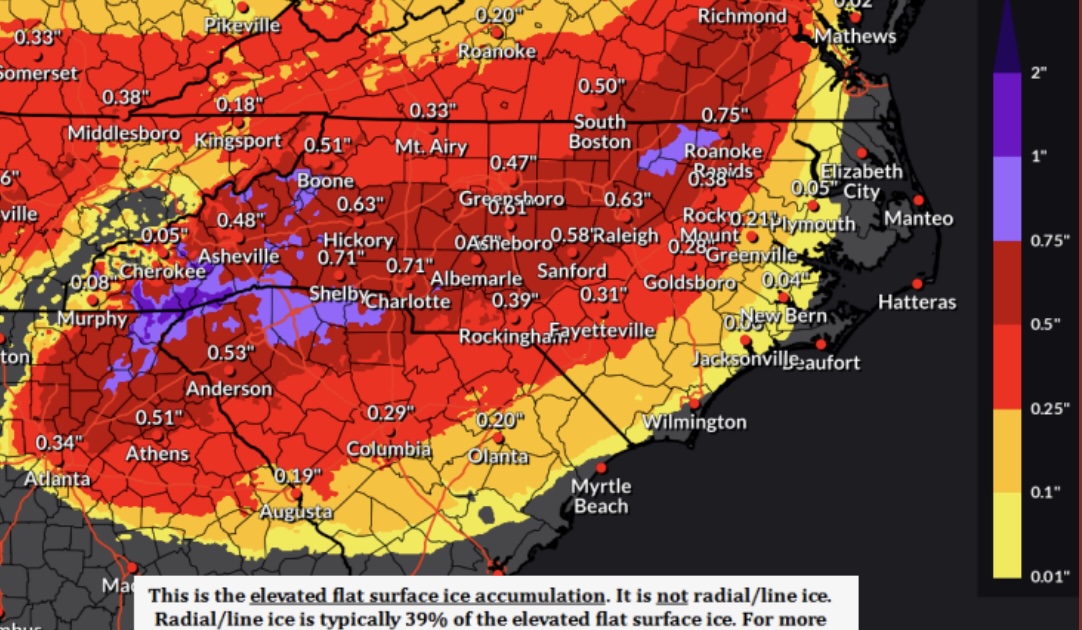
Hazardous travel conditions are expected to begin Saturday night around 10 p.m. and worsen through early morning Sunday, with lingering effects possible into Monday.
“We need all North Carolinians to remain focused on preparing for the potential impacts with a plan and supplies to support you and your family for the next several days,” Director of Emergency Management Will Ray said at the governor’s Friday press conference. “Unnecessary travel puts not only you at risk but also the public safety personnel, power crews, and DOT workers who are working to respond to emergencies, to restore power, and to clear roadways.”
North Carolina Department of Transportation has deployed 2,100 agency crewmembers to help lay 2.8 million gallons of brine on state roadways. The crews are moving from preparation to response as need be, with the agency armed with 1,250 dump trucks that can be equipped with plows and spreaders and 913 contract trucks to help clear roads.
A state of emergency was enacted Wednesday to allow crews to provide needed supplies, equipment and response to areas most affected. Ray reminded that it only takes a half-inch of ice to make tree limbs and power lines more vulnerable to collapse. People impacted in harder hit areas should be prepared for outages, though the governor said Duke Energy has 18,000 workers from around the country ready to help restore power.
Around 430 National Guard men and women and 170 vehicles are also active and ready to help with clearing roads, helping disabled motorists, supplementing first-responders and distributing supplies. North Carolina Forest Service also has varied task forces on standby.
“The effects of this storm could last for days,” the governor said, noting even after the weather system passes, more days of frigid temperatures are ahead, potentially refreezing slush. “Black ice will remain a risk in many places into next week.”
Secretary Daniel Johnson from NCDOT added the state is working with the State Highway Patrol to implement immediate towing measures. They will “remove any vehicles that have been disabled, to help both facilitate clearing of the roads and also to eliminate danger for those traveling on those roads.”
Restocking emergency kits and making plans now is of the essence, he added (learn more about emergency preparedness here).
The state emergency team has shipped pallets of meals-ready-to-eat, or MREs, and drinking water to send to shelters as need be. It also has 460 cots and blanket shipments to supplement local supply, among other commodities. So far 11 counties have declared states of emergency, Stein said.
He instructed people to connect with local governments about shelters and warming centers opening in their area.
Shelters in the southeastern NC region
Though the region is not supposed to be hit as hard by the storm as other areas in the state, temperatures will be frigid — falling below 30 but feeling colder due to the wind chill. As such warming shelters are opening.
In New Hanover County, the Warming Shelter at Grace Methodist Church, 401 Grace St., is opening for seven days starting Jan 24. It welcomes anyone, particularly the homeless, who seek warmth — with no barrier for entry. Check-in is daily at 5 p.m. and check-out is at 9 a.m. Volunteers are needed and can sign up here.
The Healing Place of New Hanover County, 1000 Medical Center Dr., is adding beds to the emergency overnight shelter for individuals needing shelter. Starting Saturday, Jan. 24, 3 p.m., people can check in. The shelter is open daily for the unhoused but, according to Director of Development and Community Outreach Trish Nicholson, 18 cost are added from the American Red Cross during extreme weather events; thus 32 shelter beds are operational. The Healing Place also provides hygiene supplies, showers, and meals.
The Good Shepherd Center also is open at 811 Martin St. and the Salvation Army at 1410 William Booth Dr., both in New Hanover County. But call ahead to ensure availability: Good Shepherd can be reached by dialing 910-763-4424 and Salvation Army, 910-762-2070.
In Brunswick County, the Brunswick Christian Recovery Centers Inc. opens at 520 Mulberry St. in Shallotte, with check-in at 5 p.m. There will be meals and transportation provided and it welcomes sober men and women. Interested parties can call 910-287-4357.
Also open in Brunswick County will be the Brunswick Partnership for Housing, serving the elderly, families with children and those with health issues. Call 910-946-1499 until 8 p.m. to seek services.
A Pender County spokesperson said they were unaware of warming shelters opening in the county.
At Port City Daily, we aim to keep locals informed on top-of-mind news facing the tri-county region. To support our work and help us reach more people in 2026, please, consider helping one of two ways: Subscribe here or make a one-time contribution here.
We appreciate your ongoing support.
