


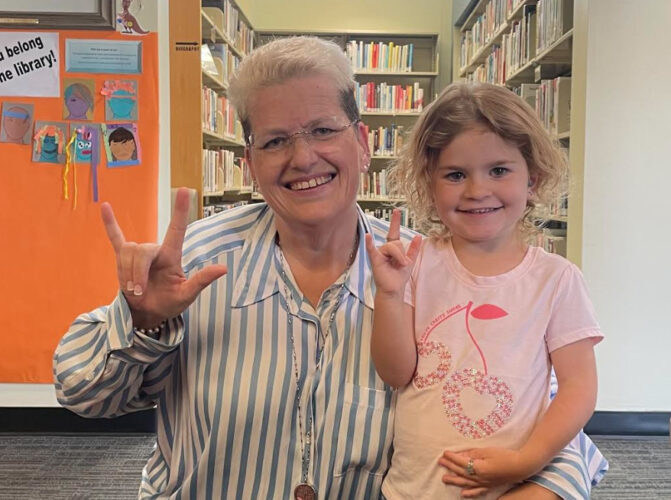
NEW HANOVER COUNTY — A proposal is underway to bring New Hanover County a charter school integrating both deaf and hard-of-hearing students with children that can hear. Founding members say it would be the first of its kind in the United States.
Named after its founding director, the Darden-Perry Academy is both a bilingual and bimodal charter school seeking to enroll 500 students by its fifth year of operation. With a planned opening in July 2027, the school would serve K-12 students by year five and operate year-round on a nine weeks-on, two weeks-off schedule.
READ MORE: NHCS shifts grant focus from students to teachers after Endowment trims award
Should it be approved by the state, the team hopes to build the academy at the corner of Market Street and New Centre Drive; it has a pending Letter of Intent for the site.
Darden-Perry Academy would be the third public school for the deaf and hard of hearing in North Carolina; already operational are the North Carolina School for the Deaf in Morganton and the Eastern North Carolina School for the Deaf in Wilson. Though, unlike its predecessors, the Darden-Perry Academy will not offer boarding, sending students home every day like other public schools.
The biggest difference would be the academy’s commitment to serving both deaf and hearing students, immersing both in English and American Sign Language from kindergarten through high school. Deaf and hearing students will learn together in classrooms, outfitted with either a bilingual teacher or ASL interpreter.
“That gives [hearing students] communication, a second language, and deaf, hard-of-hearing students are able to communicate with their peers — they don’t have to rely on staff to help them understand,” Rebecca Darden-Perry told Port City Daily.
Darden-Perry has a Ph.D. in special education and has experience as a lead deaf/hard-of-hearing teacher-specialist. Her original goal was to open a virtual academy, but after meeting Mike Lupo, founding board member for the academy, was motivated to open an in-person academy. Demand for such a school has been proven so far, in that she’s already received more than 300 interest forms.
Hard of hearing herself, Darden-Perry told Port City Daily her parents didn’t learn sign language, despite her sister also being deaf.
“The whole entire family can go to school, so not just one child that is deaf and hard of hearing, but the siblings can learn as well, and they can start to communicate. And we’re even offering parents classes so the parents can learn to communicate with both children,” Rose Jones, another founding board member, said.
Darden-Perry, Lupo and Jones take up three of seven seats on the academy’s board, the majority of which have a hearing impairment. Though not hard of hearing herself, Jones said she was motivated by her late aunt, who was a deaf educator. Jones became her caregiver after her aunt suffered a traumatic brain injury and observed how difficult communication with her was because she didn’t know ASL.
“I can feel my aunt pushing me — don’t quit,” Jones said.
While the state has several K-8 dual-language immersion programs — including the International School at Gregory using English and Spanish — dual-language ASL programs are almost nonexistent. This is, Darden-Perry said, despite ASL being the third-most popular languages to study in college, behind Spanish and French.
The Darden-Perry Academy would not just be a standout in the state, but also the country, as its dual model is rare.
Some schools for the deaf have partnerships with general education institutions offering integrated classes, like the Willie Ross School for the Deaf in Massachusetts. The Darden Perry Academy would be the only fully-immersed academy serving K-12 students.
“This is even reaching all the way to Russia and the Netherlands, we’ve got families wanting to move to the U.S.,” Darden-Perry said. “There’s a need out there, there’s a want out there, and we’re trying to fill that hole.”
With the growing list of interested families, Darden-Perry said she has already raised the initial admitted cohort from 100 students to 200 students.
“Wilmington is a desirable place to live,” Lupo said. “A lot of schools for the deaf are in locations, different small towns, where there are not a lot of job opportunities for families … Wilmington is a very desirable, a very fast-growing community. The surrounding counties as well, they’re the fastest growing counties in the state.”
In addition to his degrees in deaf education, vocational rehabilitation counseling and the teaching of second languages, Lupo has served as president and vice president of the North Carolina Association for the Deaf and founding board member of the American Sign Language Teachers Association. Lupo, hard of hearing himself, currently teaches at Forest Hills Global Elementary, part of New Hanover County Schools.
“I have a classroom deaf kids, a small group of kids — it’s always a struggle,” Lupo said. “It’s always a struggle because the public schools are seeing the whole, big picture and I’m trying to focus on a small group of kids that have specific needs that a lot of people don’t understand.”
PCD reached out to NHCS for information on its population of deaf and hard of hearing students and the offerings for them but did not get a response by press.
For students that move away from NHCS, the funding for those students will follow them, with the school district having to transfer its per-pupil allotment to the charter school, something NHCS has been critical of in the past.
With the per-pupil funding, Darden-Perry said the school is scheduled to break even by year five; until then, its initial startup costs and operations will need a boost from grants and philanthropy. The aims to raise $3 million before the school opens. It has already raised $81,000 through private donations.
Darden-Perry has already approached The New Hanover Community Endowment at its listening session earlier this month, too.
“This model gives our hearing students a second language that gives them college credit and ensures equal access for deaf and hard of hearing students — everyone learns together,” she said at the meeting.
Aside from the funding hurdle, the charter will need to gain approval from the North Carolina Charter Review Board (previously the State Board of Education before a 2023 law transferred the authority). Application submission opens in January and are reviewed at the board’s monthly meetings; Darden-Perry said the application is complete on her end and the board is just waiting for the portal to open.
After approval, the board of directors would be mandated to undergo a planning year before the charter could open its doors, though the admissions process could begin. Because charters are considered public schools, the Darden-Perry Academy would not be able to give preference to deaf or hard-of-hearing students over hearing students. Darden-Perry clarified if the school receives more applications than available seats, admissions will be determined by a random lottery, per state law.
The school is still accepting interest forms and donations; more information on both can be found here.
Reach journalist Brenna Flanagan at [email protected].
At Port City Daily, we aim to keep locals informed on top-of-mind news facing the tri-county region. To support our work and help us reach more people in 2026, please, consider helping one of two ways: Subscribe here or make a one-time contribution here.
We appreciate your ongoing support.
