


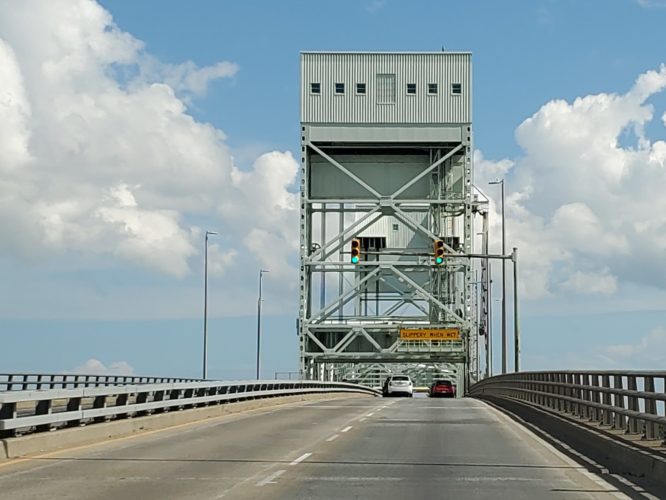
WILMINGTON — The North Carolina Department of Transportation returned to the Wilmington Urban Area Metropolitan Planning Organization this week to present a comparative analysis of tolling options for the planned replacement of the Cape Fear Memorial Bridge.
While both have upsides and downfalls, it will ultimately be up to the WMPO to decide between a public-private partnership or facility run by the state — if it chooses to implement a toll at all.
READ MORE: WMPO takes another vote on CFM Bridge toll, local leader speaks against it
ALSO:WMPO subcommittee: Funding CFM Bridge could come with tri-county bond referendum
The NCDOT is required to present a comparative analysis when a structure could potentially become tolled, though officials Wednesday were clear the WMPO is still considering all alternative means of funding.
“I do not want to toll this bridge and we have got to do everything that we can to find other methods, to find money to pay for it,” New Hanover County Commissioner Dane Scalise said. “I don’t know what will ultimately happen, but I’m not giving up.”
With repairing the Cape Fear Memorial Bridge becoming financially impractical, NCDOT and the WMPO have been searching for a way to fund its replacement for years. The NCDOT has dedicated $85 million to the project and secured a $242 million federal grant, though this will only put a small dent in the estimated $1.1 billion price tag for a 135-foot bridge replacement. Without an alternative means of funding — such as a tri-county transit tax that would most likely need to be voted on next November — NCDOT Division 3 Engineer Trevor Carroll has said a toll would be the only viable option to fund the bridge.
Carroll was joined by North Carolina Turnpike Authority David Roy to present findings of the comparative analysis.
If a toll were to become necessary, the WMPO has two options — a traditional toll charged by the North Carolina Turnpike Authority where the state maintains ownership of the road and responsibility for operations. The other choice is to bid out the project to a private entity in a public-private partnership, referred to as a “P3” for short. The WMPO received an unsolicited proposal for a P3 in 2021, which was rejected; this was before the WMPO voted to explore all funding options for the bridge replacement in order for it to score high enough for funding in the state’s ranking.
Under a P3, the state would maintain ownership of the road, but the private company would be responsible for the design, construction and maintenance of the facility for a certain amount of time.
Regardless of operation responsibility, the bridge would be inspected every two years to ensure safety.
NCDOT analyzed both scenarios under a 50-year period where the toll imposed was around $2 in 2030 dollars for a passenger vehicle (equivalent to around $1.80 in today’s dollars). Multi-axle trucks and commercial vehicles would face a higher fee.
As part of the comparison between the two tolling methods, the NCDOT conducted a quantitative analysis of the project cost, which is still subject to change due to inflation before the project exits the planning stage. The cost estimates are based on several factors, including a five-year design and construction timeline beginning in fiscal year 2028, operations and maintenance costs over the 50-year-period, as well as the financing structures available to both the state and a private firm.
The analysis showed the total project cost under a traditional toll method would be $1.298 billion, while the P3 option would be slightly less at $1.182 billion.
“Couple reasons for that: because of the [public-private] delivery method, general labor is siloed in a way to more efficiently deliver and expeditiously deliver a project because they are assuming that revenue risk and need to be collecting tolls on day one, in a way that a traditional design-build project just can’t replicate,” Roy told the WMPO board. “Also some of the contingencies that the turnpike board would need to maintain — to ensure it can cover unexpected costs or delays that may creep up — are not something that a developer would necessarily need to account for.”
After applying the cash flows estimated for each project — $971 million with the state and $915 million at the P3 — the project would still be left with a gap in funding at the 50-year mark, $327 million at the state and $267 million at the P3. The state and federal allotments would cover this gap, though the P3 would be left with around $60 million in surplus revenue.
“We don’t want to focus too much on the specific number,” Roy said, noting inflation will surely have an impact before the project is finalized. “Effectively, what this shows is, under both delivery approaches, it’s likely that the project is financially feasible.”
Aside from the project cost, the WMPO can also take qualitative factors into account when choosing a toll method, one of them being what happens to surplus revenue. Under a P3, it would be split between the company and state. Under the traditional method, the state would receive all surplus revenue and have to reinvest it into the project.
Thus, the state would be able to adjust its toll rate if the replacement bridge was overperforming, or bringing in more revenue than budgeted. Inversely, if it was underperforming, it could raise the rate to ensure return on investment.
A P3’s rate would likely be fixed at the beginning of the contract. The private company would have to take on the risk of the facility underperforming, but if overperforming, the P3 would be allowed to continue tolling even after the project costs have been recuperated and until the end of the contract. State law limits these contracts to 50 year-terms, however.
As for a state-run bridge, state law mandates a toll must come off a facility once it has been paid for.
Though Roy said the quantitative analysis was completed for 50-year timeframes in order to compare apples to apples, financing a turnpike authority project is “typically limited to about 35 years post substantial completion — that’s kind of what the markets will bear.”
Several members of the WMPO questioned affordable options for working-class residents that cross the bridge daily for work.
The North Carolina Turnpike Authority is prohibited in state law from offering discounts to certain user groups, though emergency vehicles are exempt and it could implement a “frequent rider” discount available to anyone.
A P3 would be under no such obligation and could develop its own discount programs, with certain federal restrictions. Roy pointed out the developer of the I-77 North Express Lane near Charlotte allocates a certain number of free trips in the express lanes for food stamp recipients.
NCDOT is not advocating for a particular tolling approach; it will be left to the WMPO to decide, though members weren’t forthcoming Wednesday about which method they preferred. Many comments affirmed leaders’ opposition to a toll.
“Tolling is not right, it’s the wrong thing to do,” Leland’s Mayor Brenda Bozeman said. “When they find money for everything else, every other road, but they can’t find it for the bridge, something’s wrong.”
Tips or comments? Reach out to journalist Brenna Flanagan here.
At Port City Daily, we aim to keep locals informed on top-of-mind news facing the tri-county region. To support our work and help us reach more people in 2026, please, consider helping one of two ways: Subscribe here or make a one-time contribution here.
We appreciate your ongoing support.
