


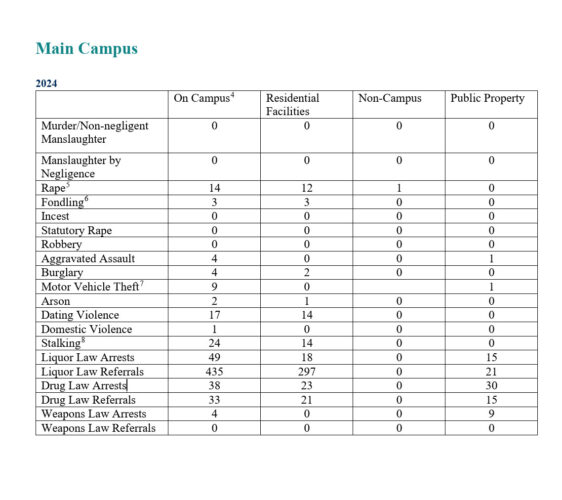
WILMINGTON — UNCW’s annual tallying of crime statistics was released last week, with reports trending upward in several categories, including rape, dating violence and stalking, along with drug and liquor offenses.
READ MORE: 10% of incoming UNCW freshmen to be placed in overflow housing
ALSO: UNCW investigating threats, including ‘militia’ presence, after Charlie Kirk vigil sparks turbulence
The report, which compiles data from 2024, shows on-campus rapes totalled 14, up two from 2023 but down two from 2022. The security report indicates these numbers include incidents that occurred during the 2022-2023 school year but weren’t reported until 2024.
Dating violence continued its gradual rise, 2024 having 17 reported incidents compared to the prior year’s 11. Stalking reports doubled from 12 to 24 reports over the same period. Both statistics were for on-campus incidents, the majority occurring in residence halls.
UNCW’s security report does track data for off-campus incidents involving students, though for the last few years, these reported numbers are either 1 or 0 as students turn to off-campus law enforcement and resources.
Port City Daily talked with Chief Frank Brinkley about the report; 2024 was the chief’s first full year in the position after being appointed in March 2023. He attributed the rise in rape, dating violence and stalking to two factors: the first being an increased student population.
“You’re going to have a percentage increase in reported incidents as well,” Brinkley said.
UNCW continues to increase its overall student enrollment each year, marking 19,895 students this fall. Undergraduates — of which freshman and sophomores are required to live on campus — numbered 16,131 students, up 5.7% from 15,254 last school year.
Though, the increase in student population cannot be the only factor contributing to the rise, as dating violence and stalking rose by higher percentages than student population — 54.5% and 100% respectively.
Brinkley said he thought the educational initiatives from his team and other campus resources, like the Campus Advocacy Resources and Education, or CARE, office could also make more students comfortable with reporting incidents.
“There’s a lot of, I’d say, stigma that can come up around intimate partner violence crimes, and when you educate potential reporters about what the process really is and the support that’s there and that we’re not going to make you feel embarrassed or make you feel bad about what happened, that encourages reporting,” Brinkley said.
Rape and sexual assault are historically underreported crimes, with studies showing around three-quarters of them go unreported to authorities. On campuses, the Rape, Abuse & Incest National Network reports 13% of all students experience rape or sexual assault, with percentages even higher for undergraduate women (26.4%). Women ages 18-24, who are college students, are three times more likely than women in general to experience sexual violence.
The CARE office is a confidential resource for victims to report sexual assault, relationship abuse, stalking, harassment and exploitation. The office offers a 24-hour crisis response, advocacy and accompaniment, and coordination with both on-campus and off-campus resources. It also hosts educational events on campus throughout the year, including healthy relationship skills-building, bystander intervention training and annual awareness-raising events. UNCW Police also offers self-defense courses for women.
While Brinkley said he didn’t see cause for significant concern over this year’s numbers, he did note the UPD’s records manager and a representative from the Title IX office meet weekly to compare numbers.
“We’re looking at, OK, is this out of norm? Does this create or present a situation that is unusual for our campus, or are these just distinctly unique circumstances that have come up?” Brinkley said.
At minimum, each report is taken through the student conduct process on campus, though outcomes are protected from public knowledge, according to Brinkley. For cases that are criminally prosecuted, he said the UPD works closely with the district attorney’s office, particularly regarding sexual assaults.
Another area of statistics he and his team are keeping an eye on is with liquor and drug offenses.
Liquor law referrals to the Dean of Students total 435 incidents, compared to 314 last year; arrests total 49 compared to last year’s 16. Drug law referrals were 33 in 2024, arrests being 38, compared to 2023, when referrals were 54 and arrests were 12.
“I will say last year we had an unusual spike around St. Patrick’s Day,” Brinkley said. “There was just a lot of parties going on.”
Aside from that spike, the chief pointed to his leadership as the reason for the increase in capturing offenses in referrals and arrests, noting 2024 had “consistent leadership within the department.”
“The department had gone through interims since I think around 2021, 2020, so when you get stable leadership, you get stable expectations and accountability for being proactive,” Brinkley said.
Port City Daily asked Brinkley how UNCW’s report compares to other campuses within the UNC System; the chief said comparing “apples to apples” would be difficult but noted he didn’t think UNCW stood out among other colleges.
However, UNCW’s data is in the same ballpark and sometimes higher than campuses with larger undergraduate populations, particularly UNC Chapel-Hill (21,000 undergrads), N.C. State (nearly 30,000 undergrads) and UNC Charlotte (26,000 undergrads), though none of the campuses require sophomores to live on campus like UNCW does.
Chapel Hill’s numbers, compared to 2023, break down as follows:
- Rape down 17 to 13
- Dating violence 1 to 10 (though the number was 12 in 2022)
- Stalking from 13 to 34
- Liquor disciplinary referrals from 302 to 329
- Drug disciplinary referrals from 27 to 25
N.C. State:
- Rape from 11 to 4 (three occurred in previous years)
- Dating violence from 11 to 7
- Stalking from 39 to 35
- Liquor disciplinary referrals from 211 to 369
- Drug disciplinary referrals forms 24 to 47
UNC Charlotte
- Rape from 7 to 9
- Dating violence from 10 to 18
- Stalking from 29 to 60
- Liquor disciplinary referrals from 119 to 90
- Drug disciplinary referrals 24 to 27
Tips or comments? Email [email protected].
Want to read more from PCD? Subscribe now and then sign up for our morning newsletter, Wilmington Wire, and get the headlines delivered to your inbox every morning.
