


WILMINGTON — More clarity emerged on New Hanover County Schools’ shortlist of bond projects through two meetings Thursday and discussion didn’t stray much into considerations outside of the five-project list, despite previously stated board members’ desires.
READ MORE: NHCS bond and test results revive redistricting convo, board members advocate ‘micro’ approach
The New Hanover County Board of Education met to discuss the district’s current facility capacity and the finance committee’s recommendation for bond projects. The committee, made up of elected leaders, staff and business industry figures, convened right before the board’s meeting and reaffirmed their project picks, originally compiled in August.
The projects include:
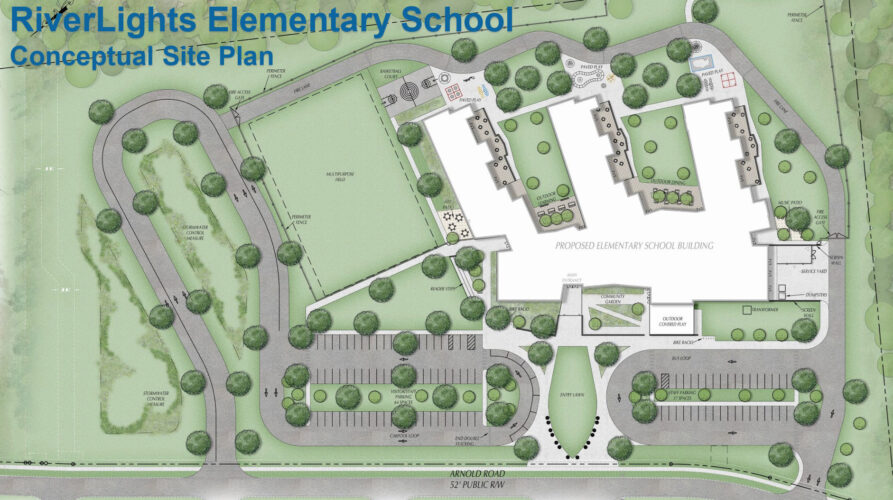
- A new elementary school at Riverlights ($53,855,851)
- Phase 1 of the proposed NHHS master plan ($59,786,276)
- A replacement of Pine Valley Elementary School ($56,332,402)
- A replacement of Trask Middle School ($94,751,362)
- An addition at Porters Neck Elementary ($7,625,000)
The costs are the latest estimates from NHCS and have increased since the finance committee’s initial list of projects was discussed a few months ago.
The committee also added to the list district-wide building systems and infrastructure, plus safety upgrades, totalling an additional $30 million. This brings the total bond amount — which would need to be approved by voters in the 2026 election — to $300,521,418.
The bonds would be issued by New Hanover County commissioners, who in August laid out several scenarios for funding based on its available debt capacity. It showed in a $300-, $400- and $500-million bond scenario, the county would exceed its debt per capita cap of $2,200 around 2034. The county commissioners could vote, by supermajority, to raise the limit, though impacts to the county’s bond rating would need to be considered.
The list of projects originally went to the board for approval at their Sept. 2 board meeting, though some board members weren’t ready to sign off and requested more information on their selection. Board member Josie Barnhart also requested Thursday’s work session to review the district’s current overhead and capacity.
Superintendent Chris Barnes characterized the project list as exchanging “buildings that are outmoded, outdated or unsafe” rather than increasing overhead.
“Our enrollment had not stabilized from where it was pre-Covid,” Barnes said, noting it slipped from nearly 27,000 to just under 25,000 this year. He attributed it to the cost of living, rise of charter schools and the nation’s overall birth rate declining.
He said NHCS’ overcrowding was largely a “geographic” issue, as overcapacity schools tend to be in the northern or southern end of the county, where there’s the highest growth, and some schools in the middle aren’t even near capacity. Still, the superintendent said simply moving a student — from the overcrowded Porters Neck to the undercapacity Snipes for example — wouldn’t work, logistically or politically.
Instead, the plan for the bond projects, granted they gain voter approval, is largely in line with suggestions made by a facility study commissioned from Cropper/McKibben in 2023. It would include combining Mary C. Williams Elementary with a new elementary school in the Riverlights community. Williams, which is only at 85% capacity and hasn’t seen renovations since 1999, would be torn down. Its students, 360 per this year’s total, would then be diverted to the new, 650-student Riverlights facility.
Porters Neck would get an 8-classroom addition to rid the campus of its current reliance on mobile units. Both Pine Valley Elementary and Trask Middle would also get brand new buildings, though the district wouldn’t be adding new schools.
Pine Valley would be reconstructed in its same footprint. Per NHCS, the replacement to the building is needed to address the security issues of the existing building, opened in 1971. The rebuild would also come with additional core facilities such as an art and music classroom, multipurpose room, small group rooms, additional office space, and a larger cafeteria.
Trask Middle would be rebuilt for 1,000 students, but on SEA-Tech’s 79-acre campus off Sidbury Road, around 5 miles from the current campus. The existing Trask building, situated next to Laney High School, would become part of the Laney campus, alleviating traffic concerns attributed to the schools’ proximity to each other and providing additional high school capacity. Laney is the most overcrowded among the four high schools with a capacity of 1,927; 2,074 are enrolled this year.
Lastly, and one project the Cropper/McKibben study didn’t touch on, is New Hanover High School. The 103-year-old school has been in need of significant renovations for years, with the county commissioners recently covering an $8 million repair to the building’s foundation and then commissioning a master plan to determine the extent of other work needed.
Three options emerged: a $280-million rebuild on 70 acres, a $137-million renovation, or a hybrid solution with renovations and new construction ranging from $195 to $230 million. The board has largely been in favor of the hybrid solution, though an official vote won’t be made until the board’s agenda review meeting on Sept. 30.
The hybrid solution could be built out over 10 years if each of its four phases were constructed in succession. However, only the first phase made it into the finance committee’s recommendation after members weren’t comfortable with the amount of money one school was taking up on the bond.
“We want to do it, but under this bond we can’t put all of them in one school, it will never succeed,” board member and finance committee chair Pat Bradford said. “So we’re not abandoning phase two, three and four, but we’re looking at phase two as coming from some other funding source in some way.”
The five projects were largely accepted by the board, though board member Josie Barnhart questioned why the district would build three new schools with its current enrollment trend and fiscal constraints.
The board member wanted the board to consider putting smaller bond projects on the ballot to expand current buildings’ capacity through additions and renovations; this could potentially reduce the district’s overhead at a lower cost than new buildings.
Assistant Superintendent of Operations Rob Morgan said it would depend on the facility.
“The work needs to be done to Williams to renovate it, the way it was previously suggested, it’s probably going to be in the neighborhood of $35, $40 million,” Morgan said. “To me then the question would become, well, is it worth us to do that and move forward with a plan that we had a few years ago? Or would it be better to build the Riverlights and know that we might be able to still use that for any number of reasons, without having to renovate as much?”
Board member Judy Justice agreed, noting Pine Valley and Williams elementaries needed to be rebuilt to assuage safety concerns, though board member Tim Merrick continued down the line of questioning, asking if consolidation should be part of district’s plan now, ahead of a bond.
Bradford said that would be “putting the cart before the horse.”
“When all things are done, you’ve got three new schools, and you’ve increased capacity, plus you’ve dealt with the capacity issue at Porter’s Neck, so that changes the whole outlook on the C word or the R word,” Bradford said, referring to consolidation and redistricting.
The majority of the board recently spoke with Port City Daily about both words, with several board members advocating for or expressing openness to “micro-redistricting” or precisely moving the boundaries of school districts, maybe in only one part of the county. Though the idea could help alleviate overcrowding, Justice and Merrick also argued the lines should be redrawn based on socioeconomic factors. The goal would be to reduce concentrated poverty in certain schools brought on by the district’s neighborhood schools model, adopted in 2010.
Superintendent Barnes weighed in on the debate Thursday.
“I think the question about consolidation comes after the question about building,” he said, adding the only three ways to put more staff in schools is to get more funding, increase current enrollment, or reduce overhead.
He went on: “So I think we would need these buildings to give us the flexibility to make good choices about closure, rather than the other way around, if that makes sense. But I think your point of, ‘can we get a sense of what schools are the next oldest, which ones are the least safe, which ones are the most concerning.’ I think we can certainly do that. I really would hate to create a run at the bank, right? I don’t want to needlessly worry staff and families, especially when we’re talking about ‘come back to schools, we want you to be in our school system, but be careful, we might close your building at any minute.’”
The board closed out the meeting with a discussion on Isaac Bear, an early college partnership with UNCW currently operating out of mobile classrooms on university’s campus. Though it ranked fifth on the finance committee’s list of potential bond projects, it was removed due to the complicated funding outlook for a permanent building.
The agreement between UNCW and NHCS stated the college would provide the land and funding for building design while the school system was responsible for constructing the building. The problem arises with NHCS putting money into a property it doesn’t own.
“If we could get a 50-year lease of the land, then I don’t think the public would have a problem with us building there,” Merrick said Thursday.
Bradford indicated a subcommittee of the finance committee was looking into funding for Isaac Bear, though Morgan said most of the coordination right now has to happen between UNCW representatives and himself. Morgan said Isaac Bear has “We’ve got “everything ready to go except money.”
Still, Barnes said he was concerned about NHCS “bearing 100% of the cost for that building.”
The board will further discuss the bond project list and take an official vote at their next board meeting on Oct. 7.
Morgan’s presentation on the bond projects can be viewed below.
Reach journalist Brenna Flanagan at [email protected].
Want to read more from PCD? Subscribe now and then sign up for our morning newsletter, Wilmington Wire, and get the headlines delivered to your inbox every morning.
