


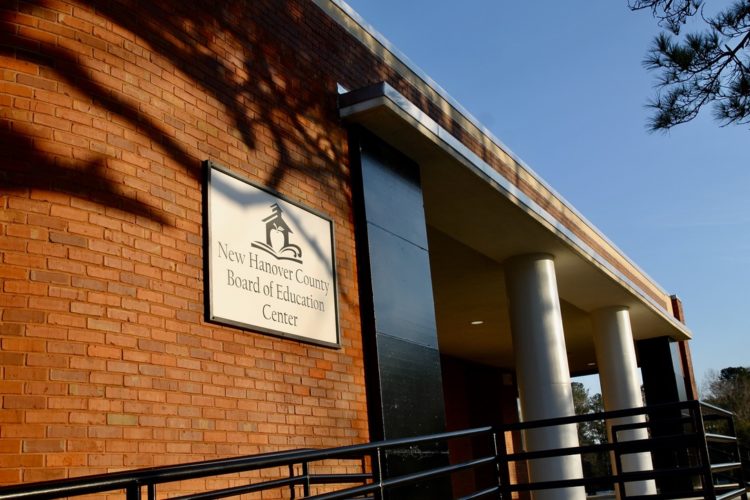
NEW HANOVER COUNTY — Some New Hanover County Board of Education members are looking to address recent public comment controversies with more concrete policy language.
READ MORE: New Hanover County school board overrules committee decision, bans ‘Stamped’ from curriculum
On Tuesday, the NHCS policy committee discussed and moved forward to the full board amendments to policy 2310. The policy governs how the community can participate in the public comment portion of the school board’s regular meetings. The review came after several conflicts over a speaker’s comments at recent board meetings, igniting debate on the limitations of personal attacks, hate speech and the First Amendment.
“We need something that can be enforced,” board member Pete Wildeboer said on Tuesday.
The approved policy amendments insert the following language:
“The Board values community input and is committed to ensuring all voices are heard in a respectful and orderly environment. In accordance with district policy and Robert’s Rules of Order, the following guidelines apply to all speakers:
- Maintain civility and respect during your remarks. Shouting, harassment, personal attacks, or other disruptive behavior will not be permitted.
- Direct comments to the Board Chair, not to individual members directly.
- Adherence to these guidelines is required. Speakers who violate them may be asked by the Chair to rephrase or redirect their comments, in accordance with Robert’s Rules of Order.”
As suggested by board attorney Norwood Blanchard and accepted by the committee, a provision will also be inserted to allow any board member to excuse themselves during public comment “if necessary.”
The proposed changes come after comments made by local activist Sandy Eyles at the regular school board meeting on Sept. 2. Eyles already has been reprimanded by the school board, two years ago after two contentious altercations with a school board member at public meetings, which led to her being trespassed.
“Tonight I’m here to thank Pat Bradford,” Eyles said earlier this month. “Pat, thank you for rudely interrupting me last month—”
Eyles was cut off by board chair Melissa Mason, who asked Eyles to direct all comments to the chair, not any other board member. Eyles pushed back, noting the board’s public comment rules explicitly state she can make comments on individual board members.
“It’s my First Amendment right — I can do it,” Eyles said.
Eyles was allowed to continue and acknowledged the board rules do limit personal attacks.
“However, because hate speech is protected, and is allowed at these meetings, so are personal attacks, so long as they are not threatening or disruptive,” Eyles said. “Which means, if I choose to say Pat or any other board member are dumb as rocks, my speech is protected…short of making threats or inciting violence, you must allow me to criticize your performance as a board member.”
Eyles’ reference to hate speech refers to comments made by a man who identifies himself as Renegade Cherokee at the Aug. 5 board meeting (read WHQR’s interview with him here). Cherokee spent his 2 minutes talking about why he despises the LGBTQ+ community, referring to queer people as “vile” and leading a life of “confusion and derision.”
Board member Judy Justice stopped him twice to call him out for “hate speech.”
Attorney Blanchard noted the board would have a hard time defending a decision to silence Cherokee. The First Amendment prohibits the government from regulating speech based on its content or viewpoint.
For example, the board cannot tell someone who wants to speak about book banning they can’t do so. The First Amendment does allow for limited regulation on the manner of speech, as in profanity, defamation, incitement of violence and threats.
There is no legal exception for “hate speech” and the Supreme Court ruled that speech cannot be limited just for being offensive or hateful in the 2017 case Matal v. Tam.
Blanchard told the board “popularity is not the test” of whether to limit speech, despite however offensive it may be.
Board member Tim Merrick thought Cherokee’s comments constituted inciting violence, though the attorneys didn’t see it the same way.
Cherokee was allowed to continue.
Mason later issued a statement clarifying his statement did not reflect the opinions or beliefs of the board and the district, and affirmed the dignity and value of all students.
The problem with Eyles’ statements at the September meeting had less to do with content and more to do with whether the speaker could address board members individually. Again, the board attorneys were asked to weigh in.
Blanchard pointed to Lowden County’s policy, which has since been amended but in 2021 prohibited harassing comments and personal attacks against an individual, including school board members. The policy was challenged and upheld by the United States Court of Appeals Fourth Circuit.
To Eyles, Blanchard said the board could silence her or ask her to leave for the earlier part of her comments, where she called out Bradford for being rude and making the “dumb as rocks” statement.
“Policy concerns are a different thing,” Blanchard said. “Unfortunately, there’s some subjectivity in the line between the two of them because at some point a policy complaint slides into a personal gripe against someone that’s harassing or a personal attack.”
Eyles was allowed to continue, though she questioned why the policy stated she could address individual board members if she couldn’t in reality. Thus came the policy amendments presented Tuesday.
“In my own personal view, I got on this board, and I knew that when I sat on that dais that I was going to get criticized, yelled at, insulted,” Mason said. “To me, that’s part of the job and I believe, personally, that individuals have the right to say what they want to say.”
But as chair, Mason said she had a responsibility to uphold Robert’s Rules of Order, which is the widely used manual for parliamentary procedure. The rules aren’t legally binding, though when an organization adopts them into policy, as the school board has, they have a duty to uphold them.
Mason pointed out one of the first rules is for all speakers to address their comments to the chair. Thus, the proposed policy amendments would allow for Eyles, and any other public speaker, to call out board members by name, though the comments would need to be directed to Mason and, still, steer clear of personal attacks.
Board member Wildeboer said he thought the public should have to maintain the same level of decorum required by the board. Board members have to avoid referring to their colleagues by name, which in reality turns into roundabout ways of still singling each other out by referring to which seat they’re in or what they’re wearing.
Justice said her time as a teacher gave her thick skin, but she asked if the policy protected staff and students from attacks. Mason confirmed it would.
All three policy committee members — Mason, Wildeboer and Justice — approved of the policy moving forward to the next board meeting. If passed by the full board, the language would also be added to the public comment sign-up sheet for awareness.
Reach journalist Brenna Flanagan at [email protected]
Want to read more from PCD? Subscribe now and then sign up for our newsletter, Wilmington Wire, and get the headlines delivered to your inbox every morning.
