


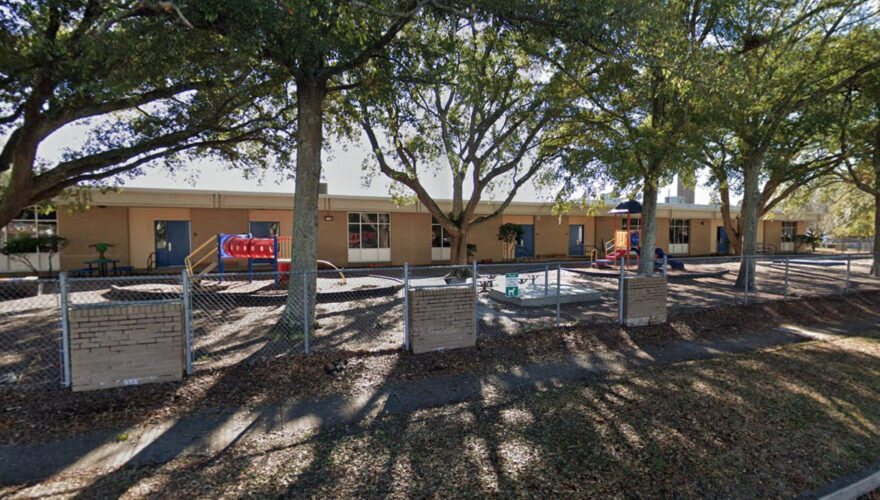
NEW HANOVER COUNTY — The funding terrain in New Hanover County Schools remains rocky after the board’s meeting Tuesday night, but the school board did make a decision on funding its pre-K offerings in the near term.
READ MORE: Tri-county schools hit with fed fund loss, NHCS says its already at ‘subsistence level’
Board members voted unanimously (Josie Barnhart and Pete Wildeboer were absent) to use Title I funding to keep six classrooms, or half of its offerings, that were cut from this year’s county budget, a budget implication worth $975,000.
Title I refers to the first component in the federal Elementary and Secondary Education Act, which provides supplemental financial assistance to school districts for children from low-income families. Some of this funding in the past has been earmarked for pre-K assistance, as the program’s eligibility is primarily based on a family’s income being at or below 75% of the state median.
To cover the cost, the plan is to use $700,000 in Title I carryover funding from last year and make up the rest with Title I funding for this year or delayed security improvements to the district’s high schools. Superintendent Chris Barnes didn’t recommend filling any pre-K student slots that opened due to a student drop-out, in order to preserve funding for the 21 Title I schools.
The district had previously promised 540 pre-K slots to families in April and planned for their inclusion in the budget submitted to the county commissioners. However, the county’s Republican majority pushed through a budget cutting $36 million and more than 70 positions, taking their Democratic counterparts and the public-at-large by surprise. When the six classrooms were no longer part of the equation, it left NHCS scrambling to find other funding mechanisms ahead of the 2025-2026 school year.
Seven options were presented at the board’s agenda review meeting in late June, including:
- Stop preschool transportation, a $300,000 cost
- Ask the county commissioners to reconsider their decision
- Ask the New Hanover Community Endowment to fill in the gaps
- Deplete the district’s current fund balance of $1.6 million
- Charge families who don’t qualify for the program to pay for spots
- Close Mary Washington Howe and move the students to Johnson pre-K, allowing the district to sell the land and building
The last option drew quite a bit of pushback from the public, specifically the Howe community, dozens of who showed out at the New Hanover County NAACP’s event to “save” the predominantly Black and Hispanic school last week. School board members Tim Merrick, Pat Bradford, Pete Wildeboer, and David Perry were in attendance; in return, LeRon Montgomery, NAACP local chapter president, offered his comments at Tuesday’s meeting as well.
“We understand the budget is tight, but equity means everything, all schools get the love and attention they deserve and not just the bigger and more visible ones,” Montgomery said.
Montgomery referenced New Hanover High School, whose master plan for repair and upfits was presented to the public Tuesday. The costs for its long-term needs range between $137 million for repairs to the same structure and $280 million for a new rebuild on 70 acres of land.
Sonya Bennetone-Patrick, president of the New Hanover Chapter of the National Black Leadership Caucus suggested the board tap into its vast resources to preserve the physical school and Mary Washington Howe’s legacy as the first Black female principal of Williston Senior High School in Wilmington.
“This city has one of the largest endowment’s in the country; there is no excuse, in my opinion, to close Mary Washington Howe,” she said.
By Tuesday night’s meeting, closing Howe was off the table.
“That community has already made those hard decisions again and again and I just think coming back to the same well is inappropriate,” Merrick said, noting the sudden closure of the historically Black Williston Senior High School in 1968.
Barnes presented two more options, in addition to the previous seven, on Tuesday, including shifting pre-K classrooms from the College Road Early Childhood Education facility instead of Howe. Mentioned to him by a parent, he said, the other choice could be to split Howe’s land property and sell the significantly sized wooded parcel.
“I’m not in favor of selling real estate, I’m not in favor of closing the school,” Bradford said.
Echoing Mongtomery’s comments from earlier, she said she feared it would deepen the wounds experienced by the Black community in New Hanover County. However, Bradford also noted Howe is not a “Black school” because the majority of its population is Hispanic, followed by white students.
She added the unused area on Howe’s property could potentially be used for another school if the district needed it in the future.
Barnes said none of the now nine options would be permanent solutions, as the district will face the same $1 million deficit next year, absent any additional funding, but he admitted he did not have a recommendation at this time. The board agreed to look for a long-term answer.
“This is an unsustainable program, so we need to find new solutions, but we need time in order to plan and so that’s why I think this is a wise idea,” Perry said of using the Title funding for now.
Perry added the district also has other funding shortages to solve. Not only was pre-K removed from the county budget, but school nurses and social workers also took a hit. The latter will not directly affect schools, as the social workers fall under the county’s department of health and human services, but families using those services could be affected. It still undetermined how many nurse and social worker positions will be reduced at this time.
While potentially otherwise absorbable, the $1 million pre-K loss was just one part of a triple threat to the NHCS budget. In May, the North Carolina Department of Instruction pulled $2.7 million in supplemental funding due to the county’s rise in property values and drop in youth poverty and just last week, the federal government paused $1.6 million in Title I, II, III and IV funding to review compliance with Trump administration doctrine.
This brought the deficit heading into Tuesday’s meeting to $5.3 million, first reported by Port City Daily Tuesday afternoon.
“I think that we all agree that someone pushed the shot clock on this a lot faster than we like and we’ve had no time to absorb,” Barnes said at the meeting.
On Tuesday morning, Barnes provided the board members his potential funding solutions, including using money from lapsed salaries or implementing a hiring freeze. At the meeting, he recommended the board take a “wait-and-see” approach for the first half of the school year due to the federal government’s funding freeze and the state’s lack of an approved budget as of yet.
“This is the reason why it’s essential for us to maintain and have a fund balance,” Barnes said. “Because, normally, what would happen is we would have a hit like this happen, and we would have $6 or $7 million sort of in our savings account. And then we would say we’re going to cover this for a year, while we make plans methodically and carefully to cover this overage.”
Board member Judy Justice noted the district’s fund balance was spent down at the behest of the county, which assured NHCS it would be there to cover any emergencies, such as a hurricane.
“I’m not trying to point fingers, but that was not our decision,” Justice said.
Barnes explained some of the solutions he proposed, almost each one containing a drawback. Using lapsed salaries from those leaving a position mid-year, he said, would not be available to hire a teacher to fill that person’s place.
Going back to the county, which is currently busy laying off its own staff, and the Endowment, fielding several large grants for the schools already, are also not promising options, he said.
Perry suggested the board allay any decision until absent board members, Barnhart and Wildeboer, could be present and provide input. Barnes said, technically, no decision was required unless the board did not want to go with his “wait-and-see” approach, which will be reevaluated in the fall.
Reach journalist Brenna Flanagan at [email protected].
Want to read more from PCD? Subscribe now and then sign up for our morning newsletter, Wilmington Wire, and get the headlines delivered to your inbox every morning.
