


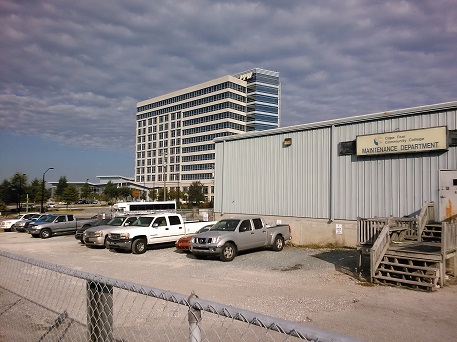
A recently approved land swap between the City of Wilmington and Cape Fear Community College is aimed at facilitating economic development in the city’s central business district.
City council approved the transfer of a city-owned parcel at 320 N. Front St., at the southeast corner of Front and Walnut streets, with a college-owned parcel at 900 N. Second St., near its intersection with Front Street at the PPD building (See map below).
The exchange gives the city full ownership of a four-parcel block that is bordered by Front Street to the west, Third Street to the east, Harnett Street to the north and a parking lot aligned with Bladen Street to the south. It gives the college a corner lot across from the Cotton Exchange and its campus, next to a building planned for use as a campus police station.
Related story: Headquarters in the works for CFCC’s fledgling police force
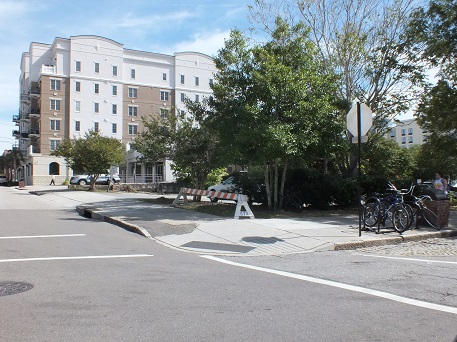
Roger Johnson, assistant to the city manager for development, told council the swap—which does not involve the transfer of any money—was recommended as a result of a recent analysis of land owned by the city and CFCC.
“City staff determined there is a land exchange that makes sense for both parties,” said Johnson, who noted the police station plan but did not mention any particular use eyed for the city-owned block. By consolidating ownership in that area, the city expects the block to become more marketable for economic development opportunities.
“Staff believes that combining the property owned by CFCC with the city’s three adjacent parcels is a proactive step to stimulate future economic development in the northern [central business district],” a memo to council states.
Johnson said the city had reached an informal agreement with CFCC for a parcel-for-parcel exchange, which would require additional levels of approval. While the parcels differ in size and value—the city-owned parcel is 10,875 square feet in size and appraised at $507,000; the CFCC parcel totals 18,347 square feet and is valued at $447,000—Johnson said it was staff’s opinion that value is “site-controlled” and the exchange was worth the economic development potential.
Johnson also noted staff had conducted due diligence including multiple site visits, asbestos exploration, a first phase of an environmental assessment to ensure the site was not overly contaminated, an engineering review and a pre-demolition review, among other analyses.
Jonathan Spiers is a reporter for Port City Daily. He can be reached at (910) 772-6313 or [email protected]. On Twitter: @jrspiers
[mappress mapid=”610″]
