


OAK ISLAND — The Oak Island Planning Board took up a vote this week to potentially usher in a new zoning district to the area.
The commercial waterfront district passed unanimously as a recommendation to council. If council also agrees to it, the district will include a handful of business types: restaurants without a drive-thru; restaurants with outdoor seating and without a drive-thru; bait and tackle; commercial pier; and event center. The planning board decided fewer allowances at first would be a more thoughtful approach and officials could add in more in the future at council’s discretion.
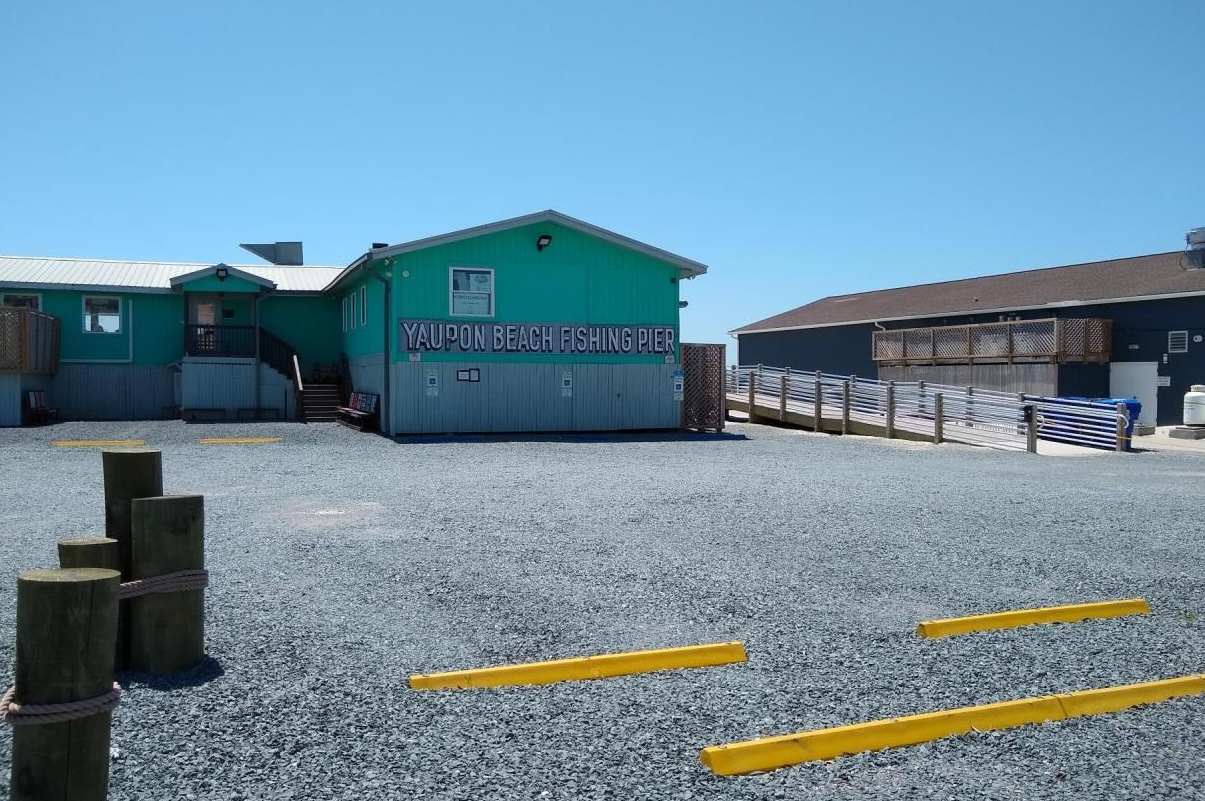
The planning board also applied the new zoning district to the town’s 801 Event Center and 705 Ocean Drive pier complex, previously zoned commercial recreation.
READ MORE: OKI to ditch parking space minimums to spur commercial development
ALSO: OKI rezoning rejected amid concerns over future of pier, event space
The pier has been at the forefront of discussion since June, when the planning board recommended council reject the properties’ rezoning to community business, due to some of the approved uses the town did not want at the complex — fuel stations, offices and residences, for example. The complex includes a fishing pier, bait and tackle shop, restaurant, and coffee shop currently.
When the community business zoning went before council for the scheduled public hearing in October, they also voted to deny it. Elected officials sent back considerations to the planning board, this time with the suggestion of creating a new district.
Oak Island’s new director of development, Craig Harmon, led a discussion the prior month, at September’s planning board meeting, to cover zoning options for the pier complex. Harmon went over the general rezoning approach (ultimately denied), conditional zoning — which would require a $15,000 professionally sealed master plan for the properties — or establishing a new district altogether.
Vice Chair Durral Gilbert expressed support for the latter and reasoned the new district adds flexibility “to define appropriate by-right uses, expand or restrict them as development interest materializes, and protect the public interest in these unique oceanfront parcels,” according to the board’s Sept. 29 meeting notes.
Though council still has to sign off on the board’s suggestion, the commercial waterway district is meant to be a distinctive commercial environment, compatible and supportive of Oak Island and its waterfront recreation, tourism, dining, specialty retail and public access to coastal amenities.
The commercial waterfront district will be different from the community recreational and commercial business districts in that consideration will be given to the intensity of a development and how it complements the waterfront more so than roadway projects. It also doesn’t include residential.
The planning board had an hour-long conversation at it’s Oct. 27 meeting about the varied business types allowed within commercial waterfront district. Staff recommended prohibiting drive-thru establishments, heavy industrial businesses, outdoor storage yards, and auto repair shops.
The planning board used the pier complex properties as a northstar when discussing the new district but also weighed how it would still apply to other waterfront areas. Gilbert questioned if the board should bifurcate what can be on the Intracoastal Waterway versus the oceanfront.
While the pier is oceanside, there are marinas and restaurants along the ICW. Watercraft rentals, sightseeing tours and fishing charters all were broached as possibilities in the new district.
“Think about water jet ski rentals on beaches,” alternate board member Gene Brooks said. “It’s an accident waiting to happen.”
Board member Bob Carpenter thought proceeding with “more restrictive measures” outright would be key: “If we add something to the table of uses, we can’t take it off later because that’s considered downzoning.”
Downzoning is illegal in North Carolina after the 2024 passage of Senate Bill 382 by the General Assembly. The law does not allow a government to amend its zoning regulations or a zoning map that downzones a property without the written consent of all property owners. This could include decreasing development density, reducing permitted uses, creating nonconformities in nonresidential districts or altering development standards.
In Brunswick County, developers of HIC Land, LLC and CLD Engineering, PLLC are suing the county after the planning board denied approval of the Green Hill Development, citing violation protections under S.B. 382.
However, Attorney Michael Bowen, of The Brough Law Firm, PLLC, clarified for the Oak Island Planning Board the town owns the pier complex.
“If the town owns the land, it can downzone however it would like. It has its own consent,” he said.
Naturally, should the town sell its properties, the zoning would stick for future owners too. Harmon told the planning board those properties would “likely” have restrictive covenants on them — a legally binding rule written into a property’s deed on how the land can be developed.
“‘Likely’ isn’t the same as ‘they will,’” Carpenter reminded, before later bringing up “people can make a request to be rezoned into it too.”
Vice Chair Gilbert agreed but used Intracoastal Waterway pub Lone Rider as an example. Since it’s zoned commercial recreational, he thought transitioning to the commercial waterfront district would not incentivize the highest and best use of the land.
“It would actually restrict their ability because it doesn’t have any residential in that,” Gilbert said, noting commercial recreational does. “But we, and town council, can take these exceptions one at a time.”
The list of uses up for discussion at first included cafes, coffee shops and bakeries, too. Carpenter suggested the planning board could always readdress and add more with a text amendment later.
Definitions of uses also entered debate — but mostly around bait and tackle shops, which is currently undefined in the town’s ordinance. The board questioned whether it should be devised as “specialty retail,” with many agreeing it’s open to expansive interpretation.
Some thought just stating “specialty retail” without qualifiers could usher in convenience stores, skate or smoke shops that also happen to have bait and tackle.
“Where there is a gray area, there is a loophole,” Bowen reminded.
Gilbert suggested adding in “predominantly” or “primarily” — as in “specialty retail that predominantly works in bait tackle and marine supplies.”
“If someone wants to hire a good attorney and poke holes in something, they’re going to hang some fishing hooks and say, ‘Hey, we’re ‘primarily’ for bait and tackle,’” Brooks said. “Since we don’t have a definition for bait and tackle, they may sell more sundries than bait and tackle.”
Board members pointed out tackle shops often peddle branded T-shirts and hats, as well as snacks. Where to draw the line became unclear.
They also were caught up on how to classify the words “predominantly” or “primarily” — would it be measured monetarily or by inventory?
Attorney Bowen advised against either, and explained seasonal operations, such as bait and tackle shops, could have “skewed numbers.” More importantly, he questioned who would regulate it: “How are you policing inventory and who in town staff will be in charge of doing it?”
Carpenter didn’t believe it was the board’s prerogative to inform a business on what it could sell.
Planning board member David Purser suggested the bait and tackle definition be centered on “marine-related fishing supplies by line or net.”
The definition that eventually passed unanimously was: “retailers of fishing supplies, miscellaneous beach supplies, products and food sundries, suitable for a family-friendly environment.”
The attorney suggested the agreed-upon “family-friendly” end-phrase to give the board and council leeway to define that in their own terms if it ever comes up in the future.
“We don’t know what’s going to be legal in 10 years,” Bowen said. “That might be a decent catchall. You’ve done what you can, and if it goes to an appeal … they will consider what you meant when you wrote that.”
Town council member Bob Ciullo was in the audience and confirmed at the end of the meeting that council “emphatically” wasn’t interested in selling the pier. He also added the board provided great discussion that gives council a lot to work with and “fine tune” the district if need be.
A hearing date for council to take up the commercial waterway district has yet been scheduled.
At Port City Daily, we aim to keep locals informed on top-of-mind news facing the tri-county region. To support our work and help us reach more people in 2026, please, consider helping one of two ways: Subscribe here or make a one-time contribution here.
