


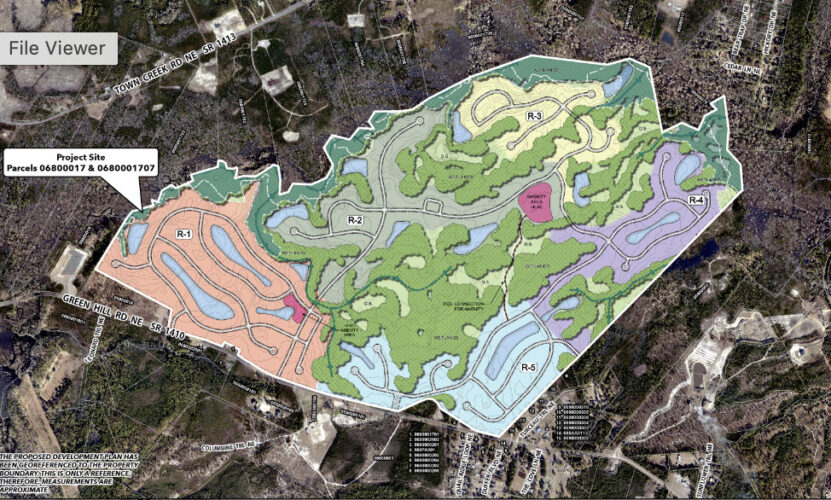
BRUNSWICK COUNTY — A 1,340-home development previously denied by the Brunswick County Planning Board is going to be challenged in Superior Court next month. The county and development team failed to come to an agreement in mediation.
A judge agreed the case between developers HIC Land LLC and CLD Engineering, of Green Hill Planned Development, and Brunswick County will move forward to Superior Court on Nov. 9 at the Brunswick County Courthouse in Bolivia. The developers are being represented by Shipman Wright and Moore law firm.
Gary Shipman did not answer Port City Daily’s questions by press; this will be updated upon response.
READ MORE: Developer suing Brunswick County for denied 1,300-home neighborhood
Mediation took place over a day in July without the parties reaching an agreement to settle the lawsuit, leading to judicial review.
Developers said planning staff found the site plan met the county’s unified development ordinance standards and the board denied it without citing a violation. The county responded that staff’s recommendation isn’t binding and the board had authority to approve or deny the project through its administrative process.
Background
The lawsuit was filed in May after Green Hill Planned Development was denied by the planning board twice — first in November 2025 (a petition with almost 1,000 signatures also was generated against the development) and again in a 3-1 vote in April 2026. The development is planned for 784.59 acres, with 1.71 dwelling units per acre, under the 2.9 maximum density in the current Rural Residential zoning allowance.
Originally, the developers wanted to build 1,450 homes but amended the site plan, reducing it by 110 units. Upon returning before the planning board in April, it presented 1,340 single-family units on the acreage, phased in over 10 years. Around 200 acres are on wetlands, though homes would be built outside the AE flood zone.
Much of the pushback came from residents, fire personnel and planning board members about flooding concerns, traffic capacity and roadways, overburdened schools, and fire and EMS resources. Not to mention, overdevelopment of the Winnabow area was broached, with the nearby Cherrytree Tract also bringing 1,000 homes to the region.
The developer’s attorney, Mike Nichols, argued in the April meeting that having a large-scale, planned development scheduled over a period of time would allow for cohesive and thoughtful engineering. Also, the developer was planning to invest $6 million in roadway improvements and upgrade signal preemptions; basically, smart technology communicates for signals to be green upon detecting a fire truck or emergency vehicle approaching. It also planned to invest in 45 new fire hydrants.
Planning staff recommended approval, noting the objective criteria were met and the plan included exceptional design features, such as 310 acres of open space, beyond the 117.68 required
The plaintiffs alleged that denying the project was “unconstitutional” but also accused the planning board of disregarding objective rules from the county’s unified development ordinance, stating they weren’t based “upon competent, material, and substantial evidence.”
County response
A response filed by Brunswick County Attorney Bryan W. Batton and Assistant Attorney Ryan King on Aug. 21 addressed multiple claims in the lawsuit.
While the county agrees planned development applications are to be assessed under objective criteria, it denies the UDO specifies wording like “not subjective or speculative concerns” and “material and competent evidence.” Plaintiffs also accuse the planning board of not identifying any UDO provision the plan failed to meet.
The development team claim the UDO doesn’t specify whether the decision by the board is administrative or quasi-judicial. Regardless, it argues the need for competent, material, and substantial evidence either way. They also allege the board didn’t follow its own procedures.
The county denies a quasi-judicial hearing should have been held; this type of hearing is like a court procedure with strict rules, such as disallowing outside factors, i.e. emails or correspondence about the project, to persuade the board’s vote and having speakers sworn in after proving they have standing to show a development’s impact on their properties. Plaintiffs argued the board had prejudgment against Green Hill, pointing to how planning board members voiced “frustration” before the hearing about the UDO limiting them to ordinance compliance rather than neighbors’ concerns. The county denied the allegations.
More over, the county maintains the planned development approval is administrative through the planning board and only requires a public hearing to garner feedback, which was held.
Furthermore, the board of adjustment in Brunswick County oversees quasi-judicial hearings, with the exception of special use permits — commissioners hear those now, due to House Bill 1222’s passage. The bill stripped the planning board of final development approval, with the authority now belonging to commissioners. This week, however, commissioners approved sending updated language in the bill back to legislators, requesting to allow all SUPs to go before the board of adjustment instead, since it oversees the county’s quasi-judicial hearings.
The county adds the certiorari statute (160D-1402) plaintiff’s cite as not being met doesn’t apply to administrative decisions, only quasi-judicial ones. A judge granted the plaintiffs’ writ of certiorari petition for Superior Court review.
While changes in H.B. 1222 don’t affect how the Green Hill case was heard six months ago, it could be taken into consideration in a final judgment ruling.
The plaintiffs also take issue that the board did not follow the desire of planning staff’s recommendations. The county responded staff recommending or denying a project to the planning board doesn’t entitle a development to either resolution.
“The Planning Board disagreed with the ultimate conclusion of staff that the application met the requirements of the UDO,” according to the county’s response to the lawsuit. “Planning staff is not vested with the authority to approve or deny planned developments.”
Developers note they spoke with the Brunswick County deputy fire marshal, who approved of the site plans after changes were made to address safety concerns. The county doesn’t dispute this.
Plaintiffs also discussed the plan with the Winnabow fire chief, who they say has no authority “over fire or traffic safety matters.”
Winnabow Volunteer Fire Department Chief Travis Mercer complained in April’s meeting about flooding in the area and proposed road developments potentially creating fire safety risks.
While the county agreed Mercer has no authority under the UDO, it also acknowledged road plans “had the effect of creating fire safety risks per the statement of” the chief.
At the April meeting, planning board member Richard Leary said ahead of voting to reject the project that “the fire chief’s testimony makes it hard to deny” questions still remained about its affects on the area.
The county concedes that fears lacking factual support aren’t enough to reject a project, and the board’s stated reasons were broad concerns about traffic safety and flooding, including the fire chief’s objection. But it disputes the decision was unlawful.
Also denied were the plaintiffs’ claims that the project met all requirements and criteria set forth in the UDO, including its traffic and flooding measures.
While the county agreed the planned 100-year stormwater ponds — now standard since January 2026 — were considered an “exceptional design,” the defendant denied the developer’s claim that environmental and cultural studies submitted found no significant impacts.
Regarding a traffic impact analysis — estimating 11,814 daily trips — the county found staff determined North Carolina Department of Transportation approved a TIA. The county denied, however, the plaintiffs’ suggestion that staff found it satisfactory with a recommended approval “on the condition that, among others, the TIA need only a revision reflecting the proposed reduction in lots from 1,450 single-family units (as originally proposed) to the new reduced amount of 1,340 single-family units.”
Per the lawsuit, the developers seek declaratory and injunctive relief, compelling the county to approve the planned development application.
The county is asking for the courts to dismiss the claims with prejudice, the plaintiffs to cover court fees, and other relief deemed proper.
At Port City Daily, we aim to keep locals informed on top-of-mind news facing the tri-county region. To support our work and help us reach more people in 2026, please, consider helping one of two ways: Subscribe here or make a one-time contribution here.
We appreciate your ongoing support.
