


SOUTHEASTERN N.C. — The U.S. Senate is expected to squeeze in a vote on a bill intended to simplify environmental permitting, though local activists are worried about loosening PFAS restrictions.
“Under this current bill, the state would be required to meet a much higher burden to require, for example, additional protections for PFAS,” senior attorney with the Natural Resources Defense Council Eric Olson said in a press conference Thursday.
The Bipartisan American Affordability and Jobs Act of 2026, or Senate Bill 5653, makes changes to the federal oversight of projects as outlined in the Clean Water Act, National Environmental Policy Act, Endangered Species Act and others.
READ MORE: State demands Chemours conduct broader PFAS cleanup, testing in Cape Fear
The bill will streamline alternative energy projects like hydropower and offshore wind by making permitting less complicated, and also allow for easier approval and construction of gas pipelines and data centers, among other provisions. Advocacy groups across the country suggested making approval processes easier would result in more discharge into local environments; data centers have been known to secrete PFAS through coolant technology used at the facilities, according to the Environmental and Energy Study Institute.
Both Republicans and Democrats have promoted the legislation as a way to make energy bills more affordable by making it easier for industries to receive project authorization.
“A more efficient permitting system would reduce costly delays, get things built faster, and provide more affordable and accessible energy across the country. It would also encourage investment in America, create jobs, and boost made-in-America manufacturing,” Republican Senate Majority Leader John Thune (R-South Dakota) said during his Nov. 10 introduction of the bill.
Supporters of the bill have not mentioned its potential negative impacts, though.
Clean Cape Fear co-founder Emily Donovan held a press conference on Nov. 19 online, alongside other national environmental activist leaders to highlight the bill’s impacts on PFAS regulation and accountability. For example, she pointed out how problematic it could be for the bill to allow discharge permits under the Clean Water Act to expire in 10 years instead of five. The extension could mean new strains of PFAS or other chemicals would not be immediately regulated and monitored because permits often includes an outline of what a company’s discharge limits are and what mitigation measures it needs to take. The bill would not allow updates to an already-granted permit.
Olson further explained potential issues that could be “devastating,” should the bill pass.
“Very often, we don’t know a lot about certain contaminants like some PFAS,” he said. “A lot of old permits don’t address PFAS at all, or only address a handful of them, and as we discover more and more, this will make it much more difficult, if not impossible, frankly, to update permits under the Clean Water Act.”
This bill would only mandate discharge into federally recognized waters be held to water quality standards under the Clean Water Act, which would exclude isolated wetlands, groundwater, stormwater runoff and other smaller, disconnected waterways.
It also raises the threshold for states to implement conditions or deny an application if a company applies for a permit. Right now, states can review how a project would affect water quality, implement restrictions and requirements based on a review and conclude whether the project would add to pollution already ongoing in the region; a state’s rejection would also result in federal denial.
S.B. 5653 indicates states have less authority over all processes and will have to provide convincing evidence to the EPA to demonstrate a potential violation or harmful impact.
“Under this current bill, the state would be required to meet a much higher burden,” Olson explained.
In another change, the EPA is currently allowed to review permits and projects of dredged or fill material discharges anytime a permit application is submitted. The Senate’s proposal would mandate the EPA also cannot overturn any permit issued by the U.S. Army Corps of Engineers.
Challenges to a company’s permits are constrained to a stricter period of 150 days from permit approval. This narrows the timeline that opposition groups can push back on discharge permits.
“Environmental activists, they have used the courts for decades to slow down and delay necessary projects that would help our country move forward,” Sen. John Barrasso (R-Wyoming) said to the Senate on Nov. 18. “Each case is filed to prevent a project from moving ahead. It is an anchor holding them back. This drives up the costs. It drives up uncertainty. This Senate bill fixes that.”
Lawsuits for permits under the National Environmental Policy Act, the Clean Water Act, the Endangered Species Act and other energy projects are currently allowed for up to six years under the Administrative Procedures Act, unless specifically stated otherwise.
Donovan said laws like S.B. 5653 make it more difficult to settle litigation but, more importantly, litigation wouldn’t be needed if the government took a more proactive role in regulating the environment. In the case of PFAS in particular, she suggested instead of ratepayers and taxpayers fronting the costs of litigation against polluters the law should be preventing the discharge at the source before it becomes a legal battle.
“One of the clearest ways to get legal settlements is when you have established federal and state standards that you can litigate with,” Donovan said. “And without those, we are stuck having to pay for the burden instead of holding the polluter accountable.”
She was referring to a series of lawsuits that have been filed against Chermours from the state, residents and utilities, like the Cape Fear Public Utility Authority since 2017, it was revealed that Chemours, and its parent company DuPont — located about 80 miles upstream from Wilmington — have been dumping PFAS chemicals like GenX into the Cape Fear River for decades.
“This one facility burdened our area and treated us like a PFAS sacrifice zone for 40 years — and more because it’s still happening,” Donovan said. “Our region’s public tap water samples have topped nationwide tap water studies for unmonitored PFAS. We are the poster child for unregulated, unmonitored, and uncontrolled, unlimited releases for PFAS.”
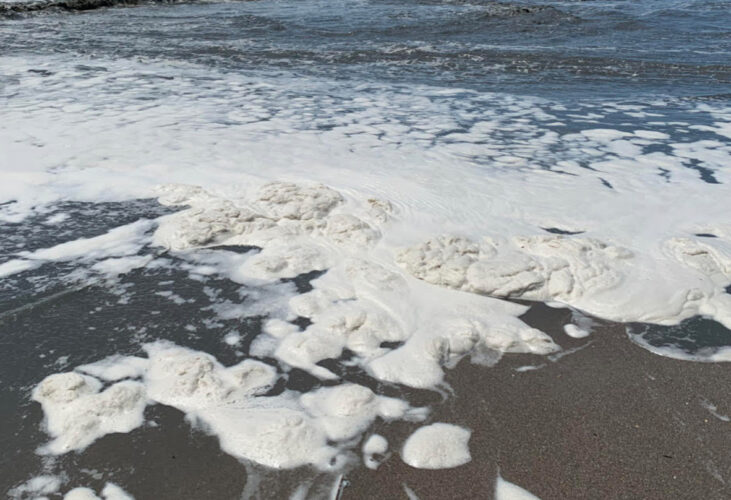
More than 1.5 million residents get their water from the Cape Fear River, the UNC Collaboratory reports. According to the North Carolina Department of Environmental Quality, more than 10,000 private wells in the Cape Fear region have been contaminated across 10 counties. GenX was also discovered in high concentrations in seafoam in the local waters, as revealed in 2025 through a joint study conducted by N.C. State University and Clean Cape Fear.
PFAS removal has cost the region millions of dollars, with local governments and utility authorities having to build filtration systems to provide the public with safe drinking water. The construction price and litigation has led to rate increases for taxpayers — by 8.46% in 2023, 4.6% in 2024 and 2025, and 6.65% this year.
“It is incredibly expensive for communities like mine right now to clean PFAS from our tap water when the releases are not stopped at the start,” Donovan said.
The vote to pass the bill in the Senate could come as early as Thursday evening, and if passed, the bill will need to return to the House of Representatives for approval before it can be brought to the president’s desk.
However, at the press conference Donovan and Olson advocated for constituents to call their senators and representatives to advocate against S.B. 5653. The bill was added as an amendment to the Survivor Justice Tax Prevention Act, a House bill originally meant to exclude settlement money for sexual assault or violence related cases from being taxed.
It is typical for the Senate to use one bill as a vehicle for approving an unrelated, separate bill by adding it as an amendment. Federal statutes dictate that amendments only need to be related to the original bill if it is for general appropriations and budget measures, outside of debate time, or under unanimous consent agreements.
The addition of the amendment passed in the Senate 69-27 on Nov. 18. Both North Carolina senators Republicans Thom Tillis and Ted Budd voted in favor.
Have tips or suggestions for Emily Sawaked? Email [email protected]
At Port City Daily, we aim to keep locals informed on top-of-mind news facing the tri-county region. To support our work and help us reach more people in 2026, please, consider helping one of two ways: Subscribe here or make a one-time contribution here.
We appreciate your ongoing support.
