


NEW HANOVER COUNTY — Copper Builders is still trying to forge a path forward for its 1,800-home Hilton Bluffs development after being stalled on multiple fronts. Though on Tuesday this was done in an unexpected way — pushing a county board to move forward with a complaint against its own site plans.
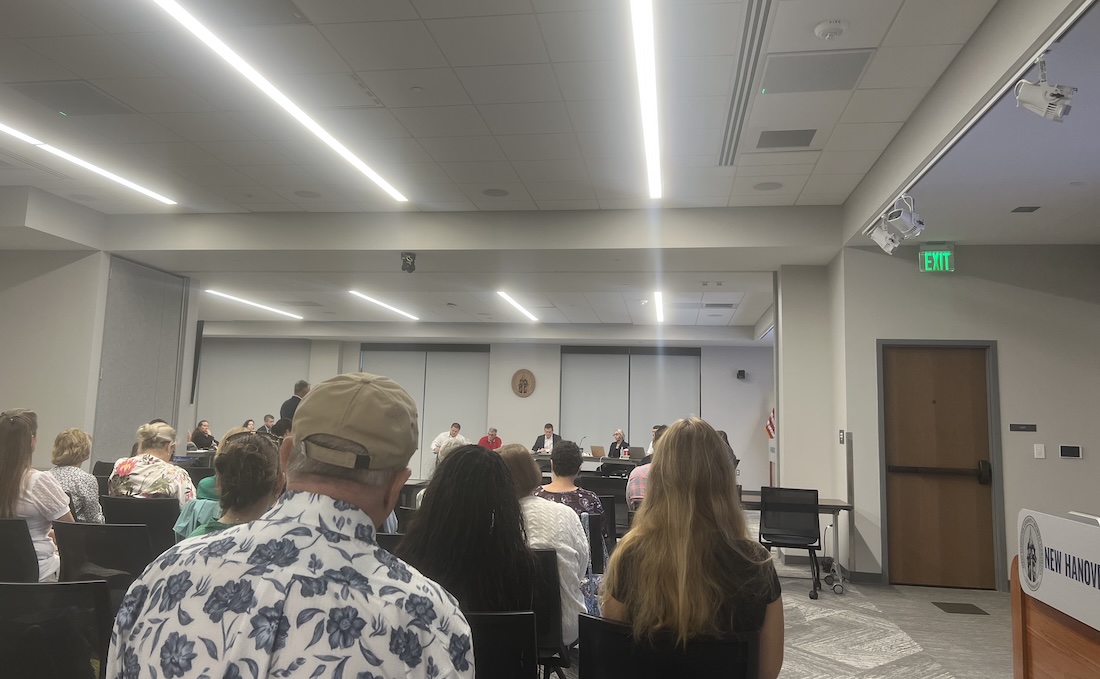
The New Hanover County Board of Adjustment was scheduled Tuesday to hear an appeal against Hilton Bluffs. It was filed in March by the Southern Environmental Law Center on behalf of Castle Hayne residents and the nonprofit Save Sledge Forest; they argue the county made a mistake in calculating the density allowed on the 600-acre subject property.
However, the board never reached a verdict, or even heard the case; instead, it spent three hours discussing whether the appeal is still valid.
Several events have taken place since July potentially affecting the appeal.
On July 20, the SELC appeal was set to be heard alongside another objection from neighbors adjacent to the Hilton Bluffs properties. The neighbors argued two proposed roadway connections to the subdivisions would violate their HOA restrictive covenants. Copper Builders chose to settle this appeal — and a parallel lawsuit — with a consent order in Superior Court.
The consent order requires Copper Builders to submit a new plan without those connections. Thus, SELC’s appeal was continued from the July meeting. Despite county officials and the SELC expecting the site plan to be updated with other access points, it was submitted with only one.
Because the state fire code typically requires two access points for developments this large, the new site plan triggered some dispute from the local fire marshal, who eventually dropped any objections when the technical review committee took up the second set of plans on Sept. 3
The TRC had yet to render a decision on the new plan when County Manager Chris Coudriet stepped in. Last week, he rejected the one access-point plan based on public safety concerns associated with a singular roadway in and out of the 1,800-home development.
The access points have been problematic as residents in the area have decried the development is located in a FEMA floodplain, adjacent to a designated hazardous waste site, surrounded by tidal waters and wetlands, and will generate 14,000 vehicle trips daily in the Castle Hayne area.
The SELC appeal, however, only pertains to the March site plan, approved with three access points — two of which can no longer be built due to Copper Builders’ consent order. Or so the county and SELC thought.
On Tuesday, both Deputy County Attorney Karen Richards and SELC attorney Susan Keelin argued the appeal is now moot.
“Those two access points that were part of the approved plan are no longer available — so, therefore, as we see it, there is no viable plan on which Copper Builders can presently proceed,” Keelin said.
The county concurred, though Sam Franck, attorney for Copper Builders and its founder Wade Miller, did not agree with the assessment. Franck argued the SELC’s appeal does not take issue with access points, rather a TRC mistake calculating density — so changing entrances to the development isn’t at the center of the hearing. He also said the actions that have taken place since March have no bearing on whether the SELC’s appeal has merit.
“This board doesn’t reevaluate plans,” Franck said. “You consider specific allegations of mistake, and in this case, that’s what the appellants have asked you to do.”
Ultimately, the board didn’t side with either party, choosing to delay a decision once again. At the new hearing date in November, the board wants each party to be ready to hear the appeal and argue its merits.
“Let’s try to end this thing,” board member Michael Sanclimenti said.
Splintering plans
It is important to note that the county, at this juncture, is treating Copper Builders two site plans separately — the one from March has three access points and the county manager’s rejected site plan has one access point. After Copper Builders agreed to submit a new plan at the July meeting, it was debated whether the second one would constitute a modification to the original or become a new plan altogether; the county now seems to be acting on the latter belief, allowing the first plan’s conditional approval to stand.
Deputy County Attorney Richards explained the process to the board: Copper Builders is allowed to submit as many plans as it would like for conditional approval. In accordance with the land code, the county can then approve any number of site plans. Decisions stay in place for two years.
“You can have 15 plans with a conditional approval, and then you pick which one and whatever you don’t build expires,” Richards said.
Thus, the county manager’s rejection of the site plan with a single access point has no bearing on the SELC appeal, filed based on a plan with three access points.
Still, Richards argued the consent order is really what stands in the way of the SELC appeal continuing.
“It seems very simple to me, so I’m sorry if it seems like I’m lecturing, but we have a conditional approval that is based on a plan that cannot happen — that is what is in front of you right now,” she said.
She also pointed out one area where Copper Builders’ other plan — the one with a single access — would affect this case.
If Copper Builders chose to challenge the county manager’s rejection, there could be two different appeals before the board on the same project. The board could issue conflicting opinions, or conflicting opinions could come from Superior Court should either case be appealed again.
Additionally, the state fire marshal could take up Copper Builders’ appeal to his office and change how the single-access site plan is viewed.
“We’d have conflicting direction on how to handle this, which would make this an even bigger quagmire,” Richards said.
Richards said the cleanest way to move forward would be for Copper Builders to submit a new plan. It would trigger a new TRC review and open a new appeal window for the SELC or anyone else to object.
Keelin concurred with Richards’ assessment, noting she was open to any solution that would get the group out of the “procedural morass” it was in. Her preference was a dismissal without weighing the merits and without prejudice, meaning the SELC would have the right to appeal the county’s decision at a future date.
Though Franck noted he would like a dismissal of SELC’s complaint, he objected to doing so without prejudice. The attorney allowing the SELC to file an appeal again in the future would stall work on the project. Currently, the project has been issued a stay on construction until the appeal is heard.
Franck argued the board had an obligation to decide whether the county’s decision-making was sound in the March 10 approval and this could still be determined regardless of whether the plan moved forward.
The attorney also said Keelin and Richards were not quite right when calling the March 10 plan dead in the water due to the consent order. He said the plan could potentially be salvaged, potentially through a property transfer.
A (theoretical) path forward?
Conditional approvals follow the land, meaning if Copper Builders sold the property, the new owner inherits those approvals. Franck said in his comments that Copper Builders has every intention of developing the property “the right way.” However, since the March 10 plan was approved, “in theory, pursuant to some paths” it could be constructed as it’s approved.
Franck added it is not Copper Builders’ first choice, which would be the single-access plans submitted to the county. Franck characterized the single-access plan as a revision to the original, despite the county treating it as a separate site plan.
In Copper Builders’ view, moving forward with hearing the SELC appeal’s merits is one step closer to a verdict. A decision in favor of Copper Builders would clear the way for the original site plan to move forward, pending “some paths” Copper Builders alluded to.
The first mention of Hilton Bluffs property ownership was brought up during Richards’ initial statements.
“Mr. Frank just asked you not to deal in hypotheticals, so I’m going to ask you not to deal in hypotheticals as to who they might sell the property to, who, if they sell, might not buy it, or who ends up with this conditional approval,” Richards said.
This reference to a workaround of the consent order prompted board member Lauren King to question whether the original plan could in fact be built, contrary to Keelin and Richards’ claims that it could not be.
Colin Tarrant, an attorney and former county planning board member hired to provide independent counsel to the board of adjustment Tuesday, said he was not comfortable interpreting the consent order. He added he didn’t think it was in the board of adjustment’s purview to say whether the consent order disallowed the appealed site plan to move forward in any way, though it could consider this a possibility.
The consent order’s text requires Copper Builders to submit a revised preliminary plan that removes access using the proposed Wooden Shoe and Marathon Colony parcels. Copper Builders completed that requirement by turning in the 1,800-home development with only one access point in and out.
According to Richards, the consent order applies not only to Copper Builders but all subsequent owners because it affirms the Wooden Shoe and Marathon Colony restrictive covenants that restrict lots to residential uses.
Richards said she talked with Grady Richardson, the attorney who represented area neighbors, on his understanding of the consent order. Richardson affirmed Copper Builders or any other holder of this conditional approval cannot access through the Wooden Shoe and Marathon Colony roadways on the site plan.
Port City Daily also reached out to Wade Miller for clarity on what theoretical paths Franck referred to during the meeting. Miller did not answer in his response.
“The Board got it right today,” Miller wrote in an email. “It rejected the appellants’ arguments, confirmed that the plan approved on March 10 remains valid, and refused the appellants’ continued attempts at delay. We’re confident that on November 4 the Board will affirm that the approval was correct when it was issued, and reject this appeal.”
Decision to continue
Without a definitive answer on whether the original site plan was null and void, the board of adjustment struggled on how to proceed.
Chair Caleb Rash asked Keelin why she would not voluntarily withdraw the SELC appeal if the organization was confident the plans could not move forward. Keelin said the SELC is unable to rule its own appeal moot and the board would need to affirm.
Tarrant advised the board against dismissal based on a moot point, noting it would be the most convoluted ruling and could open up the board to more litigation. He pointed to another option raised by Richards: remand the decision back to the TRC.
It would allow the TRC to reconsider approval based on the new information regarding Hilton Bluffs. The new information includes the consent order, but also Copper Builders’ struggles in obtaining secondary access points outside the Marathon Colony and Wooden Shoe connections.
“The request to remand may provide the cleanest opportunity for the board,” Keelin said.
The TRC could uphold or reverse its decision, and appeals could follow from Copper Builders, the SELC or any other affected parties. Franck pointed to the Coastal Land Trust as a potential appellate in either the case before the board or the county manager’s decision on the one access-point plan.
Copper Builders has agreed to donate 1,200 acres and sell 2,000 acres of Sledge Forest not included in Hilton Bluffs to the North Carolina Coastal Land Trust, contingent on the development proceeding as proposed.
Franck objected to the remand option, arguing the county’s unified development ordinance states the board of adjustment must hold a hearing on merits of the appeal before sending it back to the TRC.
Pointing out the UDO’s procedure for board of adjustment hearings, Keelin said the language doesn’t include the word “merit.” Terrant sided with Keelin and the county.
King liked the remand option: “Whatever happens at that point happens and can be dealt with.”
Chair Rash did not favor it.
“As of March 10, Copper Builders had essentially a right in that conditional approval; whatever happens after the fact can’t really take that away,” Rash said. “I think there’s still an open question about whether that plan could proceed in any practical sense.”
Sanclimenti was the board member to suggest the item be continued, though the chair and Keelin questioned how it would be different later in the year versus Tuesday.
Rash then indicated an inclination toward continuation, noting it would give more time to see how the county manager’s rejection played out.
Though two board members were not in favor of continuing, neither the SELC nor Copper Builders objected. The board told both parties to be prepared to present on the merits of the appeal in November. The hearing will take place Nov. 4 at 9 a.m. in the New Hanover County Government Center.
Have tips or comments for Brenna Flanagan? Email [email protected]
At Port City Daily, we aim to keep locals informed on top-of-mind news facing the tri-county region. To support our work and help us reach more people in 2026, please, consider helping one of two ways: Subscribe here or make a one-time contribution here.
