


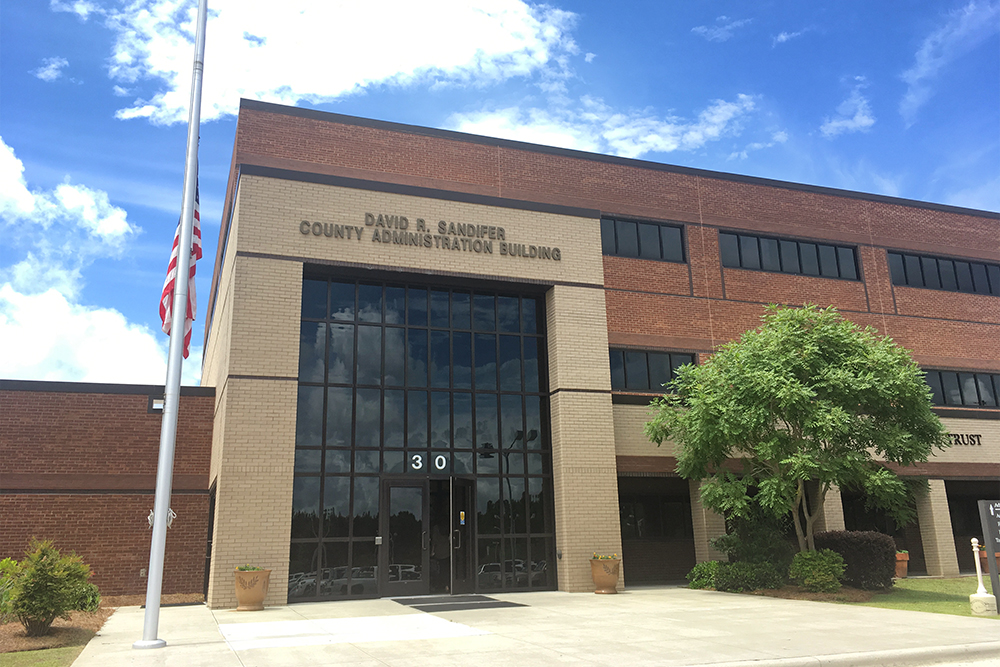
BRUNSWICK COUNTY — Proposed increases in utility fees could raise monthly bills for Brunswick County residents even as county leaders move forward with a $321.1-million budget keeping the property tax rate steady at 34.2 cents per $100 of value.
The proposal maintains the tax rate, despite rising costs across personnel and capital projects. Commissioners have spent the past several weeks reviewing departmental requests and spending priorities as they move toward final budget adoption next month.
READ MORE: Brunswick commissioners turn open-burning debate into broader push for state policy changes
ALSO: $100M health and emergency hub on track to break ground next year in Brunswick County
Even without a rate hike, the county expects to bring in significantly more revenue due to continued growth. Brunswick County’s total taxable value is projected to increase by nearly $3.8 billion, or about 7%, driven by population growth and continued development. The growth translates to roughly $12.6 million more in property tax revenue compared to the current year, escalating from $182.7 million to $195.4 million.
Brunswick County continues to be the fastest-growing county in North Carolina, with the population increasing by roughly 22% since 2020, growing from 136,000 residents to more than 167,000 by 2024, according to U.S. Census estimates.
While the property tax rate remains unchanged, commissioners spent considerable time on Monday debating potential increases to wastewater and utility fees that would directly affect monthly bills for residents and businesses.
Officials discussed a proposed $6 increase to the wastewater base rate, which would raise the monthly charge from $39 to $45, along with an increase in the volumetric rate from $6.50 to $7.50 per 1,000 gallons. For the average customer, the change would amount to a $7.50 monthly increase.
Staff noted the county has not raised wastewater rates since 2006, a two-decade gap they said has left current fees unable to fully cover rising operating costs tied to treatment, electricity and chemicals.
Chairman Mike Forte was worried about implementing the raises on the rates all at once.
“Maybe every other year, you go up $1 a month or something on the base and stay current, so that we don’t have to do these $6 and $7 increases all in one shot,” he said.
In addition to wastewater changes, the budget includes higher water infrastructure and connection fees, including a $120 increase for 3/4-inch to 1-inch meter upgrades (to $1,120), a $350 increase for irrigation meters (to $1,450), a $50 increase for standard 1-inch meters (to $550), and a $150 increase for 2-inch commercial installations (to $2,300). Wholesale water rates for the Northeast system are also projected to rise from $2.71 to $3.20 per 1,000 gallons.
At the same time, county spending is climbing. The proposed budget totals $321.1 million in expenses, up from $300.7 million this year.
A large share of the increase is tied to personnel costs, which remain the single biggest driver of expenditures. Salaries, benefits and new positions total about $145.1 million, up more than $11 million from the current year, driven in part by roughly $2 million in higher retirement contributions and about $860,000 in increased health insurance premiums.
The draft budget includes nearly $1 million for new positions, including four additional sheriff’s deputies, along with new detention center staff, emergency management personnel and social services roles. The request comes as the sheriff’s office reports seven open positions out of roughly 250 employees, or about 3% of its workforce.
Commissioner Pat Sykes questioned whether the county should prioritize filling existing sheriff department vacancies before funding additional positions.
“I don’t want to give him [Sheriff Brian Chism] four more,” Sykes said about the request. “Now, if, let’s say, December comes and he’s got them all filled and he needs four more — I don’t think we need to put money in his budget for him to spend on something else until he needs the four deputies.”
County staff said hiring in public safety positions is a continuous, year-round process tied to recruitment and training cycles, meaning vacancies are constantly opening and being filled.
“Most of the time in our public safety positions as well as others it’s almost a continuous recruitment process,” Deputy County Manager David Stanley said. “Whether you’re talking about the 911 center or paramedics, you really are trying to recruit all year.”
The pressure is not unique to Brunswick County. A 2024 North Carolina Department of Public Safety survey found nearly half of law enforcement agencies reported vacancy rates above 10%, with more than one in five reporting vacancies above 20%.
A county pay and market study completed earlier this year was also intended to address those recruitment challenges by evaluating whether Brunswick’s compensation remains competitive. The study compared county positions against similarly sized North Carolina counties and direct labor markets, including surrounding counties, Wilmington, and coastal South Carolina jurisdictions such as Myrtle Beach and Horry County.
The analysis resulted in recommended pay adjustments across county positions, including 137 positions moved up one pay grade, 162 moved up two grades, and 54 moved up three grades, while 134 saw no recommended change. Each grade increase represents a 2% salary adjustment, with increases capped at three grades.
Commissioner Sykes questioned the inclusion of out-of-state and municipal markets in the comparison group, arguing they do not reflect comparable county operating conditions.
“I just don’t think we should be using North Myrtle Beach City and Myrtle Beach City … and Horry County is a different ball game altogether compared to North Carolina,” Sykes said. “I’m fine with all the North Carolina counties and Wilmington city, but I just don’t think that they should be included. They’re going to pay higher down there because it’s a totally different area.”
Commissioner Marty Cooke defended the inclusion of those markets as part of the county’s labor pool.
“Would it be, though, that if an individual is working here and lived here, had a home here, family here, and they decided they wanted to not be here, they would go to someplace that was within commuting distance, and that would be a surrounding county,” Cooke said.
Beyond personnel, the budget is also being driven by a slate of major capital projects and debt service tied to continued growth across the county.
Among the largest capital items is the county’s planned capital improvement program, which includes a roughly $96.5 million Department of Health and Human Services and emergency operations facility, approved by the board last November.
The project drew pointed questions from Commission Chair Mike Forte, who raised concerns about how quickly the cost had escalated from earlier estimates.
“What happened? This building started at under 40 million. Last I had heard it was up to like 76, now we’re at 96,” Forte said. “Let’s get this thing built quickly before it becomes $200 million.”
County staff said the core construction cost of the building has not significantly changed, and the most recent $20 million increase reflects added funding for interior items, including furniture, light fixtures and cabling, which fall outside the base construction contract. Interior costs were included in the recommended budget to ensure the facility can open without requiring further funding requests after construction is complete. Staff noted the project remains on track to break ground in July.
Other projects on the county’s books include the planned Animal Protective Services facility, an $85.1 million expansion of the Shallotte Wastewater Treatment Plant and a nearly $85 million regional biosolids processing facility. The county is also budgeting $122.6 million for school-related bond projects, and $5.7 million for a secondary utility operations hub.
To help pay for major capital projects, the county is planning to issue a Limited Obligation Bond in July 2026, primarily to fund construction of the Human Services and Emergency Operations Center. Unlike general obligation bonds, LOBs do not require voter approval and are repaid through general county revenues.
The financial impact of borrowing will begin to show in the 2027 fiscal year, when debt service costs are projected to increase by about 17.5% from $13.5 million to $15.8 million. To help offset the increase, the county has already transferred $2.3 million into capital reserves to support future payments.
Even with the additional borrowing, county staff said Brunswick remains well within its debt policy limits. County policy allows debt service to reach up to 13% of total expenditures, though current projections put it at about 4.9% in the next fiscal year. However, staff cautioned once the new Health and Human Services facility is fully accounted for — along with a potential $122.6 million school bond package if approved by voters — the county’s debt-to-expenditure ratio could climb to nearly 12%, just below the 13% policy threshold.
Finance Director Aaron Smith said the county’s strong credit ratings — Triple-A for general obligation bonds and Double-A for revenue bonds — help keep borrowing costs low. Bond ratings signal to investors the county is a low-risk borrower, allowing it to secure lower interest rates and reduce long-term borrowing costs.
As the meeting came to a close, Forte briefly reflected on the work done by staff throughout the budget planning process.
“Our department directors worked very well with us to make some cuts to their requests that in some respects were pretty tough for them to make, but they all did,” Forte said. “It’s the first year that I can recall that I’ve never had a department head come to the podium.”
The proposed budget will return to commissioners for a public hearing June 1, with final adoption expected June 15 as officials weigh potential fee increases alongside rising long-term costs.
Have tips or suggestions for Charlie Fossen? Email [email protected]
At Port City Daily, we aim to keep locals informed on top-of-mind news facing the tri-county region. To support our work and help us reach more people in 2026, please, consider helping one of two ways: Subscribe here or make a one-time contribution here.
We appreciate your ongoing support.
