


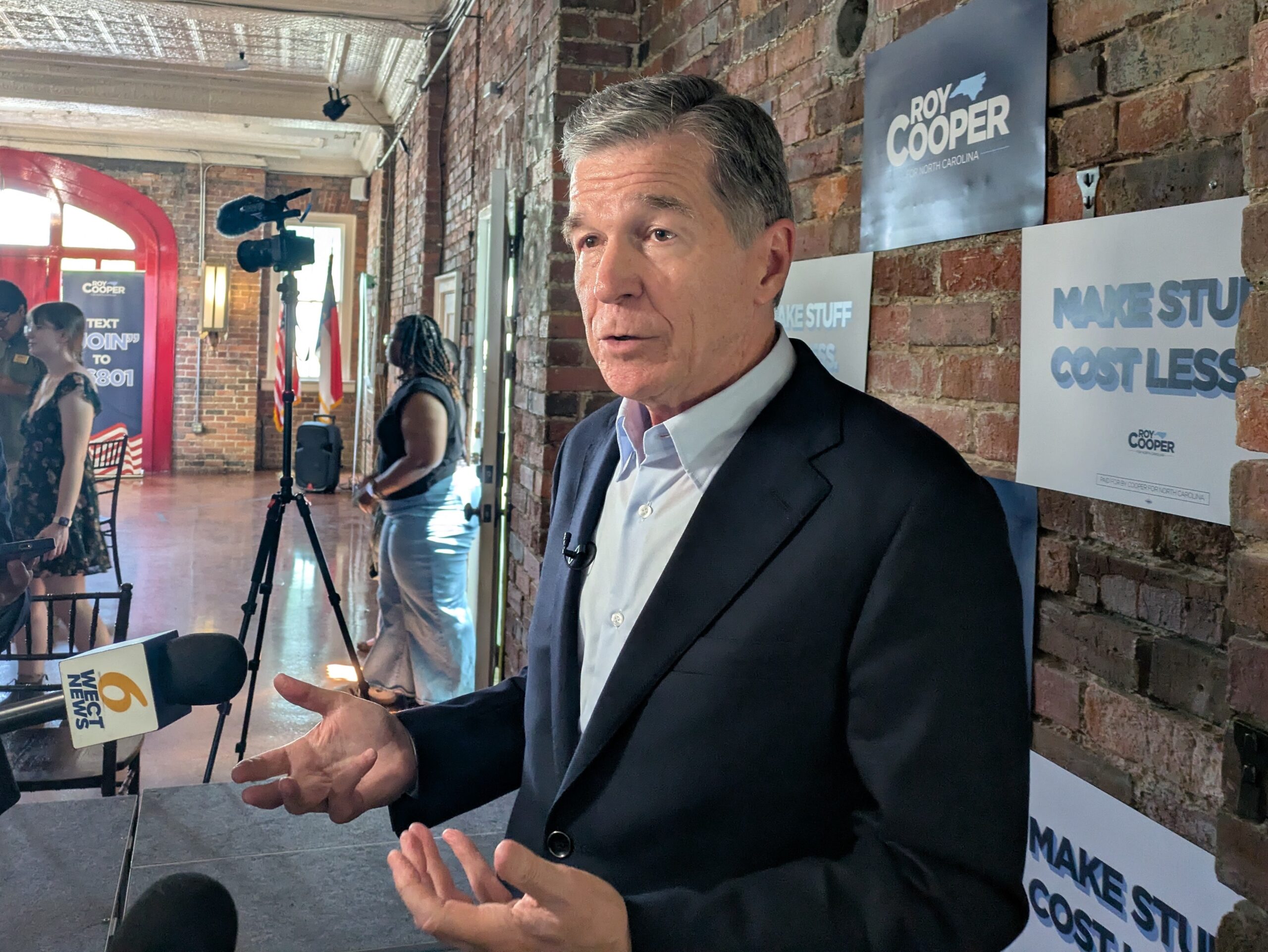
WILMINGTON — In his 2026 bid for U.S. Senate, former Gov. Roy Cooper brought his “Make Stuff Cost Less” campaign to Wilmington on Thursday, April 16. To supporters at Station No. 2 on 5th Avenue and Castle Street, he outlined his platform on child care and the rising cost of living.
“I’m running for people like you,” Cooper told the 130 in the crowd, adding many North Carolinians are currently being affected by “higher groceries, higher utility bills, higher rent, [and] higher costs of health care.”
READ MORE: Senate candidate Roy Cooper rallies Brunswick Democrats ahead of 2026 primary
ALSO: RNC Chair Michael Whatley announces run for Senate
He was introduced by Kitt Starnes, a North Carolina public school teacher and working mother, who said rising costs have become a daily strain for families.
“It used to be that if you worked hard, you could afford to get by, but now the price of everything has skyrocketed — from groceries to utilities to child care,” Starnes said.
Cooper described child care as both a household expense driving financial strain and a barrier to workforce participation. In North Carolina, infant child care averages about $11,000 to $11,700 per year, according to Economic Policy Institute data. This equates to roughly $900 to $1,000 per month, and represents about 12% of the median household income, above the federal affordability benchmark of 7%.
Cooper said a central part of his child care plan is expanding the Child Care and Dependent Tax Credit, which allows families to claim a portion of child care expenses to reduce their tax burden. He said increasing the credit would help offset the rising cost of care for families.
“The families need more help and it needs to be expanded,” Cooper said, adding the credit should apply more broadly to families caring for children, the elderly, and people with disabilities.
Beyond tax relief, Cooper also proposed strengthening the child care workforce — a key factor limiting affordability. He suggested increased investment in training programs and apprenticeships to help keep child care workers in the industry.
North Carolina is facing a documented child care shortage, with the state’s Task Force on Child Care and Early Education reporting roughly 594,000 children under age 5 but only about 224,000 enrolled in licensed programs statewide. A 2026 analysis from the North Carolina Chamber of Commerce estimates those gaps cost the state’s economy about $5.65 billion annually due to lost employee productivity, turnover and lost tax revenue.
Cooper said some federal “red tape” — unnecessary rules and paperwork from government regulations — could be reduced to lower costs for child care providers, arguing that certain requirements increase expenses without improving outcomes for children.
He specifically pointed to federal nutrition guidelines requiring child care centers to provide pre-packaged meals instead of preparing fresh food on-site. This can drive up costs for providers, according to Cooper.
“We also need to just cut [regulations] a little bit,” he stated. “We need to keep the standards for safety and education of our children, but we need to identify unnecessary regulations.”
Cooper pointed to employers as part of the solution, proposing employer tax incentives for businesses offering onsite child care or providing subsidies to help retain employees.
Outside of child care, Cooper also addressed agricultural concerns including rising costs for farmers tied to tariffs and supply chain instability.
“We need to make sure that we walk back chaotic and erratic tariffs,” Cooper said, referring to the current administration’s actions.
Trade policies in recent years — including tariffs on steel and aluminum and retaliatory tariffs from major U.S. trading partners — have raised costs for farm equipment by making materials more expensive and have also reduced demand for U.S. crops like soybeans and pork in overseas markets.
“It has increased the cost of fertilizer so much and equipment that’s just making farming too expensive,” Cooper said.
According to the U.S. Department of Agriculture’s Economic Research Service, fertilizer prices rose sharply beginning in 2021 and reached record highs in 2022 amid global supply disruptions and higher energy costs tied to production and transport. Prices have since declined from those peaks and were generally more stable by 2024 and 2025, though still above pre-pandemic levels.
Cooper also referenced broader cost pressures facing North Carolinians, including rising prices for health care, utilities, groceries and housing, though he did not lay out specific policy proposals in those areas.
Cooper concluded the event contrasting his policies with his Republican opponent Michael Whatley.
“Too many of the policies coming out of Washington are still making it harder for people to get ahead instead of easier,” Cooper said, describing Whatley as a “DC insider” and “big oil lobbyist.”
Recent polling shows Cooper leading Whatley, with his advantage increasing from a 6-point margin in an August 2025 Emerson College poll of 1,000 registered voters (47% to 41%) to a 14-point margin in a March 2026 Catawba–YouGov survey of 1,000 voters (48% to 34%).
Have tips or suggestions for Charlie Fossen? Email [email protected]
At Port City Daily, we aim to keep locals informed on top-of-mind news facing the tri-county region. To support our work and help us reach more people in 2026, please, consider helping one of two ways: Subscribe here or make a one-time contribution here.
We appreciate your ongoing support.
