


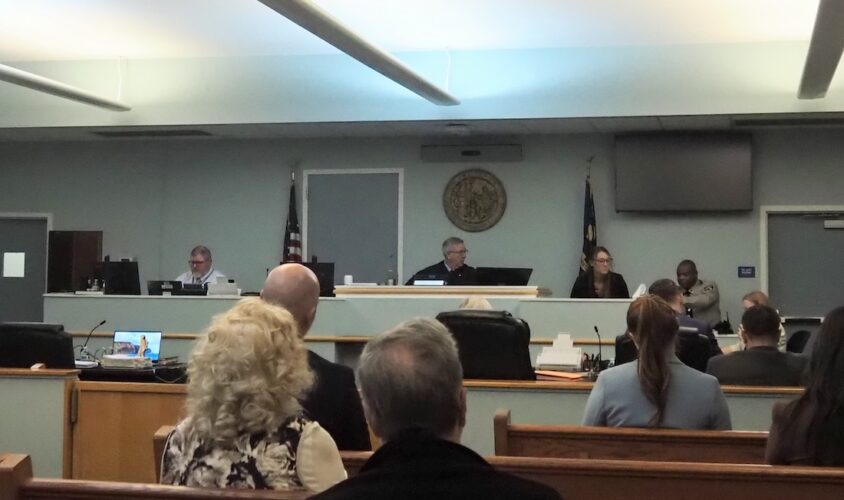
PENDER COUNTY — After three days of testimony alleging she used taxpayer funds for personal purchases, the state rested its case Friday against Pender County Clerk of Superior Court Elizabeth Craver.
Craver, elected since 2017 and won full terms in 2018 and 2022, faces three felony counts of obtaining property by false pretenses. Prosecutors allege she used roughly $1,400 in county funds to purchase items for personal use, including a MacBook Air laptop, office chairs and a portable air conditioning unit.
READ MORE: Growth, green space, public safety anchor Pender’s 2030 blueprint
If convicted of the felony charges, Craver faces potential prison time and would be required to vacate her office. She is currently seeking re-election and is on the ballot in the Republican primary, with voting taking place for Tuesday, March 3. Her opponent in the race is Camille Costin Harrell, a former employee appointed interim clerk following Craver’s 2024 suspension. Harrell resigned from the office shortly after Craver was reinstated following a removal hearing in April 2024.
To secure a conviction for obtaining property by false pretenses, prosecutors must prove Craver knowingly made false representations with the intent to cheat the county.
In opening arguments presented to the 14-member jury and Superior Court Judge William Stetzer, prosecutors framed the case as one requiring the jurors to act as the “check and balance” on an elected official. They likened Craver’s alleged misconduct to a “small cut,” which if left unaddressed would become “a gaping open wound.”
Assistant district attorneys Jordan Ford and Sarah Garner argued Craver used her authority as an elected official to sign reimbursement forms for items she intended to keep for personal use. Doing so, the prosecutors contend, meant she was representing the purchases as necessary for courthouse operations.
The clerk’s former office bookkeeper, Kristal Moore, testified to routinely carrying Craver’s signed reimbursement requests to the county finance office for processing. Pender County Accounts Payable Clerk Carlette Stanley told jurors the purchases struck her as “unusual,” noting county employees typically do not use Apple computers and questioned the need for a portable air conditioning unit in a courthouse equipped with central air. Stanley testified it was not her role to question purchases so long as they were properly authorized.
The contested purchases include eight office chairs, a printer, the portable A/C unit, and two ice machines. Craver used a personal credit card to purchase the items before submitting reimbursement requests to the county finance department. SBI agents later seized the MacBook Air from Craver’s residence.
Despite the felony charges, Craver remains the sitting Clerk of Superior Court for Pender County. While briefly suspended following her February 2024 indictment, she was reinstated in April of 2024 after Judge Kent Harrell ruled her conduct, while amounting to misconduct, did not meet the threshold to warrant Craver’s permanent removal.
Laptop use and digital evidence
Prosecutors sought to show the MacBook Air Craver purchased for approximately $300 with taxpayer money was used primarily for personal purposes rather than court business.
SBI digital forensic analyst Courtney Dail testified the laptop was linked to Craver’s personal Apple ID and contained browsing history for Etsy, retail shopping, and travel websites. Cricut Design Space, a crafting software program used to create custom designs, was identified as the only non-default application installed on the device.
At the prosecution’s request, Dail searched for 11 court-related terms associated with North Carolina judicial employees. These include searches for “NC Aware,” “Odyssey,” “police,” and “eCourts,” intending to find evidence of work completed using the laptop. Dail explained to the jury the returned results for work-related terms were “very small in number” compared to the volume of personal activity.
To determine when the device was being used, Dail analyzed 16 total logins recorded between Nov. 2022 and Nov. 2023. When Dail filtered these logins to standard working hours (Monday through Friday), she found five occurred during the workday.
Prosecutors argued the laptop was unnecessary for official duties, noting Craver had already been issued a state-provided Lenovo ThinkPad. The state only issues laptops with Microsoft operating systems, not Mac or Apple products.
The defense challenged the state’s conclusion, pointing out the MacBook was purchased as a refurbished unit and had internet activity predating Craver’s ownership. Attorneys also argued Apple devices require an Apple ID for setup and updates, and use of a personal account did not automatically prove intent for the device to be used personally.
The A/C unit and returned chairs
Last week’s testimony focused heavily on Craver’s purchase of a portable air-conditioning unit, which prosecutors argued was unnecessary for courthouse operations. According to the defense, the A/C unit — purchased for just over $200 — was used in The Nifty Place, a retail storefront in downtown Burgaw near the courthouse. Court records had been temporarily stored at The Nifty Place during courthouse renovations after the building was damaged by Hurricane Florence in 2018.
Allen Vann, former assistant county manager, testified the courthouse’s newly installed HVAC system would not have required a supplemental portable unit and such a device could disrupt the building’s air balance, causing the system to work inefficiently. He said Craver never reported temperature issues before purchasing the unit.
According to witness testimony, the A/C unit was located at The Nifty Place as county staff transferred files out of the building and into a dedicated storage area after the courthouse renovation concluded. Former county facilities manager Jeremy Drummond testified that shortly after Craver’s indictment in February 2024, she contacted him asking about the unit’s location. Drummond had moved the unit along with a few chairs from The Nifty Place to the facilities storage warehouse. Jurors were shown a text message from Craver to Drummond stating: “Don’t say anything to anyone. Please.”
Prosecutors characterized the message as evidence of “consciousness of guilt,” arguing it showed an attempt to conceal the purchase once the investigation began. The defense argued the message reflected Craver’s stress dealing with the SBI’s investigation and explained Craver never asked Drummond to destroy or hide the unit.
SBI Agent Anthony Sampogna, who led the state’s investigation into Craver over the last two years, also testified that on the same day agents arrived at Craver’s home to seize the MacBook, she returned two office chairs to the courthouse. Prosecutors suggested the timing was not coincidental.
Defense attorneys Geoff Hosford and James Allard countered that items were being moved back into the newly reopened courthouse after years of renovation and the timing only appeared suspicious in hindsight. They said she personally took chairs home to repair them and was simply returning them to the courthouse.
Office culture and management
Beyond the purchase allegations, the state presented testimony intended to show Craver fostered a dysfunctional workplace and improperly involved staff in her re-election campaign during the 2022 election cycle.
Moore testified the office environment was “intimidating” as a result of Craver’s alleged demands for personal loyalty. She also described accompanying Craver on a shopping trip for a wedding dress while recording the time as hours worked. She acknowledged she shouldn’t have done so, testifying she did not discuss her timecard with Craver, but said Craver instructed her to tell her supervisor they were going on a “bank trip.”
She also told jurors Craver held a meeting during her 2022 campaign advising employees they could use personal or sick leave to assist with campaign activities. Moore said she felt pressured to participate because Craver was her supervisor.
Debbie Tant, an HR representative with the Administrative Office of the Courts — the state-level agency for managing North Carolina’s courts — testified clerks are annually reminded with memos detailing proper employee conduct during an election. Courts employees may not campaign while on the clock or use state resources for political purposes, and officials may not coerce staff into political involvement.
The defense presented text messages showing Moore voluntarily coordinating campaign sign placement and argued employees who chose not to participate faced no repercussions. Attorneys maintained Craver’s guidance to use personal leave was an effort to comply with state policy, so employees were not using state time or resources for campaign activity.
Former deputy clerk Cassie Messer testified she left the office due to stress and described an incident in which Craver confronted her after believing she had spoken with SBI agents. Messer explained Craver slammed her hands on Messer’s desk, questioning her on whether she had spoken to anyone and what was said. She told the jury the interaction left her shaken and contributed to her decision to leave the office.
Defense attorneys characterized the encounter as a high-stress workplace disagreement rather than criminal conduct. Even if the jury found Craver’s behavior unprofessional, the defense said the prosecution failed to show her management style prevented the clerk’s office from fulfilling its statutory requirements, such as maintaining court records or processing legal filings.
Motion to dismiss denied
After the state rested, defense attorney Hosford moved to dismiss the charges, arguing prosecutors had failed to present substantial evidence and relied on speculation rather than proof of criminal intent. Prosecutors responded Craver was legally responsible for the purchases because she signed off on the reimbursement requests for items she ultimately kept.
Judge Stetzer denied the motion, ruling the state had presented sufficient evidence for the case to proceed and leaving it to the jury to determine Craver’s guilt or innocence.
The defense began its case late Friday, with Craver taking the stand. She began addressing the courthouse relocation and pressures of her role. Craver will be cross-examined by prosecutors, as the trial continues toward its conclusion.
[Ed. note: Check back with Port City Daily as Fossen’s coverage unfolds regarding the trial and its outcome.]
Reach journalist Charlie Fossen at charlie@localdailymedia.com.
At Port City Daily, we aim to keep locals informed on top-of-mind news facing the tri-county region. To support our work and help us reach more people in 2026, please, consider helping one of two ways: Subscribe here or make a one-time contribution here.
We appreciate your ongoing support.
