


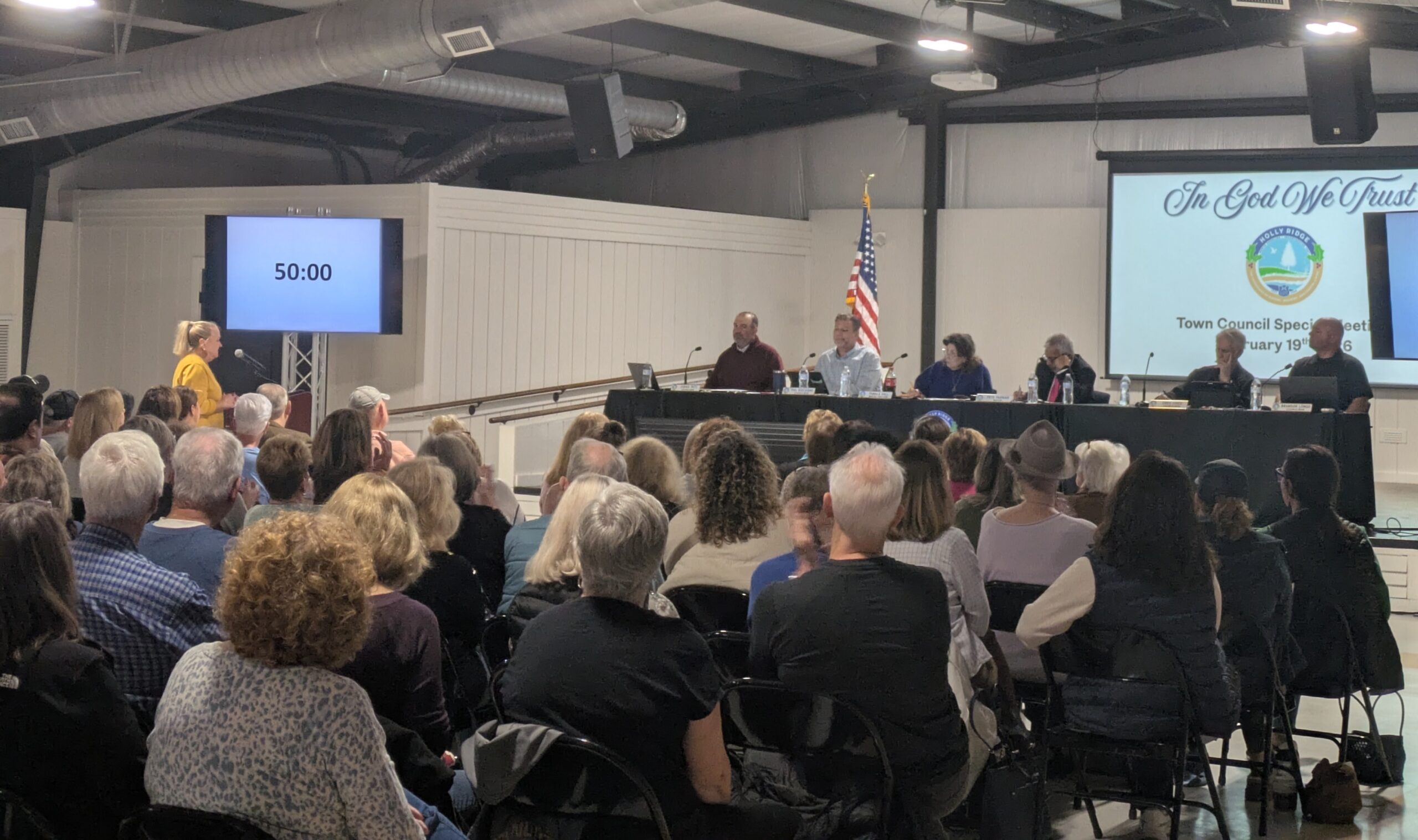
HOLLY RIDGE — Located on the border of Pender County, the town of Holly Ridge is on its way to doubling in population after a heated council meeting led to the annexation of roughly 1,200 acres into its borders. This could potentially bring forth an estimated 7,000 more people into a now-approved mixed-use development, the largest the town has seen to date.
Council voted 3-2 on four separate measures to approve what’s known as “Project Ajax,” a 1,500-acre development spanning the Onslow-Pender county line on the former Camp Davis site along the U.S. Highway 17 corridor. Because the land is within municipal limits, the project will fall under Holly Ridge’s zoning and inspection authority.
Town officials estimate it will be at least two to three years before the first residences are ready for move-in.
READ MORE: With financial safeguards in place, $10.8M Hampstead library contract inked
ALSO: Development moratorium discussed among Pender County commissioners
Holly Ridge council members Brandon Longo and Joshua Patti voted in opposition. The split vote followed a lengthy public hearing where an overflow crowd of around 200 residents challenged the board on its breadth of infrastructure, public safety, the environment, and school capacity to fit such a large project. Half the audience exited the building in a wave of frustration after the first vote passed.
Specifically, council approved multiple measures: the voluntary annexation of 1,226 acres from Onslow County and Pender County into Holly Ridge, a reclassification of the site to a Planned Unit Development, the master concept plan, and a development agreement granting Holly Ridge Development Group, LLC a 30-year vested rights period.
Project Ajax is a multi-phase master-planned community serving as the centerpiece of Holly Ridge’s long-term growth plan. Once fully realized, the project will introduce at most 2,750 residential units — a mix of single-family homes, townhomes, and multi-family apartments — alongside 64 acres of commercial space. The development is split between Onslow and Pender counties, with 1,295 acres and 1,950 residential units in the former and 205 acres and 800 residential units to be situated in Pender.
“I’m not here telling you how to do your job because I sit on that side of the table and I know how difficult it is,” Pender County Vice Chair Commissioner Brad George told the council.
However, George was critical of the project, particularly its impact on Pender County schools and infrastructure. He argued that Holly Ridge may receive municipal tax revenue, but Pender County taxpayers will bear responsibility for educating new students and providing emergency services to Project Ajax homes.
The residential development is designed to support the neighboring Camp Davis Industrial Park, a 700-acre logistics and manufacturing hub housing tenants like Onslow Bay Boatworks and Gulfstream Steel & Supply. By providing nearby housing, proponents argue the development ensures the CDIP workforce has a place to live. Phase III of the CDIP is currently underway, with plans to add 417 buildable acres for industrial use.
The proposal for the project was first brought to town council in August 2025 when it approved a resolution to consider annexing the Onslow and Pender county land. The proposal has undergone multiple technical reviews, workshops, and public hearings resulting in concessions such as dedicating land on site for a potential future school.
During Thursday’s discussion, Mayor Pro Tem Pamala Hall and council member Phil Misciagno argued the project is vital for the town’s financial health. Throughout discussions on the development, council members have stated the town cannot continue to use reserved funds to balance annual budgets. By annexing the site, they contend the town can secure a projected $1.54 million in annual tax revenue without increasing the current $0.34 tax rate — which has remained below 40 cents for more than a decade.
Misciagno noted if the town declined the annexation, the development would likely move forward under Pender and Onslow county jurisdiction anyway, leaving Holly Ridge with traffic and school impacts but none of the tax revenue or land-use control.
“Families want to move to eastern North Carolina,” Misciagno said, noting Holly Ridge has grown 20% in the last three years. “The only thing that fixes [housing affordability] is supply and demand, whether we like it or not.”
By annexing now, Misciagno argued, the town captures an estimated $300,000 in property taxes as early as year two from the undeveloped land alone. That’s before the first residences are even completed, which would be in late 2027 or early 2028.
Expanding on the potential economic benefit, Hall linked the project’s residential density to the town’s ability to attract local commerce, with a desire to see more small businesses as a result of Project Ajax. She noted many residents currently travel outside of town for basic shopping and contended that adding 2,750 households would give local businesses a reason to open in Holly Ridge.
“My fundamental belief is that inside Holly Ridge, we don’t have the mom and pops,” Hall said. “We don’t have people that are moving here. They’re going into the neighborhoods, but they’re not coming into town and building shops for even a hair salon or a cafe. I mean, they’re just not building the things that would make us be more of a town.”
The 64 acres slated for commercial space as part of Project Ajax could help add more small businesses as it is intended for mixed-use development, specifically a mix of retail storefronts, professional offices, and potentially a grocery store.
The environment in the room remained volatile throughout the meeting. As Hall attempted to outline her position, she was repeatedly met with groans and verbal interruptions from the crowd, one yelling, “You’re f***ing out of touch with reality.”
“It’s obviously not a good idea to express my opinion,” Hall told the audience after interruption. “But I am telling you where I’m coming from and I’ve heard all of your concerns.”
Countering the optimism of fellow council members, Longo and Patti said the proposal has moved too quickly and the town’s existing infrastructure is too strained to handle growth of this magnitude.
Longo, drawing on his background in public safety as Holly Ridge Fire Chief, warned fire services are already compromised by a lack of water volume. He recalled a recent fire where crews had to shut down hose lines after just 30 minutes because the town’s supply was effectively drained. The town, which gets its water from the Onslow Water and Sewer Authority, has struggled with low water pressure due to an aging pipe network. For Longo, adding thousands of new homes while the current water system cannot support existing buildings is a risk he didn’t want to take.
“We are already applying rural water supply techniques in town,” Longo said, explaining firefighters are forced to shuttle water via tankers rather than relying on hydrants. “In large fire events, we can’t even count on them.”
Patti echoed the concerns, sharing a personal account of waiting 30 minutes for an ambulance during a medical emergency at his home while his wife pleaded with dispatchers. He argued annexing the 1,500 acres would further strain response times he said have been “lacking for years.”
“We cannot depend on mutual aid,” Patti said, noting the town often relies on neighboring departments for ladder trucks and ambulances. “What if they aren’t available? I’ve not found one case where annexation has benefited the people that live here now. Slow down, and let’s take care of you [the residents] first.”
The atmosphere at the Holly Ridge Community Center was heavy with opposition and not a single member of the public took to the podium to speak in favor of the project. Instead, there were criticisms during the public hearing over the scale of the development, the long-term contract with the developer, environmental and public safety, and school capacity.
The primary point of contention for the public was the proposed development agreement, which originally granted the developer a 50-year vested rights period. This would effectively lock in the town’s current zoning and land-use rules for the next half-century for the project. This shields the project from any future regulatory changes — such as new restrictions on building height, housing density, or buffers — future town councils might attempt to pass.
“I implore you to think about future generations,” resident Julie Taylor, who did approach the lectern, told the board. “This is not just about my next 20 years, your next 20 years, 10 years, 40 years, however many years any of us have left. But it is about what comes in the fifty years beyond that.”
Town staff mentioned during the meeting that they had been speaking with the developer, Michael Rokoski, about amending the vested right period to 30 years instead of 50. Lowering the period to 30 years means the town can apply new laws and regulations to the project 20 years sooner.
Rokoski agreed to the change.
Still, residents like Bud Taylor wanted the contract to include more guardrails for the town, like performance-based milestones.
“I don’t want to argue law with council, but this is a contract and it is binding,” Taylor said, admitting 30 years was better than 50.
Town attorney Corrie Faith Lee said the agreement does contain a provision requiring the town manager to conduct an annual review of the development’s compliance and progress. Taylor, however, remained skeptical a single person could effectively police a development of this size.
“It doesn’t instill a lot of confidence that, respectfully, whatever town manager is in there is going to be able to perform those fiscal examinations in a way that protects the town moving forward fiscally,” Taylor said.
The debate continued, specifically on the impact of the development on the local school system. Pender County Vice Chair George, speaking at the meeting in his individual capacity, characterized the 800 units slated for the Pender side of the line as a looming burden for a school district already at its breaking point.
“The annexed part that is in Pender County will create more children for our over-crowded school system already,” George told the council.
He explained students from the Pender side of the development would be districted for Surf City Middle School and Surf City Elementary, but added “those schools are already overcrowded.”
As of late 2025, Surf City Middle School had about 750 students enrolled and can hold 664. Surf City Elementary has roughly 815 students and can hold 774.
Pender County is currently advancing the J.H. Lea K-8 school project in Hampstead to provide some relief, planned to house 2,300 students upon opening in 2027. Redistricting is expected once the new school opens, which would shift existing students into the new building to ease overcrowding. George’s concern is that the 800 new units in Project Ajax will effectively claim those new seats, preventing existing students at Surf City Middle and Elementary from seeing any real relief.
Beyond school capacity and the developer agreement, many residents raised alarms over the site’s environmental history. Project Ajax would be built atop the former Camp Davis military grounds, which contains an inactive, pre-regulatory landfill and a known PFAS contamination zone identified in federal records as Site 111.
The developer’s 2024 Phase I environmental report for the project — conducted by Southern Environmental Group, Inc. — concluded there were no “recognized environmental conditions,” within the Project Ajax boundary. However, residents pointed to the site’s status in cleanup programs as proof of a deeper problem.
Site 111 is currently under a PFAS remedial investigation by the Camp Lejeune Restoration Advisory Board after PFOS and PFOA levels above 70 parts per trillion were found in the shallow groundwater. These “forever chemicals” historically used in firefighting foam, are known by the Environmental Protection Agency to persist in the environment. More so, they’re linked to various health risks including developmental effects in children and cancers.
Resident Taren Carranza contended the Phase I report failed to account for actual soil and groundwater contamination. Because SEGi did not recommend a Phase II assessment, no physical samples were ever taken to confirm whether hazardous materials have leached into the soil or migrated from the PFAS site.
“I’m simply asking that the environmental verification occur before the responsibility is assumed,” Carranza told council.
Other residents like Christine Englebert gave a more stark warning to council regarding potential contamination on site.
“If you build on contaminated land, blood is going to be on all of your hands,” Englebert said. “I know who voted yes and I know who voted no, and it will be in your heart and in your head when those little babies that grow up over there get cancer, God forbid.”
Under North Carolina law, sellers must disclose known material facts about a property. Without documented contamination within the development boundary, additional disclosure obligations may not be triggered.
With council’s approval, the developer must now secure permits from the North Carolina Department of Environmental Quality and the Department of Transportation before construction can begin.
Have tips or suggestions for Charlie Fossen? Email [email protected]
At Port City Daily, we aim to keep locals informed on top-of-mind news facing the tri-county region. To support our work and help us reach more people in 2026, please, consider helping one of two ways: Subscribe here or make a one-time contribution here.
We appreciate your ongoing support.
