


CAROLINA BEACH — “How do I get people down to my business in December?” Tropical restaurant owner Roger Monk asked.
That was his impetus to pitch a social district for Carolina Beach. The restaurateur, joined by Todd Luckadoo and Tom Hayes of Carolina Beach Bar and Grill and Havana’s respectively, presented the idea to town council at its Tuesday meeting.
READ MORE: Town of Carolina Beach hit in cyberattack amounting to nearly $500K loss
Social districts are mapped-out areas where participants can open-carry alcoholic beverages purchased from participating businesses within a certain footprint; no outside alcohol is allowed. A North Carolina law passed in 2021, allowing social districts statewide and to date around 68 exist, including in downtown Wilmington’s Brooklyn Arts District. The social district passed last fall as the first of its kind in New Hanover County and takes place twice a month on Saturdays.
However, Monk pointed out none of the county’s beach towns have yet proposed a social district. He said he reached out to business owners in Wilmington’s BAD, including Tara English of Brooklyn Cafe and Wes Westlye of Commodore Pub and Kitchen, who both helped lead the charge for Wilmington’s district. The BAD hosted a three-day trial run last February, with many of its 20 participating businesses reporting triple sales, some even suggesting they had their best sales ever, despite it being the shoulder season. BAD social districts take place noon to 5 p.m. on the first and third Saturdays only, avoiding nighttime hours, which already brings in bar and restaurant patrons.
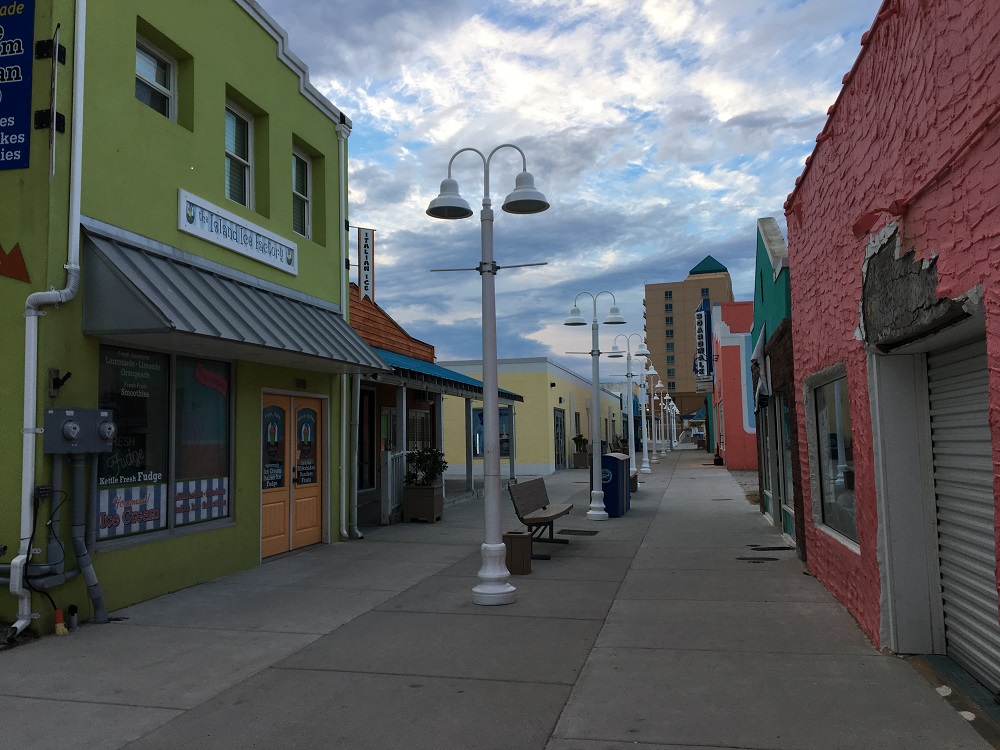
Monk proposed the CB social district to be set up in the central business district and Boardwalk from 10 a.m. to midnight daily. This would include from Lake Park Boulevard north to Hamlet Avenue south, the eastern portion of the Boardwalk to the western portion of Pelican Lane, extending to the area of businesses, including Seawitch, Nollie’s and Stoked.
Monk said it would be especially beneficial during the off-season, but he would like to see it in place for peak tourist season as well and particularly during events, such as Wednesday Bingo nights and June’s Beach Music Festival.
“The weekly fireworks is when people want to take drinks from Havana’s,” Hayes said, referring to Boardwalk Blast event featuring free music and a fireworks show every Thursday night from Memorial to Labor Day. “They won’t order another drink if they can’t because making the kids watch fireworks from Havana’s is not as nice as if you’re on the Boardwalk.”
During summertime, tourists already ask whether alcoholic beverages can be carried to the carnival rides, Monk detailed. Particularly, parents want to order a drink and watch over their children while they’re on the Ferris wheel or Cyclone.
“In one day, we had 78 requests,” he said, noting upon telling customers that drinks weren’t allowed outside of the restaurant and bar area, “probably about 68% said thank you and walked away — so that means no sales.”
He iterated his goal isn’t to change the dynamic of the Boardwalk from being family-friendly, as Carolina Beach is known for. But he believed responsible adults should be allowed to enjoy a beverage when watching concerts at the gazebo or seeing kites fly over the shoreline during November’s Kite Festival.
“After Labor Day, when it gets cooler, we are missing constant foot traffic,” Monk added. “This would give people an incentive to come down.”
He hoped staff and council would consider what a social district process may look like in Carolina Beach, acknowledging three concerns the business owners already weighed: safety, signage and waste management. They conceded costs may be involved to add more trash receptacles — particularly at the perimeter of the social zone line, as people are exiting the district and discarding cups.
A souvenir cup delineating it as bought in the CB social district could help prevent more waste; however, that option would have to be researched more per the expense it would cost businesses.
Signage would be needed as well to demark social district boundaries and could include a color-coded system that indicates which businesses are participants in the district. Monk said he studied how Raleigh handles its social district and suggested a green sign or sticker on the establishment could show social district drinks are welcome, such as inside retail businesses.
Yellow stickers would indicate drinks are served, such as at bars or restaurants, but people can’t bring in alcohol purchased from another establishment due to ALE regulations; they can purchase one from the business and carry it out into the permitted public rights-of way.
“And our bartenders are well-trained with ALE and know how to pinpoint if outside drinks are being brought in,” Monk said.
A red denotation would mean the business is not a participant.
Carolina Beach council member Jay Healy, who admitted to having enjoyed visits to other social districts before, wanted to ensure all of the how-to’s were in place. Having business-owners’ buy-in was imperative and the councilor thought the town should consider public meetings to garner feedback from everyone affected.
Monk added Raleigh requires the district to gain 65% or 75% business involvement before approval and agreed input from others was vital.
“We need a process in place and to ensure we do not have a drunk fest,” he said, but informed that none of the trial runs in 68 districts statewide were rejected.
During the meeting’s public comment, Carolina Beach resident Michelle Alberta spoke about council member Deb LeCompte holding workshops a few years ago with Boardwalk business owners and residents about pros and cons of a social district.
“After each meeting we came up with more questions,” Alberta said, adding people weren’t convinced it was good or bad.
She wasn’t against the concept Tuesday, either, but thought hosting the district only on certain nights or during events would be better than daily.
Head of the CB Trash Walkers, which meets one day a week and has gathered more than 20,000 pounds of trash in the last five years, Alberta was concerned litter would be potentially left behind.
“A lot of us at the Boardwalk have worked hard to make it cleaner and family-friendly, so I want to understand that impact,” she said.
Alberta also was concerned with policing and law enforcement needs, which she said in Carolina Beach is “maxed out.”
Monk stated earlier in the meeting he didn’t anticipate more officers would have to man a social district; Wilmington’s BAD social district also doesn’t put more resources on officers. In fact, it reported to Wilmington City Council last year they didn’t have arrests or complaints, except for parking crowding nearby neighborhoods.
Luckadoo thought a CB social district may even provide more transparency for patrolling officers: “As far as underage drinking — this could be a quick eye test of who is drinking in cups that are marked.”
Monk added that currently people bring coolers down to the area and Yeti cups are not always “full of Gatorade.”
“It has to be tight,” Healy said, desiring a full understanding of how a social district would be managed and all resources needed.
Council member Vincent Losito wanted to see it become a “controlled environment” that did not cause “mass confusion” to tourists.
Their colleague, Wayne Rouse, responded to Healy there would always be some “trial and error” regardless of the amount of planning done.
“Carolina Beach is different than Wilmington, than Monroe,” he said. “But the great thing for a trial run is, if it doesn’t work and everyone says this is a nightmare, we shut it down.”
Monk hoped to see a trial take place during the Steve Haydu Lo Tide Run happening mid-March. The St. Patrick’s Day-themed 5K and 10K, with proceeds benefiting cancer patients, brings in around 2,500 or so people to the beach annually. Though Monk also suggested the height of summer and Memorial Day weekend as other options.
LeCompte was in favor of “getting the ball rolling” sooner rather than later, but Healy thought staff should take its time to understand the ins and outs thoroughly. Mayor Lynn Barbee indicated he had little knowledge on how a social district should work and agreed vetting an initiative of this caliber first was important in order to not “screw it up.”
Town Manager Bruce Oakley told council that staff would start researching and preparing ideas for consideration; no date was put forth as to when the social district may return for discussion.
At Port City Daily, we aim to keep locals informed on top-of-mind news facing the tri-county region. To support our work and help us reach more people in 2026, please, consider helping one of two ways: Subscribe here or make a one-time contribution here.
We appreciate your ongoing support.
