


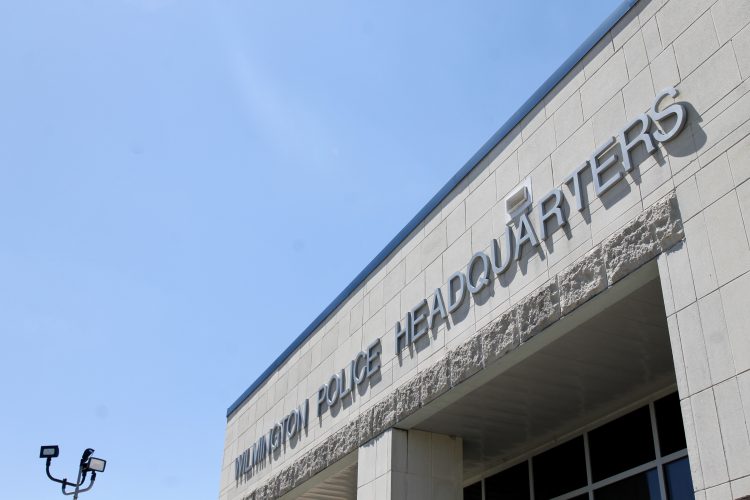
WILMINGTON — A federal judge has dismissed a lawsuit brought by Val D’Auvray II against the City of Wilmington and several police officers, ending a legal battle over the 2022 death of his son.
In a ruling issued Dec. 29, U.S. District Judge Louise Flanagan acknowledged the facts surrounding the Wilmington Police Department investigation were “concerning and disheartening.” However, she ultimately ruled a combination of state immunity laws and federal legal standards barred the case from reaching a jury.
READ MORE: Man files negligence suit against WPD, City of Wilmington in son’s death investigation
CATCH UP: Family of man found dead at TRU Colors wants answers
The lawsuit, filed by D’Auvray in March 2025, sought to hold the city and Wilmington Police Department officers accountable for negligence in the investigation into the death of his son, Val Flor D’Auvray III. D’Auvray alleged the department botched the investigation by failing to enter his son into the missing persons database in a timely manner and mishandled a face-to-face encounter with him just 24 hours before his body was found.
City of Wilmington was named as a defendant and contended a lack of adequate training and oversight within the police department created a culture where such procedural failures were allowed to happen.
D’Auvray sued for negligence under state law and violations of the 14th Amendment under federal law. He was seeking compensatory damages, but emphasized accountability was his primary goal.
“My motive was for the police to do the right thing, not to close the case until it was final,” he told Port City Daily after the ruling. “To not lie, not to cover up, just to be able to have transparency on what was going on and what was done.”
The almost four-year ordeal began on April 2, 2022 as D’Auvray’s 21-year-old son left a hospital detox program. After 10 days without contact, D’Auvray filed a missing persons report with the WPD on April 12.
Five days after the report should have been in the system, on April 17, D’Auvray’s son had a chance encounter with officers responding to a trespassing call at an assisted living facility. Officers did not realize the man they were checking on was reported missing. The following morning, April 18, Val Flor D’Auvray III was discovered deceased at the site of the former TRU Colors Brewery on Greenfield Street.
While WPD’s own internal investigators admitted officers failed to follow procedure — including failing to file a missing persons report while Val III was still alive and not checking the missing persons database during their encounter with him at the assisted living facility — Flanagan ruled the officer’s failures did not legally equate to a violation of constitutional rights or malice under North Carolina law.
State statute maintains local governments are generally immune from being sued for negligence, known as governmental immunity. A city only loses this shield if it waives immunity by purchasing liability insurance to cover a specific claim, such as an auto accident involving a city vehicle or a slip-and-fall on city property.
However, as Judge Flanagan noted, Wilmington’s insurance policy contains a “non-waiver” provision, which states insurance will not cover any claim for which the city is already immune under state law.
The individual WPD officers named in the suit — William Ostrosky and Jameson Hutchins — were protected by public official immunity. Under North Carolina law, a public official cannot be held liable for actions taken within the scope of their duties unless a plaintiff proves they acted with malice — showing the officers had a “wicked purpose” or a deliberate intent to harm.
D’Auvray and his legal team contended the department’s failure to file the missing persons report, mishandling the encounter with his son the day before his body was found, and the “misleading” information given to his family constituted malice. However, Judge Flanagan determined the actions did not meet the high legal bar set.
Even though the officers may have shown “reckless indifference” to his son’s safety or violated internal police policy, the court found there was no evidence showing actual “intent to injure.”
“To me, there was malicious intent not to allow me to see the body cam videos,” D’Auvray said.
While the WPD initially denied D’Auvray’s request to view the footage, he eventually obtained a court order to see officer body cam video of the April 17 encounter. The footage allegedly contradicted initial accounts of the encounter with his son provided by officers, who characterized the incident as a trespassing response involving an unstable and shirtless individual. Instead, it showed his son was clothed and in a visible state of distress, believing he was being chased. D’Auvray contends this information was purposefully withheld from the family.
“After lying about the whole episode completely … how is that not malicious? It’s not malicious in that, ‘Oh, there was no harm, no foul’? My son winds up dead when he could have possibly been saved,” D’Auvray said.
WPD reports later sustained D’Auvray’s complaints regarding the officers’ failure to properly document the encounter. Specifically, investigators found officers failed to check for an active missing persons report or file a “General Offense” report for the trespassing call.
The judge’s ruling effectively split the case into two parts based on the court’s authority.
First, the judge addressed the claims involving constitutional rights — specifically the argument that the city violated the 14th Amendment by failing to properly train its officers. Judge Flanagan dismissed constitutional claims for “failure to state a claim upon which relief can be granted.” This means the facts as presented did not prove a constitutional violation and, as a result, the court found no legal basis to move forward in federal court.
Second, the state-level negligence claims against the city were dismissed “without prejudice.” This is not a ruling on whether the city was right or wrong. Instead, Judge Flanagan decided that because the federal constitutional issues were over, federal court no longer had the authority to hear the state-level negligence issues.
Under federal court rules, there is a 30-day window to file a notice of appeal to challenge Judge Flanagan’s dismissal of the federal claims. D’Auvray indicated he was not yet sure whether he intended to pursue an appeal.
As the decision potentially marks the end of the case, D’Auvray reflected on the outcome, disillusioned by the ruling. He said the suit’s dismissal feels like confirmation the legal system is designed to shield those in positions of authority from accountability.
“You try and fight for what’s right and you get nowhere,” D’Auvray said. “All we were asking for was to do the right thing. You know, one of my sons said that you’re just ignorant if you don’t think the police are going to lie and cover up. I really thought the opposite in the beginning. When things started not adding up and everything, you would have to be a fool to swallow what they were telling me.”
Have tips for Charlie Fossen? Email [email protected]
At Port City Daily, we aim to keep locals informed on top-of-mind news facing the tri-county region. To support our work and help us reach more people in 2026, please, consider helping one of two ways: Subscribe here or make a one-time contribution here.
We appreciate your ongoing support.
