


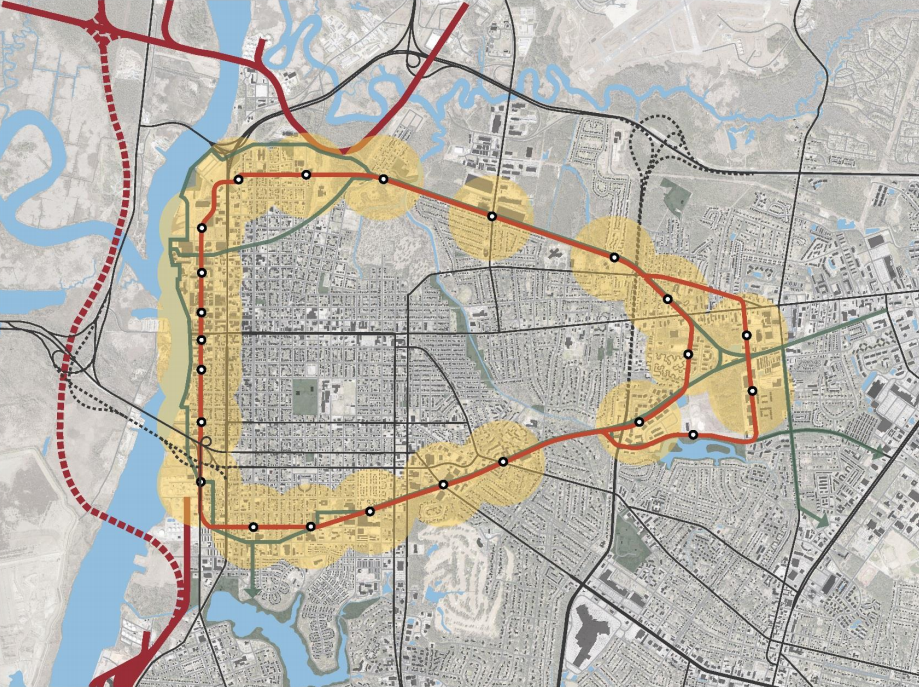
WILMINGTON — This week City Council will vote to approve a firm to study the financial feasibility of the long-planned rail realignment project, which could cost as much as $1 billion and would shift freight rail across the Cape Fear and repurpose rail lines in Wilmington as a light passenger-rail service.
Read more: This ambitious railway plan could reshape Wilmington. It could also cost a billion dollars
The $115,000 contract with Strategic Finance & Marketing Consultants, Inc. (doing business as Strategic Rail Finance) is being recommended after staff received six responses to an early-June request for proposals. According to state records, the company is based in Pennsylvania and incorporated in North Carolina in July. The city’s selection committee, including Director of Rail Realignment Aubrey Parsley, Director of Finance Jennifer Maready, and a deputy city manager, shortlisted four proposals for interviews and then selected Strategic Rail Finance as the most qualified.
The contract is expected to last six to eight months but will be continued as long as necessary. Strategic Rail will conduct an Economic Feasibility Study with the goal of investigating a range of viable options for funding, ownership, operation, and maintenance for the Rail Realignment Project.
According to the city, funding for the contract is available, and the contract vote has a companion ordinance to move necessary funding to a special fund.
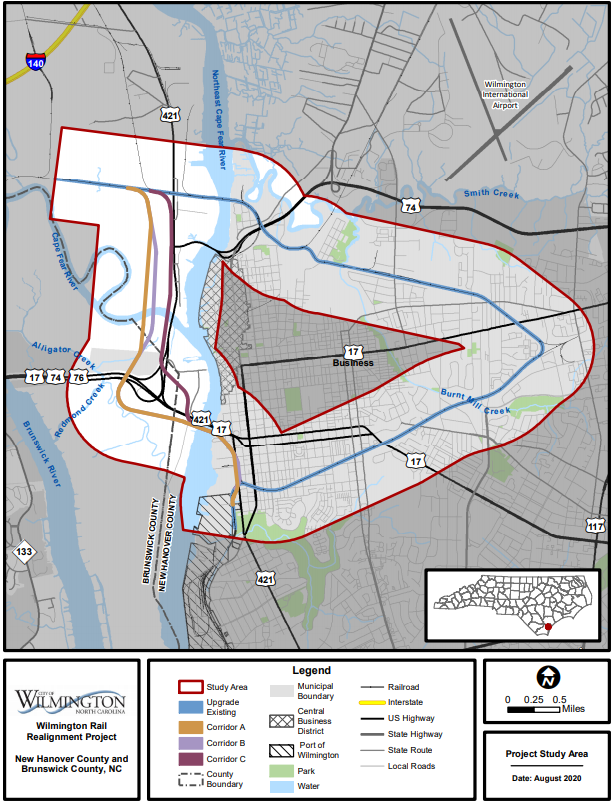
The city has also taken other recent steps to move the project forward.
In June, the city approved a $2.5 million engineering contract with AECOM Technical Services of North Carolina, Inc. to perform engineering for the project, along with environmental and historic (i.e. protected historic areas and buildings) reviews. The environmental review, in particular, is an important step for any large-scale infrastructure project. Funding for the engineering contract comes from a federal grant with a state contribution.
Cost estimates for the rail realignment have varied considerably over the last several years, and includes factors like right-of-way acquisition, environmental mitigation, and whether a new rail line over the Cape Fear is included in a vehicular transportation project or not (currently, one of four concepts for a new Cape Fear Memorial bridge includes a rail line).
Another major factor is how many public and private stakeholders will get on board. Several counties, including Pender, New Hanover, Brunswick, and Columbus, along with the City of Wilmington, Belville, Navassa, Leland, the NCDOT, and Federal Railroad Administration could all be involved on the public side. CSX, which owns the rail loop in Wilmington, would have to be at the table, but other private interests might also be involved.
