



WILMINGTON — Wait staff everywhere know, it’s all fun and games until it comes time to bring out the check. It’s no easy task, especially if the bill is for a billion dollars.
“That’s billion, with a ‘b,’” Laura Padgett said. “The number definitely strikes people.”
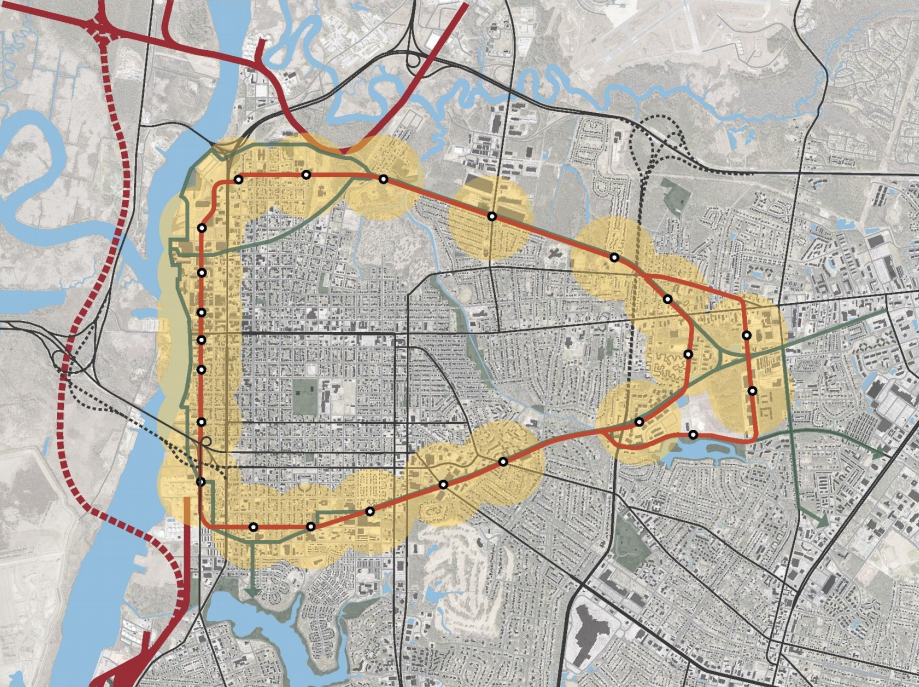
Padgett, formerly the longest-serving member of Wilmington’s City Council, heads the Mayor’s Task Force of Rail Realignment. It is one of the most – if not the most – ambitious capital projects in the city’s history: a plan to relocate Wilmington’s freight rail system out of the city, with a price tag of between $500 million and $1 billion. That also includes a plan to re-purpose the tracks to build a citywide street car system.
Defining the problem
It’s a complicated plan, with a lot of moving pieces (you can read Padgett’s presentation on it, here). At the heart of the program is both a problem and an opportunity. Right now, freight rail runs from Navassa, over the Northeast Cape Fear River, and makes a long loop around the city, cutting through the south side back towards the Port of Wilmington. As the crow flies, it is a few short miles between the Port and Pender County Industrial Park and northwestern New Hanover’s industrial businesses along Highway 421.

On the current rail-line it takes four hours.
“CSX limits its engineers to 10 miles per hour over movable bridges, and at the eastern curve of the track, it’s a five-mile-per-hour turn. It can block traffic for 10, 15 or 20 minutes at a time,” Padgett said.
That’s not just inconvenient for drivers and businesses moving freight in and out of the port. CSX freight lines cross the major routes to New Hanover Regional Medical Center. A derailment – or even a minor slowdown – can cut off two thirds of the county from the hospital, according to Padgett.
A proposed solution
The proposed solution? Building a new rail line – and a new rail bridge across the Cape Fear River – that would connect the Port directly to CSX’s rail line in Navassa, the Davis rail yard.
Construction won’t be easy. Facing some of the same issues as the proposed Cape Fear Crossing bridge, environmental easements and right-of-way concerns have been raised. In fact, while there could be some benefits to pairing a rail-and-traffic bridge, Padgett said tying rail relocation to another project – like the Cape Fear Crossing – would “significantly slow it down, or just plain kill it.”
Perhaps the most striking thing about the plan is that actually seems doable.
“There are people in other cities, in other countries, and they’ve accomplished projects like this. It’s really quite amazing when people put their heads down and get it done. There are a lot of variables, and a lot we still need to know, but we have a project that’s buildable,” Padgett said.
“But,” she added, “the price tag is huge.”
What’s driving the cost?
Environmental concerns drive part of price tag; elevating a proposed railway over the wetlands on Eagle Island – between the Port and the Davis yard, will add hundreds of millions in cost, according to Padgett. Another issue is the field of unknowns when it comes to building the trolley system. The budget has a 40% contingency built into it; it is an attempt to keep the budget realistic in the face of the complexity of the project.
What it comes down to, Padgett said, is the result of a feasibility study currently underway. The study was original due in April, and the rail task force had planned on making it public in May. It’s still working out the details of the plan, and Padgett hopes to have those details in hand for a June 6th meeting.
“We’ll have more answer then, but part of the problem is, this project opens up a lot of opportunity for expansion and new businesses, but it’s hard to put on paper – it’s hard to quantify the benefits we’d hope to see,” Padgett said.
Here are the best – and worst – case scenarios.
The best case scenario is, again, complicated. A lot of things have to go right. If they do, Padgett said “this will be the most transformative project the city has seen in a long, long time.”
Financially, the best case scenario is that the project comes in at the low end of the budget, under $500 million. Padgett hopes private investment of $100-150 million could bring the project well into the budget range of state and federal Departments of Transportation. The theory, according to Padgett, is that that CSX’s Davis rail yard in Navassa would see increased business; this might entice the company to help invest in a relocated rail-line.
The benefits
The task force hopes that the more efficient – and less expensive – rail system brings new businesses to the Pender County Industrial Park and also New Hanover County along 421. The same circuitousness that makes the current CSX rail-line problematic for freight would make it ideal for mass transportation; Padgett said the city would consider entering into a long-term lease of the old CSX rail, turning the lines into a street-car loop around the Wilmington area (this proposal is not part of the estimated $500 million – $1 billion cost of relocating the railway to the Port).
“Eventually you could have sleek street cars a la Amsterdam or Copenhagen,” Padgett said. “But we’d start simple, to get people used to the idea of taking rail travel.”

Eventually, the further unused CSX rail could be used to connect to cities to the north, as well as Leland.
“CSX runs a lot of trains at night and they’ve told us that they share with commuter trains in other cities; a service line to Leland would definitely be possible. Train service to other cities could follow. It could fundamentally change the region for the better,” Padgett said.
An expensive gamble
Then there’s the worst-case scenario, which is much simpler.
“Essentially, the worst case scenario is that we spend a billion dollars and nothing changes,” Padgett said. She added that the risks, in terms of economic stagnation and traffic congestion are just as extreme.
If the project were completed at the cost of a billion dollars and did not bring in more industrial traffic, it could be a disaster for the area. Still, Padgett said everyone involved at the local level is on board.
“We’ve been talking to people – a lot of people, thousands of people – for a long time. We’ve heard the worst case scenarios. We wanted to; we wanted to hear the bad news first. But we’re ready to move forward. The region is growing – we’ve got more people and more cars. We need to do something ambitious to make that growth possible and sustainable.”
Look for more information ahead of the June 6 Wilmington City Council meeting.
