


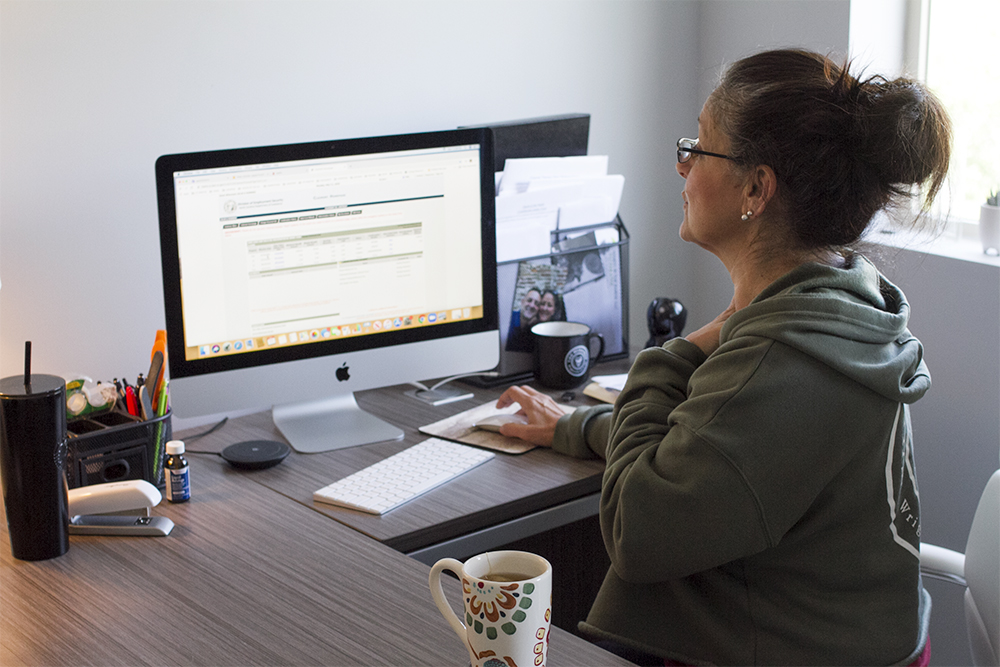
WILMINGTON — By noon Monday, Julie Romero had placed her 98th call of the day to North Carolina’s Department of Employment Security office.
She scrolled through her phone, counting the calls that log the daily routine she’s found herself in since late March. Like most days, no one had yet picked up the phone. An automated message informs her all agents are busy helping other callers. Every now and then, she said a real person will call her back, only able to address PIN and password issues. “Then they transfer you, and the call drops,” she said. “Every time.”
Related: ‘Non-essential’ Part I: Covid-19 hit them early, but help lagged behind [Free read]
A filled-out, stampless envelope sat on her desk addressed to “Landlord.” It contained a check for $1,520 — enough to cover her business’s rent for May, 11 days late.
“Once this clears I’ll have $176 to my name,” she said.
Romero owns a microbusiness, Hands in the Sands, where she practices massage and bodywork therapies off Oleander Drive in Wilmington. Employing only herself, Romero files as an “S corp,” under the advice of her accountant, she said. Because she doesn’t collect a paycheck, her business is ineligible for a Paycheck Protection Program loan since she has no payroll to cover.
“I’m afraid I’m the one who’s going to fall through the cracks. And who’s going to care? I’m a microbusiness with one person. If Hands in the Sands goes under, the Wilmington economy will be OK. And it will. But I won’t be,” she said, explaining her frustration and sense of helplessness.
“I just feel like there’s so many of us that are going to fall through the cracks,” she said. “I feel desperate.”
Unemployment
The day after Governor Roy Cooper issued Executive Order 120 that closed massage practices, Romero filed for unemployment. “I filed knowing full well I wasn’t going to be eligible but I thought, get yourself in there,” she said.
She was right. When the state finally opened up claims to non-W2 employees on April 24, claimants were required to have already submitted an unemployment claim through the pre-existing system and been rejected before being processed as a self-employed individual. Theoretically, this would place Romero at the top of the queue.
A retired public school teacher, Romero receives a $412 annuity payment from the state of Pennsylvania at the end of every month. She suspects her disclosure of this payment to DES has put her case on hold. Her claim is designated as “open” on the state’s website, with an eligible payment amount of $134 she has not yet received.
This figure is not random, she said. Across social media platforms, Romero said she has seen self-employed individuals have been designated this amount or $132, with $134 showing a $2 overpayment notice. “It’s not a coincidence,” Romero said. She received the one-time federal stimulus payment but has not yet received weekly $600 federal pandemic unemployment payments, which is administered through the state’s DES, over a month after it was supposed to be rolled out.
Wednesday, she said she made “a tiny bit of headway.” After spending 5 hours and 39 minutes on hold, a real person answered, she said. Romero then watched in real-time as the DES employee updated her start date on her dashboard and noticed her $134 payment update with a $2 overpayment notice. The woman on the other line told Romero she’d call her back next week, she said.
Dealing with DES has been her biggest frustration throughout the pandemic, she said. The department has received 1.2 million claims since mid-March, tripled its staff, as the nation faces the highest unemployment rate since the Great Depression.
“I know that they’ve been inundated. I know they’ve never seen anything like this before. But, I mean, it’s been six weeks now. They’ve got a call center with 250 reps and they thought that was going to do it?” she said.
“And I understand the people on the other end of the phone haven’t necessarily been doing this all their lives. So many of them are being thrown into the deep end and they’ve got to deal with all of us on the phone being angry,” she said. “But my greatest frustration is that the system is broken.”
Seven weeks in
Previously making ends meet between two full-time incomes, Romero and her husband can no longer cover living expenses. But he’s a fastidious shopper and already a germaphobe, she said, and she trusts him to make their remaining funds stretch at the grocery store. On her 7th week of no income coming into her business, Romero is in a bind.
“I don’t want to break down. When people reach out, I need to put this happy face on, ‘Everything’s going to be OK,’ but that’s not what I’m feeling inside,” she said. “I’m trying to keep that very zen, positive attitude that my clients are accustomed to but I’m not feeling it at all.”
The business recently moved into a location of its own after a previous space-sharing arrangement became unavailable. Romero spent money upfront to secure the new location, which Hands in the Sands has occupied since March. “I put myself in a $7,000 hole just making this move,” she said.
Before the closure, Hands in the Sands was booked solid, two weeks out. She said she’s ready to get back to work once the state enters “phase two,” allowing personal care services to reopen sometime after May 22, not just because she’s lost her income, but because he clients have close their massage therapist. Her work isn’t “fluffy,” she explained. It’s therapeutic, she said, with clients that see her weekly, biweekly, or monthly as part of their healthcare routine.
Once business returns, she said she’ll book clients one hour apart, instead of the pre-pandemic 15 minutes apart, to give her time to disinfect everything. It’ll make her days longer but will make all parties more comfortable, she said. “I feel like I can do — I can conduct my business and keep myself and my clients safe. With zero apprehension,” she said.
Handed a series of bad news and luck, Romero said she’s just looking for any glimmer of hope that says, “it’s on the way; help is coming,” she said.
“I don’t want anything for free. I just want to be whole again,” she said.
Send tips and comments to Johanna Ferebee Still at [email protected]
