


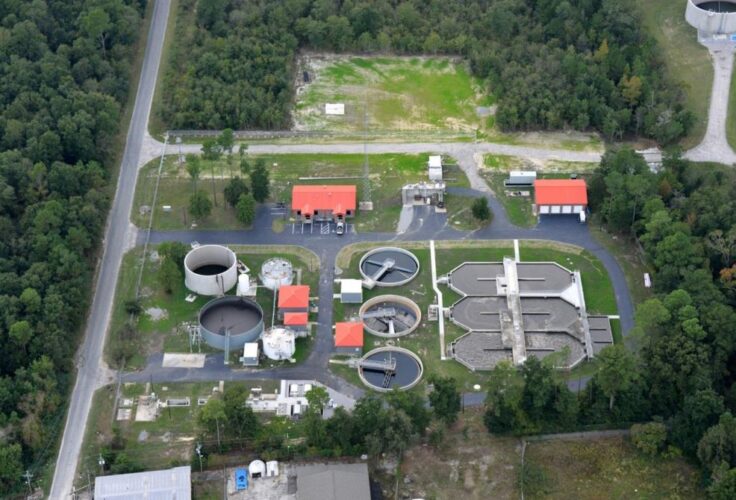
BRUNSWICK COUNTY — With Brunswick County wastewater plants exceeding capacity, new sewer permits are frozen under state law. Commissioners are now considering hundreds of millions of dollars in investments, with one plant’s expansion set to break ground in August 2027.
At a special meeting this week, Public Utilities Director John Nichols gave a presentation to commissioners about expanding its wastewater treatment plants, an endeavor that could cost between a quarter of a billion dollars and a billion dollars.
The Northeast Brunswick Regional Water Reclamation Facility in Navassa is currently closest to construction, having been agreed to already, and is expected to cost $173 million, with the funding split almost evenly between the county and public utility service provider H2GO since both entities share custody of the facilities.
READ MORE: Brunswick County hits sewer capacity snag under new state law, freezes permits
The county also plans to expand at least two plants in Supply and Shallotte and, if finances permit, the Ocean Isle Beach plant as well. There are three options for expansion size for all three, with estimated costs ranging from $290 million to $700 million.
However, the current proposals for the western and southern expansions do not accommodate commercial line extensions, so to factor in the developments, the county would need to expand beyond what it proposed to commissioners Oct. 19, depending on how much capacity commissioners want to allot non-residential projects.
The goal of the expansion is to make room for residential developments — built and unbuilt — slated to receive utility hookups. As it stands, prior to project completion, the county has overpromised its capacity.
According to Nichols’ report, the county’s allotment for residential developments for its western and southern portion exceeds capacity at 607%. The Navassa plant on the northeast of the county exceeds its capacity at 127%.
The numbers also include developments yet built because a 2023 state law mandates Brunswick County include unbuilt developments with utility hookup obligations as already in service. The North Carolina General Assembly wanted utilities to consider future demand, in order to be realistic about infrastructure limits.
The law states counties in the top 20% of fastest growing municipalities cannot go over 110%; they can exceed capacity up to 115% if there are expansion plans underway at treatment plants. Because all of Brunswick County’s plants exceed 115% capacity with anticipated developments added in, the North Carolina Department of Environmental Quality issued a freeze on issuing sewer permits at the start of 2026.
Port City Daily reached out to the county to ask how many applications for line extension permits have been submitted during the freeze but did not receive a response by press. The county can still approve developments, but it cannot obligate any hookups until they are underneath the statutory threshold, which would be accomplished by expansions.
The expansion of Navassa’s plant will bring down its capacity to 73%, according to Nichols, allowing for hookups to this facility.
The Navassa facility’s current capacity is 4.975 million gallons per day — about 6.3 million gallons per day have been promised to developers or are already connected. The expansion would raise that cap to 8.725 million gallons per day.
Nichols also presented commissioners with the options to alleviate inundation on the county’s western and southern infrastructure in Supply, Ocean Isle Beach and Shallotte. On the low end, estimated to cost $290 million, the county could expand the three facilities to increase capacity to 6.5 million gallons per day from its current 1.5 million. However, this would still have the county overpromising on utility hookups.
“According to the law, that would not allow line extension permits for development projects,” Nichols said.
Nichols suggested the plants’ capacities could go from 1.5 million gallons per day to either 9.5 million gallons per day or 15.5 million gallons per day with larger expansions; this would increase capacity by more than 500% to over 900%. Commissioners were torn between being cost effective and having capacity to accommodate future developments.
The 500% increase would provide just enough wastewater treatment to cover what already is permitted. The expansion to 9.5 million gallons per day is also a goal outlined in the county’s 2026-2027 capital improvement plan. This expansion level is expected to cost $440 million.
“You would have very limited amount of capacity to then allocate for new development, but it would at least meet your current permitted obligations,” Nichols said of the 9.5 million gallons per day.
The increase to 15.5 million gallons per day would allow future hookup applications to be accepted, which is expected to cost $700 million.
“One thing: When you start looking at adding 14 million gallons per day of capacity for Brunswick County, then affordability starts becoming an issue,” Nichols cautioned.
Commissioners asked about how this would affect ratepayers, but staff did not have a figure to present. The Navassa plant is being paid for in part with revenue bonds, sewer and water impact fees paid by developers and agreements with Leland, H2GO and Navassa.
However, Nichols also explained if the commissioners wanted to set aside capacity for commercial development, they would need to expand all facilities even more. For example, commissioners could choose to allot 1 million gallons per day to non-residential developments. The commissioners ultimately chose to factor this in, so Nichols said staff would return with another proposal to include how much commercial should be allotted.
Commission Chair Mike Forte asked if the county already had the land for the projects “today,” which Nichols explained staff were still assessing how much is needed. Though for the Navassa plant, he said the county is looking at land around the property.
He added the presentation assumes the National Pollutant Discharge Elimination System permit for the Navassa plant will be granted. The permits are needed for a facility discharging treated wastewater into surface waters like the Cape Fear River. Nichols expects to receive the permit in December, though it could change depending on the state’s timing.
Construction for Navassa’s expansion is expected to be completed in 2030, according to Nichols. A construction company will still need to be decided upon, completed through a request-for-proposal process. McKim & Creed, the engineering firm behind its design, were chosen in 2023.
Commissioner Pat Sykes also was concerned by projects being stalled, not only from the new law, but also from the county side of operations. Currently, there is no expiration for line extension permits or flow-tracking forms granted to developers. So a project approved years ago that has not begun construction is still counted as being serviced, per S.B. 673.
“We got projects here that are holding up capacity,” she said.
Sykes asked if it was possible to put a time limit on permits and forms to help projects move along. Doing so would discount expired applications and free up the wastewater plants’ capacity.
Nichols suggested a “sunset clause” or 90-day expiration on flow-tracking forms and a three-year expiration for line extension permits. Flow-tracking forms certify exactly how many gallons of wastewater a project will need and are required for developers to receive the line extension permit.
Nichols also explained commissioners have to decide whether staff should renegotiate what level of capacity each party wants and needs from the plant. Currently, of the 8.725 million gallons, Brunswick County has been allotted 3.025 million gallons per day and H2GO 5.7 million gallons per day. However, some commissioners did not want to decide how to divvy up the allotment for the Navassa facility without speaking with the company’s board.
“I’m not interested in changing something without talking to them,” Commissioner Frank Williams said.
Forte wasn’t comfortable making a decision because he also did not know what H2GO’s needs and usage were, nor how they operated.
The meeting also included discussion of how the county would handle wastewater management moving forward. Sykes and commissioner Randy Thompson championed the idea of ceasing development review when at capacity, though not all commissioners agreed, with Forte likening it to a moratorium.
Commissioners decided — sans a vote — that they would only really stop accepting flow-tracking forms. Further, because commercial and residential have different capacities, commercial developments could still be considered.
Staff plan to bring a policy draft to commissioners in either November or December, though no vote was taken nor was a decision made about which level of expansion to pursue in the west and south of the county.
At Port City Daily, we aim to keep locals informed on top-of-mind news facing the tri-county region. To support our work and help us reach more people in 2026, please, consider helping one of two ways: Subscribe here or make a one-time contribution here.
We appreciate your ongoing support.
