


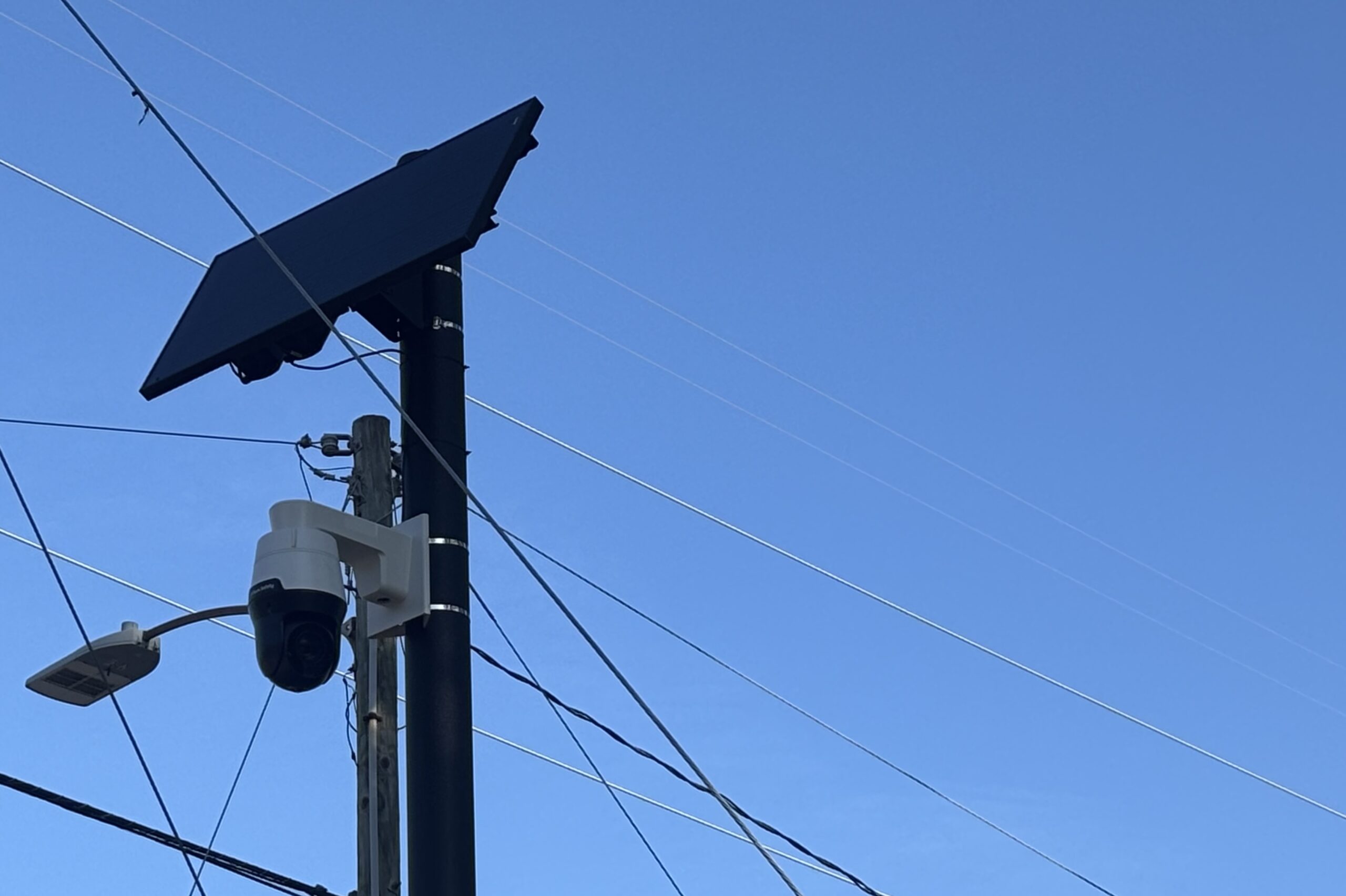
BRUNSWICK COUNTY — While Flock has been a hot topic among local governments — and continues to be in Brunswick County — one area that hasn’t been broached as much is its use in the private sector.
Approximately 51 ALPRs are placed across Brunswick County, according to DeFlock the USA. Representative for the Brunswick County Sheriff’s Office Emily Flax, told Port City Daily the sheriff’s office has access to 10 privately owned ALPRs.
Commissioner Randy Thompson brought up the private use at this week’s commissioner meeting and afterward told PCD he had been in contact with a homeowner’s association for Sea Trail Plantation — an approximately 2,000-acre community located in Sunset Beach. The community currently has two Flock cameras with four more coming.
READ MORE: Brunswick County paying for 8 Flock cameras but have 15 in use — new purchases paused
ALSO: Former Brunswick deputy indicted on charges for alleged Flock camera misuse
“I received a phone call directly from one of the HOAs in my district,” Thompson said. “They contacted me to discuss and let me know that they were acquiring additional flock cameras for their entrances so that they could provide that resource to local law enforcement and the sheriff’s office.”
Thompson was among commissioners who voted to pause all new future contracts last month on ALPRs in the county. While commissioners don’t have private property authority, Thompson worried about data-sharing capabilities between the private and public sector.
There was debate on whether the Sea Trail community could access law enforcement data. Board of Commissioners Chair Mike Forte said he was unaware private citizens could even purchase Flock cameras. Brunswick County Sheriff’s Office Attorney Glenn Emery said they could but clarified private citizens do not have access to the law-enforcement networks.
Thompson asked Emery for further explanation on what information private citizens can obtain, referencing a conversation he had with a woman in an HOA community that utilized Flock.
“The lady that I spoke with told me very clearly that she had access to the information,” Thompson said. “I’m trying to figure out what information can she see and what is she pulling up.”
While Emery was unsure how data-sharing works among two private entities with Flock cameras, he knows private citizens cannot access law-enforcement data.
“I’m certain that private owners do not have access to the law enforcement agency cameras throughout the state, here or throughout the country for that matter,” Emery said.
According to Flock, when an HOA uses the company’s cameras, only designated HOA users and admin can access the footage, as well as law enforcement but only if they are given permission by the HOA. Additionally, the HOA owns all footage and data from the cameras.
A representative for the Sea Trail Master Association — the governing body for the various homeowner’s associations at Sea Trail — did not answer Port City Daily about the community’s decision to share its network data with law enforcement, how the decision was made to implement Flock there, and who has authority over the technology by press. The community’s website indicates it utilizes Flock to add “a layer of security and peace of mind for everyone who lives, works, and visits Sea Trail,” particularly when it comes to locating vehicles that could be involved in theft, vandalism, or other criminal activity.
“My understanding is it’s getting more and more common for gated communities in particular, but any home owners, like these sort of sectioned offed communities to have them so they can see whose coming in and out of the neighborhood,” Emery told commissioners Monday.
Forte responded if he lived in a gated community he would not be upset to see cameras at entrances and exits.
“That’s why I’m paying to live in a gated community,” he said. “I wanna know who comes and goes.”
According to the gated Sea Trail Plantation’s Flock transparency portal, its cameras have detected 13,148 unique vehicles in the past 30 days. However, there have been zero searches — not including law enforcement — within the same time frame.
Sea Trail Plantation grants both the Brunswick County Sheriff’s Office and Sunset Beach Police Department access to its Flock system.
Flax said at least one case has been solved using a private Flock camera.
“During an investigation involving a stolen Featherlite enclosed trailer, ALPR technology captured a vehicle associated with the investigation towing the stolen trailer through Brunswick County,” Flax said. “ALPR helped identify a suspect and connect that individual to stolen property as part of a larger breaking-and-entering and larceny investigation.”
The investigation resulted in 32 felony charges and seven misdemeanor charges.
Sunset Beach Chief of Police Kenneth Klama told Port City Daily his department has used the Sea Trial neighborhood’s ALPRs during an active investigation but the search conducted did not render any results — meaning the vehicle the department was looking for did not pass those cameras.
“Similar to any other similar device, there must be a law enforcement purpose,” Klama added. “Simply because it is privately owned does not reduce the obligation of the agency to access the data for anything other than official business.”
Klama said searches the department makes on the Sea Trail cameras are included in the department audits.
While law enforcement’s use of Flock has regulations per North Carolina General Statute 20-183.30, there has yet to be a state regulation expressly addressing private citizen’s operation in North Carolina.’
Mark Williams, lawyer and founder of DeFlockILM, told Port City Daily he struggled with whether regulations should be in place for private use of Flock.
“The Constitution protects us from the government, not private entities,” Williams said. “But certainly citizens should have rights to sue for invasion of privacy, appropriation of likeness and other similar torts.”
House Bill 372, called the “Homed-based Business Fairness Act,” attempted to create guidelines for certain private associations’ use of ALPRs but the provision failed to make it into the final version of the legislation, signed into law in July.
The proposed requirements included homeowner’s associations needing to tell local law enforcement they had an intent to use an ALPR system 30 days before it went live, notify all lot or unit owners in the neighborhood 30-days prior to turning the cameras on, adopt a written policy for system use, and provide ongoing system access to local law enforcement.
When asked if the regulations proposed in the bill were appropriate or needed, Williams reiterated he was conflicted. As an organization, DeFlockILM has not yet taken an official stance on private ALPRs.
“I generally believe private users should be held responsible for their actions through civil suits, not government regulation,” Williams said. “But given the rapid expansion of the surveillance state, such regulations may in fact be necessary.
Civil liberties groups opposed the bill due to the ALPR provision, with the North Carolina American Civil Liberties Union citing concerns of mass surveillance. Port City Daily reached out to the ACLU but didn’t hear back by press; however, the group posted on its webpage about the bill that had Flock cameras mentioned:
“The requirement to provide law enforcement ongoing access to the system is concerning because it automatically makes privately collected surveillance data available to law enforcement, increasing the government’s ability to surveil private citizens entering or existing their homes.”
The state does not require policy guidelines be put in place for private ALPR use. However, North Carolina General Statute 20-183 says law enforcement agencies must have a policy in place for ALPRs.
The Brunswick County Sheriff’s Office revised its policy on Oct. 16, 11 days after former Brunswick County Sheriff’s deputy Daniel Little was issued 18 charges for alleged misuse of the office’s Flock system.
Little faces six counts of accessing a government computer, six counts of misusing an automated license plate reader system and six counts of willful failure to discharge duties.
The sheriff’s office policy now limits ALPR access to investigators, supervisors, intel analysts, ALPR administrators, auditors and IT. Also allowed access are deputies with ALPRs on police vehicles, which issue real-time alerts — in other words, these deputies cannot look up old data and searches.
On Monday, County Manager Steve Stone noted the total number of those who can access the system is now 49 people, down from 79 people. He added the function which allows ALPR system searches to be saved has been disabled in all police vehicles — meaning the data is not shared with the Flock network.
Authorized and prohibited uses are also outlined in the newest version of the sheriff’s office policy, which bans personal or curiosity searches,family, friends and acquaintance searches, or searches for political or other non-law-enforcement purposes.
Stone clarified reciprocal agreements — when two agencies concur to share data with one another — do not mean other agencies can see all of Brunswick County’s search data. A specific tag would have to be requested by the searching agency.
Brunswick County Sheriff Brian Chism will address the board in November with further updates and to answer commissioner questions about the county’s use of Flock.
At Port City Daily, we aim to keep locals informed on top-of-mind news facing the tri-county region. To support our work and help us reach more people in 2026, please, consider helping one of two ways: Subscribe here or make a one-time contribution here.
We appreciate your ongoing support.
