


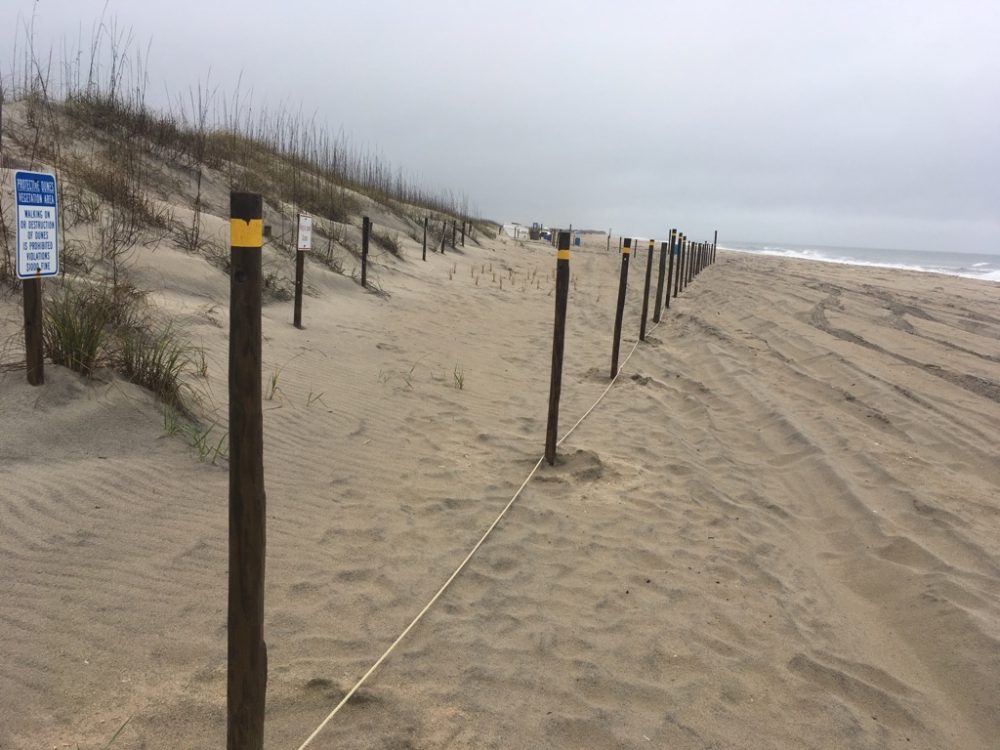
CAROLINA BEACH — It has been nearly two years since the Town of Carolina Beach closed Freeman Park to the public after property owners decided to plant sea oats and install rope fencing — a move that would signify the start of a prolonged legal battle between the town and private landowners.
The parties have been embroiled in ongoing lawsuits and have gone to mediation without success, instead calling for a trial; now, it appears the town and landowners are going back to the table to discuss a possible settlement.
The proverbial ‘first shot’ was fired by property owners on Valentine’s Day in 2018 when the park was closed to the public due to the installation of the fencing, but the conflict goes back further than that.
The land located on the town’s North End that abuts Freeman Park to the west is not public property, instead, it was actually owned by the Freeman family heirs for decades — until corporations began buying the land from them. These corporations are all owned by the same individuals, despite going by different names: DRDK, LLC.; B&F Enterprises of Calabash LLC.; Carolina Freeman LLC.; and Freeman Beach LLC.
Don Formyduval, one of the co-owners of the properties explained his involvement in the purchasing of land at Freeman Park in court documents. Beginning in 2007, ‘The Company’ (Freeman Beach LLC.) began its acquisitions of property owned by the Freeman heirs, in 2014 that acquisition was complete.
The four different LLCs make up what is known as Freeman Beach Associates, LLC, “…which was created to preserve, promote, and develop the private properties,” Formyduval said.
Who owns the beach?
Despite owning the land at the North End, these LLCs (as they are typically referred to) do not own the beaches — but neither does the town. Instead, beaches are part of the Public Trust according to the state. This law makes beaches part of the public domain and forbids private ownership of them, even if a property deed claims the property line extends to the ocean.
The public is granted access to the dry sand beaches which gets defined as starting at the toe of the sand dunes to the mean-high water line.
So how does the town get away with regulating Freeman Park and forcing people to pay to access it? Well, as it turns out, the town only owns the property where the access point is located and only charges those wanting to access the beach by vehicle.
Anyone is welcome to access the beach by boat or by walking for free.
The LLCs first took issue with the town allowing camping on Freeman Park because campers were allegedly destroying the dunes and going onto private property. In turn, the property owners asked the town to stop camping activities on the beach but the town was not eager to limit one of its biggest moneymakers (the park brings in millions in revenue each year).
Formyduval admitted that he was aware of the public’s right to access the beach when he acquired the property and he was also aware of the extraterritorial jurisdiction the town had been granted to operate the park.
“When we were acquiring the property we were aware of the ordinances which prohibited driving within 10 feet of the toe of the dunes and felt that these were good ordinance which would protect the property and allow the expansion of the dunes seaward and also extend and enhance the growth of the dry sand beach,” Formyduval wrote.
In 2015 the owners of the companies observed the town’s installation of posts and ropes along the dunes — an effort they thought was to help protect the dunes. Instead, the ropes were actually the new campsite boundaries.

“However, it was not until the following year that we learned that Carolina Beach was actually renting the property, and in doing so, was allowing 4-wheel drive vehicles to drive within the protected area from the toe of the dune. We observed additional and substantial damage to the dune line as well as the private part of the beach, owned by the entities named herein, and that Carolina Beach was actually renting out our private property to individuals who would camp in those designated sites,” he said.
Last summer, the town decided to limit camping and close the northern part of the park at the so-called ‘pinch point’ because of high tides and safety concerns. But Formyduval said the town did this because beachgoers could not possibly make it to the northern end of the beach without driving within 10 feet of the dunes, in violation of the ordinance.
The use of private property for ‘public gain’
When the property owners realized the town’s efforts to rent campsites on what they claimed was private property, they instructed their attorney to send the town a letter objecting to the “leasing of private property for a public gain.”
After that letter, Formyduval said they observed the town relocate some of the campsites in question, but driving within 10 feet of the dunes continued.
“The initial actions of Carolina Beach led us — the owners of the four companies — to believe that Carolina Beach was trying to relocate or was going to abandon the campsites. Then we learned that Carolina Beach was competitively bidding against us in our effort to acquire title to adjoining property which Carolina Beach ultimately acquired,” he said.
An acquisition that would cost the taxpayers $500,000 for a piece of land that currently serves no purpose other than ‘preserving greenspace.’
The town went even further and sent the companies each a notice of condemnation telling them the town intended on acquiring all of the properties through eminent domain.
Eventually, the town rescinded its notifications of condemnation but the court cases have continued. On Tuesday, prior to the Town Council’s budget retreat the town attorney, Noel Fox, gave council an update on the cases — however, this was in a closed session and not open to the public.
Send comments and tips to Michael.p@localvoicemedia.com and follow him on Twitter and Instagram
