


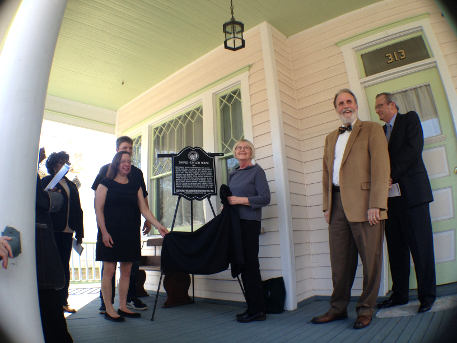
Two houses of significance to local black history drew cheers Tuesday as a preservation group marked their porches with concise but reverent plaques.
The Snipes-Taylor House at 313 McRae St. and the Moore-Davis House at 313 N. Sixth St. are the latest additions to the Historic Wilmington Foundation’s plaque program, which tells the stories of wise, old buildings on hand-lettered, wooden markers affixed to their facades.
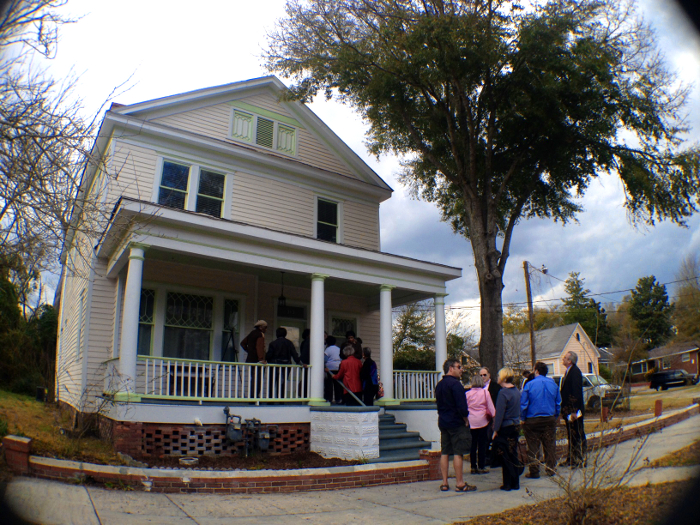 Circa 1911, the neoclassical revival-style Snipes-Taylor House is most notably the former home of the Wilmington-born Robert Robinson Taylor, who in 1892 became the first black graduate of the Massachusetts Institute of Technology, or MIT–a well-chronicled milestone.
That’s in part because it made Taylor the first professionally trained black architect in the country, but also because MIT was where Taylor met and befriended Booker T. Washington, the day’s foremost black leader and the founder of the Tuskegee Institute.
Taylor eventually followed Washington to Tuskegee, “where he dedicated the rest of his life to teaching and designing campus buildings,” according to a recently published booklet prepared by the City of Wilmington on the city’s black heritage sites. (Click here to view it.)
The Snipes-Taylor House was Taylor’s retirement home, according to the plaque unveiled there Tuesday, where another group of former tenants was on hand to celebrate.
For 42 years, after Taylor’s family sold the property in 1971, the Snipes-Taylor House was the home office of the United Order of Tents’ Royal Degree Chamber No. 9, the local chapter of the post-slavery betterment organization managed by black women. It delivers scholarships to promising children among other charitable work.

“We are so pleased to come by and see it looking so good,” Fannie Freeman, a Wilmington native and longtime member of the order, said of the roughly 103-year-old house. It was falling into disrepair until the current owner restored it, just a year or more ago, according to the Historic Wilmington Foundation (HWF).
The house, built originally for Elmer Burriss Snipes, a salesman with the Independent Ice Company, and his wife, Catherine Estelle Bell, is today a sturdy residential property divided into two units.
The circa 1898 Moore-Davis House on North Sixth Street, the second HWF plaque recipient Tuesday, was originally a rental property for James Henry Moore, a Pender County native and farmer, according to HWF.
In 1970, French Isadore Davis Jr., a black businessman and community leader here, bought the house. According to the plaque, Davis graduated from North Carolina Agricultural and Technical State University in Greensboro before heading to Gupton-Jones College of Mortuary Science for his embalmer’s and funeral director’s licenses. They enabled him to, in 1944, found the French I. Davis Funeral Home at 316 N. Sixth St., which according to HWF was one of the city’s most successful such operations.
The Davis Funeral Home lives on today on South Fifth Avenue.
“Davis was also very involved with the community as a member of a number of civic and professional organizations,” the plaque reads, adding the house remains in the Davis family.
George Edwards, executive director of HWF, said these brief but remarkable summaries also tell of the importance of the group’s plaque program.
“The plaque program does such a wonderful job of recognizing the history of buildings and people … who help make the history of this community,” he said.
To qualify for a HWF plaque, a structure must be in either New Hanover, Brunswick or Pender counties and be at least 75 years old. Buildings in New Hanover County’s beach towns are eligible if they’re at least 50 years old.
According to Beverly Tetterton, a local historian and chairwoman of HWF’s plaque committee, the group as of Tuesday had plaqued at least 580 historic buildings in the area.
Ben Brown is a news reporter at Port City Daily. Reach him at [email protected] or (910) 772-6335. On Twitter: @benbrownmedia
