


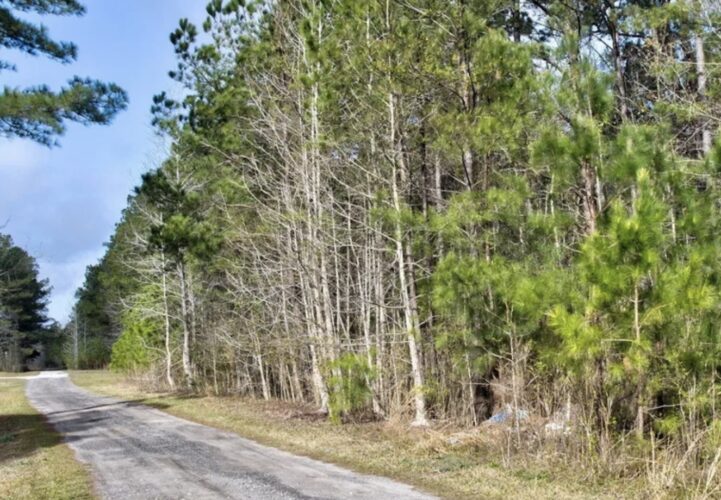
WILMINGTON — Cape Fear Habitat for Humanity’s $1.5-million 30-acre land buy in the northern part of the county is closer to completion. The Endowment announced $950,000 for the nonprofit to help with its purchase of property on Sidbury Road and Buck Avenue.
The acreage will be used for a mixed-income neighborhood, consisting of affordable and workforce housing, as well as market-rate housing. The project is in the early stages. Though design and engineering has yet to begin, the nonprofit is considering single-family homes and townhouses, but is keeping all options open.
The mixed-income development model is not a new concept. Cape Fear Habitat Executive Director Marlowe Foster pointed to Habitat for Humanity affiliates in North Carolina and California as successfully launching developments of this caliber. In Charlotte, both Townes at Carya Pond and Hillside Ridge sell a portion of the units to qualified Habitat buyers, with the remainder going for market rate.
READ MORE: Cape Fear Habitat for Humanity plans mixed-income development off Sidbury Road
ALSO: The Endowment awards $12M in grants
Esmond Anderson, Cape Fear Habitat for Humanity’s vice president of construction, volunteers and land acquisition, said Habitat is looking at selling lots on the 30 acres to developers who share in their mission of workforce development and providing home ownership opportunities to residents.
The project will be phased over the next seven years, with anywhere from 150 to 200 units coming to market. Habitat leaders are unsure how many homes will be built for its individuals and families and how many will be for developer partners as they look for the right collaboration model.
“We continue to engage developers and partners to come in on this with us,” Anderson said of the public-private partnership. “But whatever design we might have now, it’s probably going to change 15 to 20 times.”
Aside from creating social cohesion by breaking down poverty stigmas, a mixed-income development also diversifies the tax base and allows for assorted housing stock sharing similar amenities and design aesthetics.
“There’s no clear delineation between what is Habitat, what is market-grade, what is workforce,” Foster said. “We want everyone to feel welcomed.”
The project will serve Habitat’s normal homebuyers in the 30% to 80% average median income range — or $26,050 for an individual with 30% AMI and up to $55,550 for an individual at 80% AMI. It also will be open to workforce housing in the 80% to 120% range — or $71,640 for an individual at 120% — and other income-earners who can afford market rate.
“Building a community makes homeowners more successful,” Foster said. “Everyone learns from each other.”
The development will be the largest unit count Habitat has overseen in New Hanover County to date. Anderson said once it solidifies developer partnerships, the nonprofit will act as the general contractor over the project. Its volunteers and homeowners will still participate in physically building the Habitat homes, as is a standard practice of the nonprofit business model, while the developer over workforce and market-rate housing will be in charge of their output.
The idea to do something on a larger scale was a natural move for Habitat, Foster added. He came into the nonprofit’s fold a year-and-a-half ago and said the board was clear they wanted to increase outreach and impact of Habitat projects. Its goal is to allow homeowners a chance to purchase a residence without it taking up a third of their pay — which by U.S. Department of Housing and Urban Development standards is considered cost-burdened.
On choosing the Sidbury Road location, Anderson said it came down to logistics.
“We’re running out of land,” he explained of New Hanover County. “We’re fighting against the big developers and small developers for property. I mean, if you have a big developer building a neighborhood, they’re not going to invite us into it, but we see this as an opportunity to change that, and say, ‘We all can work together for affordable housing.’”
While many workforce housing-centered developers — such as Blue Ridge Cascade, formerly Blue Ridge Atlantic, behind Avenue Flats and Seahawk Cove — share the same mission and values as Habitat, upon asking about the benefit for a market-rate developer to partner with the nonprofit, Anderson said the answer is simple.
“They’re able to find a lot to build on,” he said.
“And to Esmond’s point, it’s hard to find 30 acres in New Hanover County where you can get water and sewer, too, at a reasonable rate,” Foster said.
New Hanover County spent millions of dollars to install miles of water and wastewater mains and utilities along what’s been dubbed “The Last Frontier” — referring to developable land in the northern county.
While the Endowment’s grant covers the majority of funding for the land, the infrastructure itself will likely be in the ballpark of $10 million or more, Anderson estimated. He noted it could take the next two years to work through engineering and permitting before a shovel is even put into the ground.
The group will continue with fundraising efforts to tackle the incoming multi-millions but said working with The Endowment on the land purchase has been a boon to further development.
“When The Endowment invests in your organization, that sends a signal to the broader community about legitimacy and the importance of your work … and it amplifies our ability to engage additional donors because we can say they believe us, so you should come alongside,” Foster said.
Foster said Terri Burhans was the network officer who worked through the grant process with Habitat — which has received three awards from The Endowment to date. Habitat got $200,000 in 2022 for its programming, such as repair work for homeowners that meet AMI thresholds, and $3 million in 2024 for multiple projects, like its 35-unit Haven Place in Castle Hayne now under construction.
“It always feels like an engaging, back-and-forth conversation with Terri,” Foster said, referring to her knowledge in affordable housing, as Burhan was the housing director for Cape Fear Collective previously. “She understands the issue.”
In New Hanover County, the escalated population growth, a housing deficit, and soaring prices have left around 35% of households cost-burdened. New Hanover County also has a 21,656-unit housing gap, between homeowner and renter data combined.
The Endowment invested $19 million to tackle affordable housing in 2024.
Amber Rogerson, The Endowment spokesperson, said the grant for Cape Fear Habitat’s land aligned with housing as a “cross-cutting strategy and a core priority” of the organization. Adding support seemed logical, if not a strategic investment due to developable land being so hard to come by in the county and the biggest barrier to residential affordability.
“Without land, there is no project,” Rogerson said. “Housing stability is closely linked to a wide range of well-being outcomes. When families have stable, affordable housing, they are better positioned to maintain employment, support their children’s educational success, improve health outcomes, build financial resilience, and strengthen community connections.”
At Port City Daily, we aim to keep locals informed on top-of-mind news facing the tri-county region. To support our work and help us reach more people in 2026, please, consider helping one of two ways: Subscribe hereor make a one-time contribution here.
We appreciate your ongoing support.
