


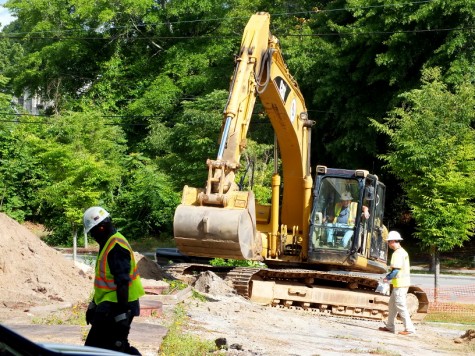
Thankfully, the large petrol tanks that long dwelled underground near the corner of Fifth Avenue and Dawson Street came out intact.
They did, in fact, have a little liquid left in them.
The property in the mid-20th century held a gas station, remnants of which are coming out of the earth this week in an initiative the City of Wilmington is overseeing.
The point–and this may play out at several former industrial sites around town–is essentially to set the property up for sale and redevelopment. Getting there, said Wilmington Senior Environmental Planner Phil Prete, involves identifying any potential contaminants that landowners and buyers would surely want to know about as the property sits on the market.
“The whole purpose of this program is to get rid of the uncertainty,” Prete said Wednesday morning at the Dawson Street site, where patches of grass were defeating the gas station’s remaining asphalt. Though the above-ground structure was long gone, still visible were a few concrete islands that once sat between pumps. At the corner of Fifth and Dawson was an enormous hole dug open by an excavator to reach the below-ground tanks, pumped of their remaining liquid prior to their removal.
The city’s share of the work was worth about $25,000, though any great contamination found would be for the property’s owner or other party to cover, Prete said. The process Wednesday involved soil sampling, with some groundwater samples collected prior, results of which are pending.
The origin of the work, however, is in a $400,000 award from the Environmental Protection Agency (EPA) that has enabled the city to identify and assess old industrial sites potentially contaminated by the residuals of their past use.
A former gas station, for instance, might have left some petroleum products in the dirt.
Documenting the contamination, if any exists, should give the property owner and potential buyers the confidence of knowing what they’re dealing with, say project officials, adding that appropriate measures, such as cleanups, are made easier when they know what exactly to address.
Properties potentially hindered in use by the presence or fear of contaminants are officially termed “brownfields.”
“Cleaning up and reinvesting in these properties protects the environment, reduces blight, and takes development pressures off greenspaces and working lands,” the EPA says.
In 2002, a federal brownfields grant to the city afforded the assessment and redevelopment of the old Love Grove Landfill property, which sat on 19 acres near homes close to Burnt Mill Creek and Smith Creek. Today, it serves the community as Archie Blue Park.
Another notable one: PPD’s world headquarters along the Cape Fear River downtown. Its land once held the Almont Shipping Company, later designated a brownfield for its former, heavy industrial usage.
The Wilmington Convention Center nearby has a similar story, that general stretch of the downtown riverfront once a thriving site for shipbuilding, shipping and manufacturing, according to city literature.
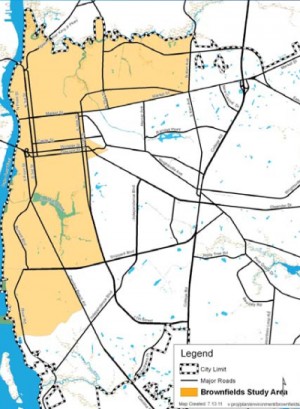
Prete on Wednesday said the city, with the EPA grant, had identified 60 potential brownfields in a study area bounded by Smith Creek, the Port of Wilmington, the Cape Fear River and 16th Street.
Assessing those properties–and leading to their clean-up, if needed–fits right into the City of Wilmington’s plan to bring old, abandoned or underused properties back to life.
When the state’s legislature removed the option for municipalities to grow through involuntary annexation–city-initiated efforts to incorporate outskirt properties–local officials said Wilmington realized its future growth would have to be “inward and upward.” (Related story)
The city is at least 80-percent built out, and as the municipal government says it can’t forever rely upon its residential tax base for funding, a goal is putting old and out-of-service properties back on the tax rolls.
Prete noted that grants are available to anyone wanting to clean up a brownfield, and a cleaned-up brownfield slated for redevelopment is far more likely to secure financing.
He said the remnant removal at the old gas station property at Fifth and Dawson should be complete by Thursday.
More information about the city’s brownfields efforts is available here. Click here for a printable brochure.
Ben Brown is a news reporter at Port City Daily. Reach him at [email protected] or (910) 772-6335. On Twitter: @benbrownmedia
