


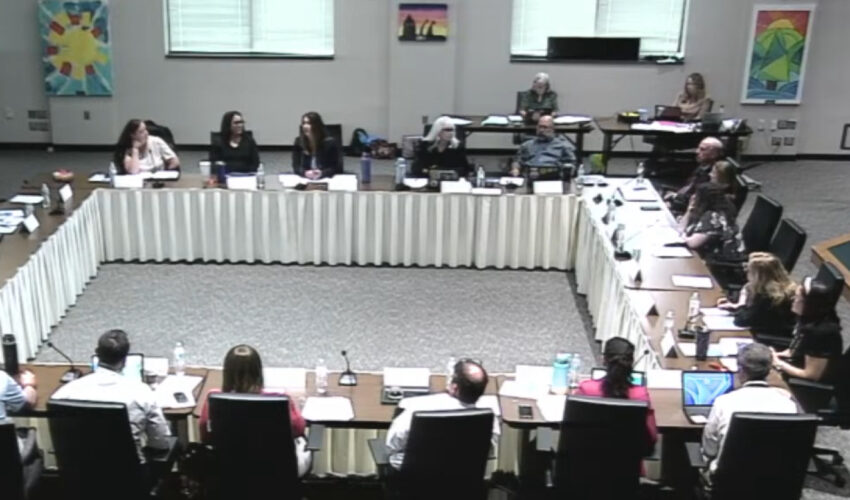
NEW HANOVER COUNTY — The New Hanover County Schools superintendent provided insight into his building sustainability plan before the district’s finance committee last week, indicating which schools may be most ripe for a closure.
“We need to make this decision on which buildings are oldest and are most expensive to maintain,” Chris Barnes said.
Many of the oldest and high maintenance buildings overlap with institutions with the lowest academic scores; they also have the highest populations of students of color and socioeconomic means, yet are under capacity. The district has been clear schools will not be closed based on academic scores or low-performing status.
ALSO: At a NHC NAACP meeting, community members say ‘no’ to selling Mary Washington Howe pre-K
As the district continues to see enrollment decline, the sustainability plan is intended to show where the district can close or consolidate facilities to save money in maintenance, capital upgrades and staffing.
Because the state and county fund New Hanover County Schools based on student enrollment, money should follow a decline in students. Because a loss of students is felt across the district and not concentrated in one school, NHCS has kept the same number of buildings.
“Everyone wants more adults in our buildings, we want more resources for kids, we want more support for kids,” Barnes said. “I’ve been fighting for change in the funding formula for a decade — I don’t know how long we want to wait for that.”
In March, the school board unanimously voted to direct Barnes to put together a 10-year building sustainability plan.
Barnes shared that he recently asked staff to make two lists: one with the 10 oldest schools, which are also the least efficient and most costly to maintain in the next decade, plus a list of schools with the lowest population compared to school capacity. The schools on both lists could then be targeted for potential closures in the future.
At the meeting, committee members were given a chart showing the current capacity of schools (inclusive of mobile units) and told the ideal is for each school to fall between 70% and 95% full. Only elementary schools fall under 70% at this time — Alderman, Forest Hills, Rachel Freeman, and Snipes.
These elementary schools also routinely fall among the lowest academic scores in the district, per state testing data included on the chart provided to the committee. Low performing schools either received a D or F in academic testing and did not exceed growth expectations; though it has been low-performing in the past, Forest Hills exceeded growth this year and thus, is not currently on the low-performing list.
While no middle or high schools’ capacity fell below 70%, Williston Middle and New Hanover High School was the closest with 70.87% and 75.15%, respectively. Williston is also considered a “low-performing school” by the state due to its test scores.
New Hanover High, Williston, and Forest Hills are some of the district’s oldest schools, with all three being constructed 100 or more years ago. Alderman Elementary was constructed in 1963, Rachel Freeman in 1999, Snipes was rebuilt in the mid-2000s.
No one at the committee meeting suggested closing schools just because they’ve been deemed low-performing.
However, the academic scores were included in the chart provided to the committee; Port City Daily asked why.
A spokesperson told Port City Daily: “Those were included as part of the broader information provided for context about each school. They are not intended to determine decisions regarding building overhead or facility needs. Facility decisions require consideration of multiple factors, including building condition, capacity, enrollment, repair and renovation needs, and other operational considerations.”
Information on the maintenance demands of New Hanover County Schools buildings was not included in the committee meeting last week. Afterward, the district provided to Port City Daily summaries on each school’s capital need estimates based on a recently finalized facility condition assessment.
It measures a buildings’ infrastructure and physical condition at a point in time, not necessarily fitness for present or future educational needs; it also doesn’t account for any planned renovations to the property in the near future. However, the summaries provide an approximate capital spending outlook on items like building integrity, energy and service life extensions over the next 21 years.
Among the elementary schools, Snipes needed the most in maintenance at $19.25 million.
It is followed by:
- Holly Tree: $15.45 million, built in 1997, 84.31% capacity
- Eaton: $14.66 million, built in 1997, 95.52% capacity
- Sunset Park: $14.38 million, built in 1953, 92.09% capacity
- Bradley Creek: $14.16 million, originally built in 1942 on Oleander Drive, where the Arboretum is today, but burned in 1982 and was rebuilt thereafter on Greenville Loop Road, 70.54% capacity
Though Rachel Freeman is under capacity, its upfit is only estimated at $2.19 million; Forest Hills and Alderman, being under capacity as well, are expected to cost $11.23 million and $5.76 million, respectively.
Among the middle schools, Williston ranked the second highest in projected maintenance at $19.12 million, only behind Roland-Grise with $19.21 million and operating at 99.78% capacity.
Barnes was clear at the committee meeting there is currently no list of schools marked for closure. Furthermore, he said choosing to shutter any school would be an emotional issue, just as it has been in the district’s past attempts.
“I could go, ‘These are the schools that are oldest, these are the schools that are least safe, these are the schools that are least efficient,’ and that argument isn’t going to work for people who are emotionally tied to certain buildings and spaces, so it takes time to have a conversation,” Barnes said.
Thus, to mitigate disruption to families and student loyalties, Barnes said he envisioned a phase-out process. For instance, an elementary school planned for closure would include the district halting intake of new kindergartners the first year, then both kindergartners and first graders the following year, and so forth.
There are questions on discontinuing a school that the district, in its data-gathering stage, is not ready to answer — such as what year a school would start, where its students would be redistricted to, what would happen to the school building or its land.
Barnes said redistricting would need to happen eventually, but the very next step in the conversation over the district’s footprint is the passage of the $320.5-million school bond this November.
As informed by the finance committee’s suggestions, the bond includes the first phase of New Hanover High School repairs and additions, a new building at Trask Middle School, a new school facility in Riverlights to replace Mary C. Williams Elementary, a replacement of Pine Valley Elementary and an addition to Porters Neck Elementary. The bond also includes district-wide upgrades, particularly HVAC systems, across the district that could adjust down how much in repairs the facility condition assessment notes for each school.
Without these projects, the schools on the table for closure could change or be expedited due to safety concerns.
“What I don’t want to do is spend this money on a bond, come 10 years from now, get up to 2036, and come back and say we need another bond, but we haven’t done anything to solve our own problem,” Barnes said. “This bond is the starting point for all the discussions that come later: capacity, consolidation, redistricting.”
The finance committee did not take a vote on anything related to the sustainability study. Port City Daily asked for the timeline of the plan but did not hear back by press; the facility assessment summaries are anticipated to be posted to the New Hanover County Schools website by the end of the week.
[Ed. Note: A previous version of the article stated Snipes was built in 1942; while the original building was constructed in 1942, it was reconstructed in the mid-2000s. The original location of Bradley Creek, built in 1942, also burned in the 1980s and was rebuilt thereafter. PCD regrets the errors.]
At Port City Daily, we aim to keep locals informed on top-of-mind news facing the tri-county region. To support our work and help us reach more people in 2026, please, consider helping one of two ways: Subscribe here or make a one-time contribution here.
We appreciate your ongoing support.
