


NEW HANOVER COUNTY — The New Hanover County Board of Education has taken an official step toward addressing its facility needs in the face of declining enrollment, after months of pondering whether it should reduce overhead.
The board voted unanimously to direct Superintendent Chris Barnes to put together a 10-year building sustainability plan. The vote came at the budget session on March 12, after Barnes revealed the district currently has a $2.5-million budget — along with several million in capital needs outside this year’s planned bond referendum.
“I think the question we have to ask ourselves is: Do we need the same number of buildings for 22,000 that we needed for 26,000 students?” Barnes said, referring to a hypothetical future enrollment.
READ MORE: NHCS sitting at $2.5-million deficit in early budget talks
The board has brought up the idea — as pushed for mainly by board member Josie Barnhart — of reevaluating its overhead for several months. The district even tried to close a few campuses in the last few years — such as Mosely and Howe Pre-K Center — in the face of student enrollment’s downward spiral.
Enrollment has declined from 27,435 in the 2017-2018 year to 26,721 this year, with a projected count of 25,864 next school year. Barnes said the decrease is largely attributable to the nationwide birth rate decline, exacerbated by financial factors unique to the county. He noted the district’s Title I student population — often children from low-income households — has dropped over the years, despite New Hanover County’s population growth and rising cost of living.
Theoretically with fewer students, the district would have less of a need for staffing, and if it lost enough students, entire schools.
“I wonder if it would be better served for me to bring you a district sustainability plan to say: ‘Yes, we need the bond, but the bond is not to build new buildings — it’s to replace outmoded, unsafe, inefficient buildings,’” Barnes said. “And once we have those, can we then double down and say, what other buildings do we have that are outmoded, outdated, inefficient? And maybe look at shuttering some of those.”
The superintendent said he could probably get the district to 2030 shoring up funds. However, as affirmed by the board, he said the district should break free from the cyclical request for more money, especially considering the county has yet to right-size its per-pupil allotment. It is projected to reach $4,000 next year, up from $2,700 since 2017-2018.
The county and state pay for teacher salaries and operating expenses based on the number of students in a district, which often doesn’t neatly align to the needs at each school. For example, the state provides for an assistant principal per a certain number of students, not necessarily per school. While there is wide acknowledgement the state’s model is outdated, Barnes acknowledged it may not be fair to continue to ask the county to fill in the gap as it has been.
The continued need for more money stems, in part, from inflationary increases to benefits plus state-mandated pay increases, which only apply to state-funded positions. Any staff paid through the county’s supplement would also be entitled to a raise, though
this would need to come from the county.
County Manager Chris Coudriet summed up the district’s predicament at the commissioners’ budget session last week: “They don’t have fewer campuses because there are fewer students, ostensibly, the same number of teachers and administrators are there. So their argument would be, those are the costs applied across the system, even though the students are going down.”
Barnes told the board last week his job is to “relentlessly” advocate for more funding and he would continue to do so. But when it came to commissioners’ capabilities, he said it would only be “fair ball” to now look at ways to reduce the district’s overall funding need.
“Asking for money, money without figuring out where to tighten our belts first, is not fiscally responsible,” he said.
The superintendent described the plan as an in-house operation and didn’t indicate the district would be hiring a consultant to do the work; he said his approach would be to examine its oldest and most outdated facilities as they overlap with areas seeing reduced enrollment. Upon initial analysis, Barnes said both Mary C. Williams and Pine Valley elementaries fit this mold.
Port City Daily asked the district if any of the other 40 schools fit into both categories but did not hear back by press.
Barnes noted community input would be key to the building sustainability plan’s development, noting the district’s past attempts to close a school were unsuccessful due to community pushback.
After the county commissioners slashed $36 million from their 2025-2026 budget and jeopardized six pre-K classrooms, NHCS identified one way to make up for the funding loss would be to close the Mary Washington Howe Pre-K Center and transfer its classrooms to the Dorothy B. Johnson Pre-K Center. Doing so would have allowed the district to sell the property.
The Howe community didn’t like that option, and the New Hanover County NAACP hosted an event to “save” the predominantly Black and Hispanic school. Many attendees spoke to the school’s significance as a monument to the school’s namesake, was an American educator and the first and only female principal of the historically Black Williston School.
In 2024 under Superintendent Charles Foust, parents of the low-enrolled Career Readiness Academy at Mosely were told the school would close at the end of the school term, to the surprise of many board members. It sparked community outrage that brought the commissioners into the fray; they signed a resolution against the closing of the academy and the district relented.
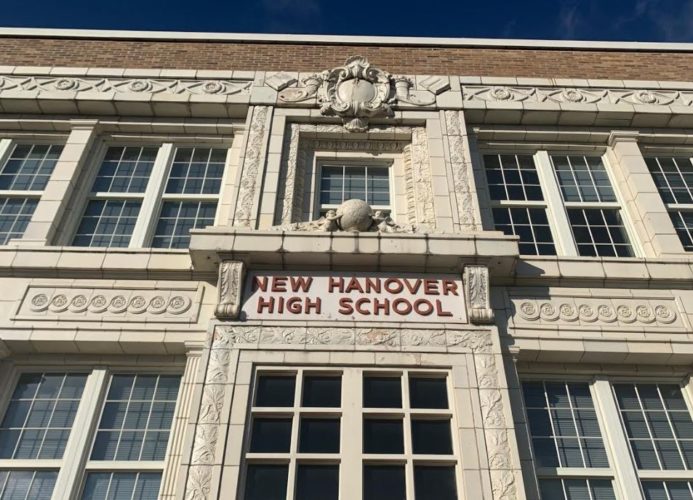
The district has also discussed closing New Hanover High School, a building with more than 100 years of age and several hundred million dollars of capital needs. After commissioning a master plan last year, the school board decided to include phase one of a $230 million hybrid model to fix up and modernize the school, though no funding plan has been decided on for the other phases.
Barnes said the board could anticipate him bringing back an outline for community input and more details on building sustainability plans contents and timelines before summer.
Board member David Perry said he supported the plan, but would rather the district not sell any property in case they needed to reopen schools in the future. Barnes clarified that would be a separate discussion subject to the board’s decision.
Board member Pat Bradford supported the measure, despite noting it was a hard decision the public would need to reckon with.
“We can sit in the dirt and cry about the loss of essential service funding, or we can take to the stakeholders, to the taxpayers…you want more positions, but we can’t get you more positions, and we have facilities that might be combined,” she said.
However, she was concerned about the plan coming to fruition by the November election. Barnhart jumped in to say she didn’t anticipate the board would make any decisions until the next budget cycle, so spring of 2027.
A firm timeline is unknown at this time.
Reach journalist Brenna Flanagan at [email protected].
At Port City Daily, we aim to keep locals informed on top-of-mind news facing the tri-county region. To support our work and help us reach more people in 2026, please, consider helping one of two ways: Subscribe here or make a one-time contribution here.
We appreciate your ongoing support.
