


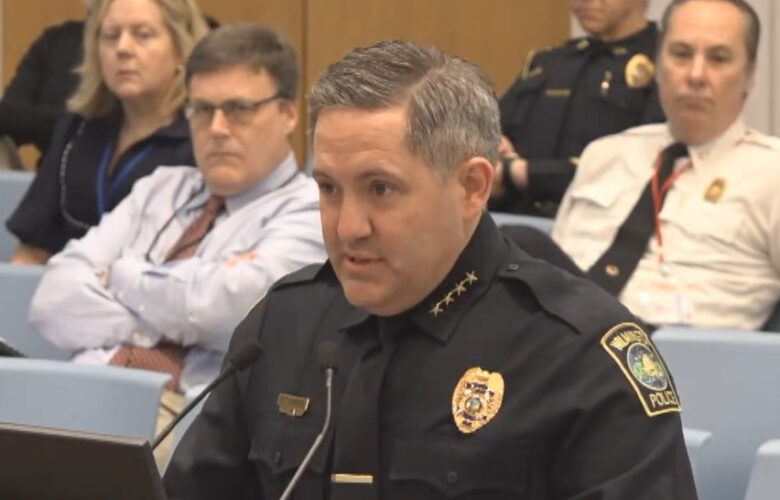
WILMINGTON — The Wilmington police chief is coming up on his one-year anniversary this month, a year marked by building up the ranks of officers while also fielding public scrutiny over several violent incidents in the city.
Chief Ryan Zuidema sat down with Port City Daily for an interview reflecting on this past year and addressing top-of-mind issues for Wilmington’s citizens, including Flock cameras.
He cites a major success for the city as Wilmington City Council’s passage of the “livable wage” philosophy, tying its starting wage to 60% of the area median income. Employees are now guaranteed to earn $45,531, a change that affect many of the city’s first responders.
However, the WPD has also had to respond to several highly visible acts of violence, including two stabbings that occurred minutes from each other in downtown Wilmington in April.
There have also been two officer-involved shootings, one of which concluded with the State Bureau of Investigation deciding no wrongdoing was found. The other is still under investigation.
Much of Port City Daily/s conversation below is focused on downtown, where high-profile incidents have occurred but also where concerns abound over the city’s nightlife. Though the city ultimately chose not to participate in a statewide pilot project addressing improvements to nightlife, Zuidema talked about some of what he’s noticed about the region while serving in his role.
The following interview has been lightly edited for clarity.
Port City Daily: I wanted to start by opening up the floor to you and your thoughts on your first year successes and challenges. What’s been your overall assessment?
Ryan Zuidema: A busy year for sure, without a doubt.
I’ve been trying to learn a new department — a lot of new people, a new community. So that part has definitely been challenging and enough to keep me busy, for sure.
What I’ve been impressed with, though, is the caliber of employees here. We’ve got a great group of men and women who do some exceptional work in the community, dealing with some very difficult tasks and challenges. I’ve been very encouraged by how hard they work and how dedicated they are to the department and to the community.
Some of the successes: definitely the rather historical investment by city council into public safety has been huge for us, not just in terms of the pay raise — that’s a big piece, certainly — but also investment into our training budget, which helps us with developing future leaders, helps us with ensuring that folks have all the right training to best deliver services to our community.
Staffing still remains a bit of a challenge. We made some headway there, but we still have some vacancies we need to get filled. That’s not unique to Wilmington PD, by any means; across the country, the pool is very shallow, and we’re all kind of fishing in the same place, so to speak. But we’ve made some headway there.
We’ve still got some room to improve, certainly in terms of adding to our staffing, but we’ve been seeing a lot more lateral officers apply since the pay increase.
We can turn around a lateral officer usually in about a month-and-a-half, put them on their own, whereas a brand new employee who’s never been an officer before it’s about a year before they’re on their own. So a little bit quicker return on our investment there, but overall I’ve been very encouraged by where we’re going as a department. A lot of the people here, I think, have risen to the occasion and continue to look forward to what the future holds for us.
PCD: Going back to the pay increase, I know a lot of that was geared toward the first responders, and I think the number floated before the budget was about 80 vacancies at the WPD. Do you have updated numbers on how much that has been cut down?
RZ: I’m not 100% sure where those numbers came from. What I can tell you, the last numbers I saw last week, I believe, is what I refer to as a hard vacancy — meaning that I have a position that I don’t have a person in, is about 32.
Last year at its peak, the high was somewhere in the mid-40s. So I think we’ve made some progress on that, definitely. There’s other folks that certainly work here that are not what we call “deployable,” meaning that you know they could be on military leave, they could be on family medical leave, they could be on injury, they could be on a variety of other things. But as far as hard vacancies, right about 32.
PCD: Would you say that’s going to take time to fill, as far as getting the word out about the new pay and what that looks like — or what would you say is the reason?
RZ: I’m very optimistic, in that we’ve seen some greater numbers of applications, especially on the certified side of officers coming over from other agencies.
I think it does take a little bit of time, certainly for folks to see that and the turnaround. Again, our hiring process, we try to move through it as quickly as we can, but at the same time we’ve got to be very thorough because we’re entrusting a young man or woman to have some pretty significant authority and power in the community with what they have to do. But I think those numbers will continue to improve.
We’ve got to continue to hire more people than we lose, right? And there’s going to be a level of natural attrition through just retirements, or somebody who’s got to leave to go take care of their mother in Arizona because she’s sick or whatever that may be. So we’ve got to make sure that we’re hiring more than are leaving, and we’re trying to build out the infrastructure that we have here to allow for larger academy classes in hopes that we can continue to increase those as well.
PCD: As far as turnover, are you seeing that sort of ease off in recent months, or what does that look like over the year?
RZ: In recent months I think it started to slow down a little bit. 2025 saw a decent number of folks leaving for a variety of reasons.
My hope is, with the changes that have taken place in terms of salary, the changes that we’re trying to implement in the department — in terms of training for our folks, investing in our folks, providing them opportunities — will help keep the ones we have here first and foremost. Because if we’re doing a really good job of retention, we don’t need to do nearly as good a job of recruiting, right? But we want to make sure that we’re investing in the folks we have here, and then we’re hiring folks that not just want to come here, but folks that want to come here and stay here.
PCD: Last year, I know you were coming in as chief after an investigation into the department, where bullying, harassment, and intimidation concerns had been sustained. Can you talk about how the department’s culture has shifted since then?
RZ: We’re going to hold people to a very high standard here. We’re going to hold them accountable to that standard.
What I tell folks is, I obviously wasn’t here for the past. I didn’t live through that. But I also try to remind them, regardless of what happened here in the past, neither I nor any of them can change that. But what we can do is focus all of our efforts and our time and our energy on where we’re going forward as a department.
And that’s really been my message to folks: We want to continue to build the police department and make sure that it’s a place people want to come to, a place people want to stay at, a place people want to invest into. And I’ve been very happy.
I think morale is improving over the last year, and that’s not just because of me, that is a team effort across the organization — from supervisors all the way down to line level officers — and creating an environment where people feel heard, understood, and like they’re a part of the team.
We’re getting ready to roll out an internal advisory committee; it’ll be representatives from across the department, both sworn and non-sworn, across a variety of ranks, where they’ll get to meet on a routine basis with senior staff here to make sure that we understand what’s going on. Some of the the greatest ideas usually generate from the folks that are actually out there doing the work, not somebody like me sitting in an office most of the time, and then also you know they’re usually going to see some of the challenges before we see them as well, and so give them a formal means of communicating that with us.
We’ve got a group that’s already started working on a uniform committee to look at is there a better or different uniform that we could potentially be wearing right now? Polyester in 90-degree weather isn’t great. So the idea is, again, we’ve got staff from across different ranks as well as our professional staff looking at you know are there different options we could look at. We certainly want something that looks professional, but also something that’s functional. A lot of our folks are wearing these things for 12 plus hours a day in 90-plus-degree heat and humidity, and as you know, it doesn’t seem to be getting cooler anytime out there soon.
PCD: I want to get into some of the crime numbers, but before we do that, I wanted to bring up the issue of Flock cameras, since that’s on everyone’s mind. The Wilmington Police Department does not have a contract with Flock, but I wanted to gauge your philosophy on AI in technology, integrated into camera systems.
RZ: What I would say generally about technology related to, especially AI, and of course to include license plate readers, Flock, all those things is they are an incredible tool that can be extremely beneficial to law enforcement in terms of both efficiency and effectiveness. But they’ve got to have guardrails on them as well.
AI specifically is evolving at a pace much faster than the law and policies can usually keep up with. By its definition, it is teaching itself every day, and what I think you found across both local, state, federal laws, as well as the courts, is they’re not keeping up with it. I think we need to look at any technology that can help us as a police department more effectively and efficiently solve crime, find missing persons, things like that, but we’ve got to have those guardrails in place, and they need to be in place before we implement the technology.
I think sometimes what you’ve seen in some places is where technology is implemented prior to having those discussions. Because the reality is, they can be an incredible tool to solve homicides, to get breaks in crimes that we may not otherwise get, but we’ve got to make sure they’re being used in an appropriate manner in order to ensure the public has trust in what they’re doing. And there’s always going to be some folks that don’t agree with certain things, I understand that. But we’ve got to try and take into account some of the concerns before we start implementing the technology.
BF: Can you help the public understand what guardrails look like for a police force as far as using those cameras? What does that look like on a day-to-day?
RZ: I think it’s a couple of things. It’s certainly policy, first and foremost, to make sure there’s a very clear delineation of what they can and can’t be used for.
The second piece of, I think, is training. There’s got to be very clear hands-on training for folks so they understand that. And I think those two things are critically important.
The third piece is audits — routine audits of that because human beings are human beings, and human beings sometimes make errors or mistakes, and we’ve got to make sure we’re capturing and catching those as soon as possible. And then if we find that people are violating either policy or law, they need to be addressed swiftly and held accountable for that.
I say this quite regularly, but the only people that dislike bad cops more than the general public are the good cops. Because it only takes one bad one to make all of us look poor. I think you know the policy, the training, the audits, and then the accountability piece is really kind of the crux of making sure we’re doing those things correctly.
PCD: Can the WPD access Flock cameras, even though you don’t have a contract with them — say Wrightsville Beach’s cameras or somewhere in Raleigh?
RZ: We don’t directly access any of those. If we had, let’s say, a license plate that we believed was involved in a homicide, we could call an agency and say:“Hey, is this license plate a hit on any of your Flock cameras?” But we don’t have direct access.
PCD: Top of mind for many Wilmingtonians is the seemingly increase in violent incidents, particularly in highly visible areas like downtown. Compared to January through April of last year, there were four incidents and then this year, over the same period, it was nine homicides. Is that trend continuing?
RZ: The good news is, overall crime in Wilmington is down compared to both last year and to what we look at a five-year average. But there are certainly a couple of categories that are higher; homicides are definitely up this year compared to last year.
We hope that trend levels back out, for lack of a better term, but obviously one homicide is one too many. We want to make sure that we’re putting every resource we have available to address those, which we do.
We’re grateful that we have a strong partnership with the New Hanover County Sheriff’s Office through several task forces we work together on. We have a great relationship with the sheriff and that helps us provide us with additional resources when we need to address those. And we have other partnerships as well, with other state-level organizations and federal organizations that we partner with. Sometimes those are very visible. Sometimes those are not, depending on what type of investigation we’re working, but we’re very in tune to the fact how violent crime impacts our community, and try and put the available resources we have to address those things first and foremost.
[Ed. Note: Port City Daily did ask the WPD for updated crime statistics in August; the request was submitted to the city clerk, Penny Spicer-Sidbury, in a public records request that has yet to be returned.]
PCD: When one violent incident gets in the news, people think downtown is unsafe. It could just be one incident, two incidents, when really, overall, in that five-year average, it’s not that many more. How do you communicate that downtown or in any area of the city that it is a safe place to be?
RZ: I’d stress that, overall, Wilmington is a safe place to be. Does that mean that we have no crime? No, certainly there’s crime here, but overall it’s a safe place.
I think your point is well-taken. When you have a couple of violent crimes, especially in close proximity, both time and location to one another, that tends to lead to an: ‘Oh my goodness,’ Chicken Little the sky is falling, when in reality, when you look at it in context, it’s not too dissimilar from either previous years or when you look at a five-year average. Not as bad as maybe it’s portrayed.
What I cannot control, and never will be able to control, is social media.
I will tell you it is, in many cases, a cesspool of folks that put information out there that sometimes is accurate and oftentimes is not. We try to do as good a job as we can of putting out factual and accurate information as soon as we can, understanding that you know, although television tells you as soon as a homicide occurs, the police know everything that happened, and within 30 minutes they’ve got DNA back from the lab, and the case is solved — the reality is, that’s not how it works.
We want to make sure we’re putting out information that we know is accurate, or at least we believe to be accurate, based on the information we have at that time and to the public as soon as we can. That’s our pledge: to continue to try and do that.
I can’t control certainly how someone feels about it, but some of it is educating folks on what goes on in the community. Some of it is building those partnerships and building that trust, so that folks understand if we say this is what happened, then that’s what we believe happened again based on that information.
I think, sometimes, the push, unfortunately — in not all media, some media, and certainly in social media — is to be first and not to be accurate. That has been a downfall for communities across the country for many years now.
PCD: Aside from the violent incidents, are you seeing an increase in calls downtown, specifically for assault or drunk and disorderly?
RZ: I’d need to get the numbers pulled to say for sure. Anecdotally, I wouldn’t say there’s been a significant increase in that.
PCD: The city chose not to participate in the Sociable Cities initiative, but I know some WPD officers had attended some of those sessions, and I wanted to get your thoughts: Did you see any value in participating in the initiative? And if there’s anything you would like to see discussed at the state level that could benefit Wilmington — any laws or initiatives you’ve seen other cities do?
RZ: There’s a couple things.
If you were to pull the numbers for ABC-permitted locations per capita, Wilmington far outpaces anyone in the state, and so those numbers speak very clearly for themselves.
On top of us having per capita the greatest number of ABC permits issued, in many cases, back to your previous question about downtown, many of those are in a very condensed, defined area. A four- to six-block radius, give or take, that on any given Friday night or Saturday night at 2 a.m. you are going to, if those places were fully occupied per the fire code and occupancy ratings, you’d be dumping out potentially close to 6,000 people into the street. Many are highly intoxicated.
I don’t know what that looks like at the state level or potentially even at the local level, but having the ability to not condense so many ABC permits in one place would be beneficial for us as a department and us as a community.
The other thing I find different — having come here from a different state — there is no such thing in North Carolina as an offense for being drunk in public. In North Carolina, you have to be both drunk and disorderly in public in order to have that addressed.
I can tell you, in Virginia there is a drunken public offense. It’s a class four misdemeanor, meaning you cannot get any jail time for it. It is simply a fine. But what it does allow, is law enforcement to take that person into custody, take them to the jail, and they basically sleep it off, and after a period of however many hours in the morning, they’re let out and they walk out the door.
That is challenging here. If you’ve had the opportunity to be downtown at bar-closing on a Friday or Saturday night, there are a large number of highly intoxicated folks who are out wandering the streets. If you’ve ever tried to reason with a very drunk person, that does not go very well, usually.
So some of the things we’ve been doing is working with ALE. We actually had them come in and do some training back in June. Don’t quote me on the exact date. We offered that to all of the ABC establishments downtown, as well as other areas, to come in and [learn] best practices. Here’s some things you should be looking at. Here’s what the law says about overserving and all that.
PCD: What did participation look like in that?
RZ: Very bluntly, it was poor.
And that was not something that was a cost for them to show up at. ALE went literally door to door, handed out information one-byone to a lot of these businesses, and yet we saw very few people show up for that and very few businesses show up for that.
It gets back to this idea of responsibility as law enforcement, but business owners also have a responsibility. And if you’re going to run an ABC establishment, there are responsibilities that come with that that you need to, very bluntly, step up to the plate and hold up your end.
We’ve seen some violent crime related to either directly in some establishments or just outside of establishments … and that’s not acceptable. Those folks need to be held accountable as well. So we continue to work with ALE, local ABC. We work with, obviously, the city attorney’s office and any ways that we can address those things is really, really important — but it’s certainly a team effort.
PCD: I want to ask you about the social workers, which council decided to hire four to deploy with WPD officers and respond to calls associated with homeless individuals. When you last spoke, it was at a city council meeting back in January. Do you have a status update?
RZ: We’ve hired three of the four. We’re in the process of trying to hire the fourth, and they are working through a lot of training, obviously, when they get on board. They’re working through the best way to serve the population that they’re designed to help.
I think they’re a great resource in that, oftentimes, police officers are going to these calls for service, and they are dealing with what I would argue are symptoms of a problem as opposed to the actual problem. We’re putting Band-Aids on those symptoms and hoping they go away, and that’s not a good practice. We want to deal with the root cause.
The idea is the social workers will be able to kind of dig in a little bit and address some of these issues; as you know, there’s oftentimes co-occurring issues that are taking place. There could be mental health issues, could be substance abuse issues, could be homelessness, could be a variety or combination of any of those things.
So three of them are knee-deep in it right now and getting out there some to start to help, hopefully, address some of our chronic or repeat folks that we deal with quite regularly, to get them the services that they need.
A lot of the folks that we often get called to address in the community are not committing crimes; they’re just nuisance type, disruptive behavior that’s not against the law, and officers are somewhat handcuffed — no pun intended. But if there’s not a crime being committed, there’s only so much we can do.
We can certainly encourage them and suggest, but we can’t force. The idea is social workers can fill in that gap. They’re hopefully going to be able to do a lot more of that work as they get their feet under them a little bit more. But having the three of them on board has been great. They are good folks, and I know they’re really excited about helping out to try and address some of the kind of repeat folks that we deal with on a regular basis.
At Port City Daily, we aim to keep locals informed on top-of-mind news facing the tri-county region. To support our work and help us reach more people in 2026, please, consider helping one of two ways: Subscribe here or make a one-time contribution here.
We appreciate your ongoing support.
