


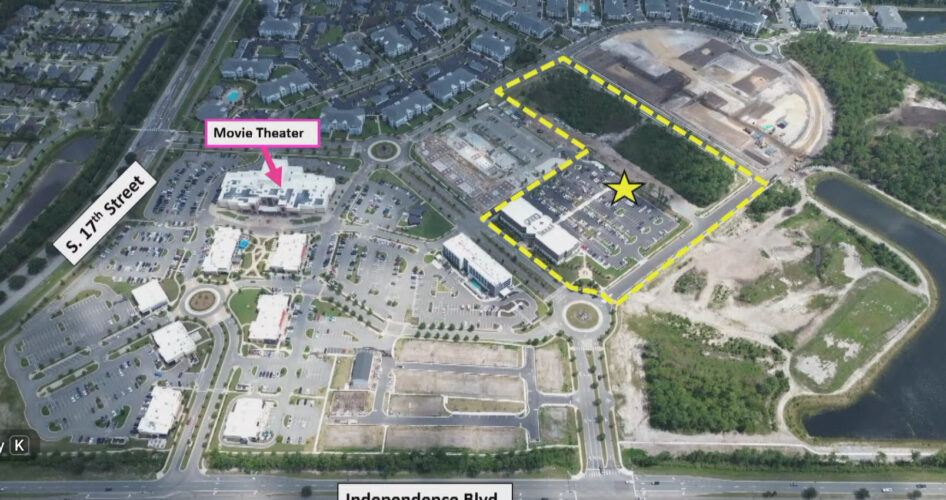
WILMINGTON — The developer behind Barclay projects at the corner of 17th Street and Independence Boulevard is looking to undo a decade-old density restriction on property near The Pointe.
The request’s outcome, to be determined by Wilmington City Council, will affect how the last acreage of the Barclay projects are developed, as well as overall housing options in the area.
The Wilmington Planning Commission is recommending to council the conditional rezoning of 12.25 acres of Barclay West near The Pointe. However, the rezoning would not result in actually changing the property’s zoning from office and institutional.
The rezoning is a mechanism for Cameron Properties Land Company to remove a condition placed on the property in 2013. The condition, referred to as the density cap, limits the number of housing units on the site.
READ MORE: Wilmington releases vision for downtown, larger execution questions remain
Though the cap applies to the whole Barclay West development, Cameron Properties is only requesting it be lifted on the one 12.25-acre parcel. The land is currently home to a Wilmington Health facility and parking lot.
The developer wants the ability to construct housing on the undeveloped 7.5 acres that remain.
Under the density cap, the developer could build only 44 additional units on the property, compared to 208 allowed by the land code if the cap wasn’t in place.
Attorney Matt Nichols appeared before the planning commission on behalf of the owner to make the case that the unit cap was outdated, and thus, should be removed.
“All we’re trying to do — and it boils down to sort of your right to petition the government, which we all talk about in civics class and that sort of thing — we’re trying to get in front of this commission, and ultimately get in front of city council, and say: ’Could you please look back at that condition you did in 2013?’” Nichols said. “Does it make sense today? If you think it does, then we’ll go home.”
The planning commission didn’t send Nichols packing. It unanimously voted to give a favorable report on the rezoning request to council, but only after some back and forth with Nichols about the intentions for the land.
Approved in 2013, Barclay West is a largely residential development, inclusive of the Element apartments near The Pointe at Barclay — the commercial center also developed by Cameron Properties. Barclay West also includes the Hamlet and Mosby neighborhoods across the street from The Pointe.
When Barclay West was approved in 2013, it used a “bubble plan,” which established zones for the properties’ various uses without clearly defining them on a site plan. This provided flexibility for the developers as the area around the 12.25 acres transformed into the current mixed-use complex.
Neither city staff nor Nichols could pinpoint council’s exact reasoning for the density cap in 2013. Though, its result is a limit of 1,375 units for the whole Barclay West development; only 116 of those units could be located in the parcels zoned for office and institutional use. Based on what the developer has already built, it could only put 44 units on the 12.25-acre parcel subject to the rezoning.
Nichols told the planning commission his client originally envisioned most of the property being dedicated to commercial use. However, 16 years following the original approval, there is a demonstrated need for more housing in the region, with the city’s land code also adjusting to promote more dense housing.
Additionally, the surrounding area now offers more services, including those built out at The Pointe, for residents to take advantage of.
“If you were wanting to increase density in Wilmington, this is exactly the place where you would want to do it,” Nichols said. “It’s close to grocery stores. It’s close to public parks. It has probably the best access of any large site in all of Wilmington, with Independence Boulevard, 17th Street, Carolina Beach Road. Most of this is signalized, and none of that was really there in 2013.”
Planning commissioners supported increased density on the site. They also indicated it was hard to grapple with the lack of site plans, typical for conditional rezonings, and the path the property owner was taking to accomplish its goals.
One way Cameron Properties could do away with the density cap is by dedicating 10% of its planned residential development to workforce housing — units designated to residents making 60% to 120% of the area median income.
Commissioner Ace Cofer asked Nichols why his client wasn’t pursuing that option. Nichols answered they’re undecided on how to develop the property, which is also why no site plans were before the commission.
“It’s possible that no residential would go there, but we would like the opportunity to put residential there,” Nichols said.
Additionally, the developer could not simply ask for a modification to the density cap condition of the 2013 rezoning approval without affecting all properties at Barclay West. The problem is: Cameron Properties does not have control over some parcels anymore after having sold them.
The attorney clarified his client was not asking for an exception to what the land code allows, only for the ability to follow it without the 2013 density cap in the way.
Still, Commissioner Danny Adams questioned how the board was supposed to determine the developer was planning to build units “in a smart way from a design standpoint.”
Nichols pointed to what currently exists at The Pointe, arguing Cameron Properties’ will continue to provide a high-quality product in the area.
“There’s really no reason to think they would come to this last seven-and-a-half acres and make a mess of it,” Nichols said.
Cofer qualified the attorney’s argument with a note that Cameron Properties could sell the remaining Barclay West parcel to a property owner without the same stewardship principles.
Nichols said the assurance against that reality lies with the other conditions approved in 2013; they remain in place and will continue to be tied to the land in any sales.
The conditions include that the eventual site plan for Barclay West be architecturally in line with the overall development and the land code — retail strip malls, an example Nichols brought up, would not be permitted.
The developer would also need to complete a new traffic impact analysis for the parcel.
Still, Cofer worried about the precedent the commission would be setting for future multi-phased master plans appearing before the city. But such is the nature of conditional rezonings — the planning commission, and ultimately council, can decline to rezone if the conditions aren’t right.
Cofer indicated he wouldn’t let the concern over precedent stand in the way.
“It could be concerning elsewhere, but I don’t think there is a whole lot of concern here on this particular site,” Cofer said.
Chair John Lennon said he thought the project only gained so much scrutiny because of buzz words that typically spark community alarm: “density, apartments, change.” He pointed out Cameron Properties’ request was discussed for only 90 seconds during agenda review; city planning staff are also in support of the request.
Nonetheless, he suggested staff provide a more “comprehensive explanation” to council when the rezoning appears on the dais again.
At Port City Daily, we aim to keep locals informed on top-of-mind news facing the tri-county region. To support our work and help us reach more people in 2026, please, consider helping one of two ways: Subscribe here or make a one-time contribution here.
We appreciate your ongoing support.
