


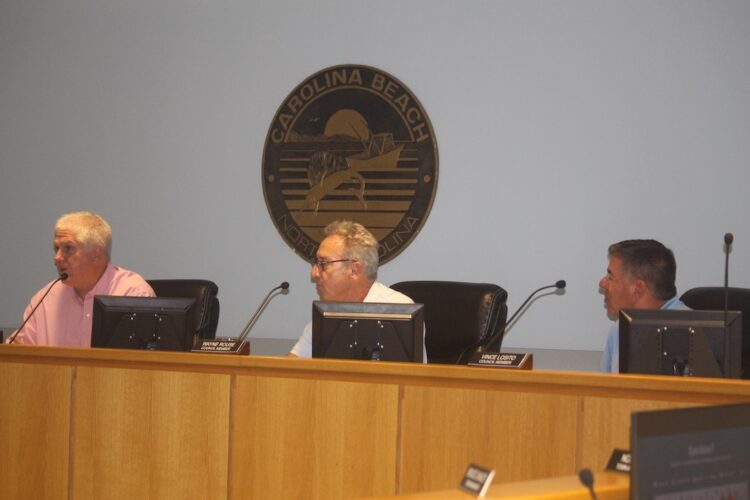
CAROLINA BEACH — Carolina Beach is one step closer to owning several boardwalk properties, after the Local Government Commission approved Tuesday its $10-million debt agreement. But how the town got there has been a winding path. For one, the town settled on a lawsuit it was likely to win — and gained multiple properties from it to steer the direction of downtown Carolina Beach.
The town is purchasing nine parcels, including the location of the boardwalk’s seasonal amusement park, for $12 million, down from the $15 million it was poised to spend when it first announced the land buy in January 2025. The purchase is a part of the town’s settlement agreement in a lawsuit filed by Carolina Beach Land Holdings LLC in November 2023 over an easement and property line dispute. The town will close on the deal by Sept. 30; as of now, the lawsuit is stayed.
A public records request showed negotiations with the property owners raised concerns about potential higher-density development near the boardwalk. It also indicated the town worked on a leaseback agreement with Carolina Beach Land Holdings LLC to operate a handful of private parking lots on four of the parcels for the next two years.
READ MORE: CB budget: Residents weigh costs and benefits, including $12M Boardwalk buy
ALSO: Carolina Beach Boardwalk properties decreased by $3M in town settlement
According to text messages between council member Wayne Rouse and company owner Ken Cofer, Carolina Beach Land Holdings LLC was likely to lose the lawsuit as well.
“Like I said,” Cofer wrote in April, regarding some of the parcels which operate as private parking lots, “f**k the lawsuit, we may lose the case but we still have our income producing land. What has the town gained?”
In a conversation with Port City Daily, Rouse and other council members confirmed the town was in a “comfortable position” to win.
Filed in 2023, the lawsuit was over an easement for a public sidewalk adjacent to where the Ferris wheel is typically situated; Carolina Beach Land Holdings argued the town’s use of the easement and its place across one of its properties made the parcel unmarketable. Because the town had a claim on the sidewalk, if Carolina Beach Land Holdings wanted to sell that parcel to someone other than the town in the future, it would have to include the town in conversations as it had a partial claim to the land. The town was using the property as an entrance to the boardwalk, while Carolina Beach Land Holdings argued the easement was only viable for already existing underground utilities.
Had the town simply won the lawsuit, it would have retained its easement as a public access sidewalk boardwalk entrance.
The courts could have prevented the town from using the easement, had it ruled in Carolina Beach Land Holdings’ favor. The company also sought “further relief” for the trouble caused by the dispute and sidewalk, though it was not specified what that would look like if it won.
Town officials wanted to settle in order to prevent the lawsuit from dragging on further. According to town documents, legal fees were over $100,000, but this does not include the cost for attorney Charlotte Noel Fox’s services (those numbers were not provided by press). The town retained Rountree and Losee LLLP and Coble Law Firm, in addition to Fox’s services.
“From what I understand from legal counsel, we believe we were in a good position as far as the lawsuit,” council member Vince Losito told Port City Daily, who added he was sure Cofer and his partner Matt Murphy’s attorneys were also of the same belief. “Basically, all we were doing was running up legal fees.”
Settling the suit also meant ensuring the downtown area could be preserved for public use rather than high-density development.
According to 2017 preliminary plans sent to Rouse from Cofer, and obtained by Port City Daily, showed several mixed-use buildings were floated as possible developments along the entrance to the boardwalk, most four stories or 50 feet maximum. The highest unit count, according to the town, was 18 units.
Rouse told Port City Daily: “They had the right to do that.”
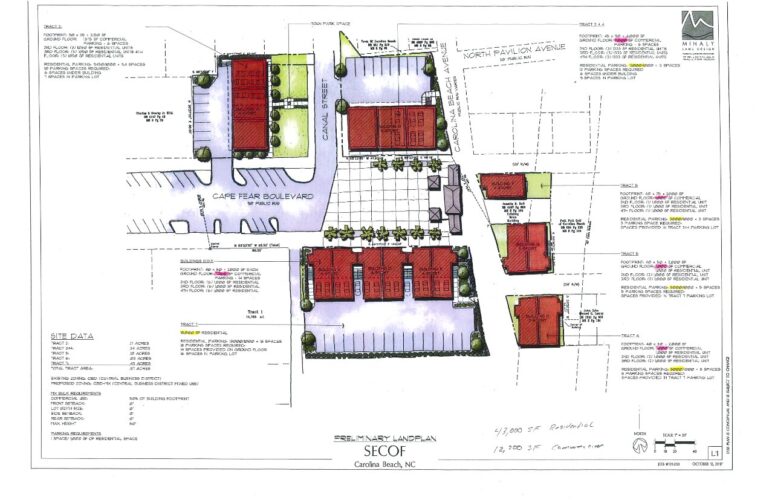
The central business district allows buildings 50 feet by-right. The plans were never set into motion and Cofer did not respond to Port City Daily’s request for an interview by press.
“I have no idea why they did or didn’t do that,” Mayor Lynn Barbee said. “But, certainly, it was in our interest for them to not do that because then the downtown park idea goes away. So when they signaled that they would be interested in discussing other options, that certainly piqued our interest.”
Barbee said the town was itching to own the properties around the boardwalk entrance and gazebo stage for more than a decade. Town councils of the past have wanted to turn the area — a hub for tourism in Carolina Beach — into an oceanfront venue, he explained.
Council members Rouse, Losito and Jay Healy said owning the nine properties brings forth “generational change.” It assures the downtown Carolina Beach area remains a community and tourist attraction, with the boardwalk entrance being the heart of the town.
“That is going to be the center of activity,” Rouse said. “Has been and probably will be for generations.”
Council members have not had conversations yet about what to do with the parcels, despite sharing hopes for more entertainment space to host their events.
“There have been preliminary talks, but I don’t think anything’s set in stone,” Losito said.
Currently, 1 Cape Fear Boulevard houses boardwalk rides, rented by SECOF Construction, which is owned by Cofer. The fate of the yearly summer attraction remains up in the air, Healy said.
Ultimately, the plan is to use parcels for a public amenity. The goal for the next two years consists of council and staff to draw up plans for an oceanfront park. This will include getting public input from residents, according to Rouse.
Barbee also explained there were no plans to receive a return investment.
“We’re not going to create a park and say: ‘How do we charge enough people to come to our park to pay for it?’” Barbee said. “That’s not how public assets work. It’s an amenity for the public.”
Port City Daily followed up with the mayor to ask if the town or council would ever be interested in selling any of the properties in the future; he explained that hasn’t been discussed yet.
The negotiation
In order to secure the parcels, Rouse and Barbee negotiated the price down from $15 million. Upfront, Rouse told Cofer and Murphy he was doubtful the town would be able to pay the full $15 million. This was due to mounting legal fees and the disparity between the appraised value and asking price. The nine parcels are valued at $3.45 million cumulatively, according to the appraisal.
The parties added a leaseback agreement to the deal; Carolina Beach Land Holdings will pay the town $1,000 a month to continue renting four of the properties until the lease ends in September 2028. The company has private parking lots on the parcels, with revenue generated from them to make up for the $3 million in the reduced price tag.
Rouse explained Cofer and Murphy told him they made “well over” $1 million a year in parking revenue from the lots near the boardwalk.
“So, I was like, if you can make that, OK, let’s take $3 million off the price,” Rouse said. “And they agreed — because they obviously know what they’re doing, they know what they’re making, and they were willing to do the deal.”
He added the town was unlikely to make that amount from the parking lots because Carolina Beach Land Holdings charges more — one lot comes in around $11 an hour. According to town and Pivot staffing, the lot’s pricing is dynamic and changes often, meaning the prices fluctuate depending on market circumstances.
By comparison, Carolina Beach’s parking program is run by Pivot, which charges $6 an hour and $25 a day, flat.
According to Town Manager Bruce Oakley a figure on how much the town could make a day on the parking lots has not been calculated.
As for how the town is paying for the nine parcels, Oakley explained it’s using $1 million from its fund balance and another $1 million from its room occupancy tax reserves. The remaining $10 million will be financed through a loan with Truist Bank over the next 15 years; the debt was approved by the Local Government Commission Sept. 1.
“We hope to land grant money to help cover some of this,” Barbee said at the Aug. 11 council meeting, wherein they voted to go with Truist.
Have tips or suggestions for Emily Sawaked? Email [email protected]
At Port City Daily, we aim to keep locals informed on top-of-mind news facing the tri-county region. To support our work and help us reach more people in 2026, please, consider helping one of two ways: Subscribe here or make a one-time contribution here.
We appreciate your ongoing support.
