


LELAND — Since Leland Town Council restricted the raising of livestock and poultry within town limits in March, Jay Lafayette McDaniel II has been working to relocate his animals from his home in Marion Estates to a barn outside of town, all the while being issued violations. Now, he may face legal action should the town file a complaint with the court.
The town has issued McDaniel four citations since June, related to his peacocks and pigpen housed on residential property. The citations, each for $50, state McDaniel needs to get rid of both species to comply with the town’s ordinance.
Leland passed an ordinance in March banning residents from keeping peacocks within town limits, along with other avian species. It also limits how many pigs someone may keep on the property — one animal per 20,000 square feet. It also prohibits nuisances like an odor or noise from causing a disturbance.
READ MORE: Peacocks out, livestock restricted in Leland, following resident complaints
ALSO: Council amends animal waste ordinance in prep for goatscaping crew
Before the ordinance, the peacocks and pigs were permissible under town code. However, the ordinance change was preceded by complaints from McDaniel’s neighbors, George and Elizabeth Gibblets, who have been asking the town to prohibit the animals altogether since June 2025.
McDaniel is complying with the acreage requirements for his group of pigs — McDaniel wouldn’t say how many — though they have still been categorized as a nuisance in the neighborhood.
The Gibblets have brought concerns about health impacts related to possible animal excrement in their water and complained about the stench from the animal enclosure.
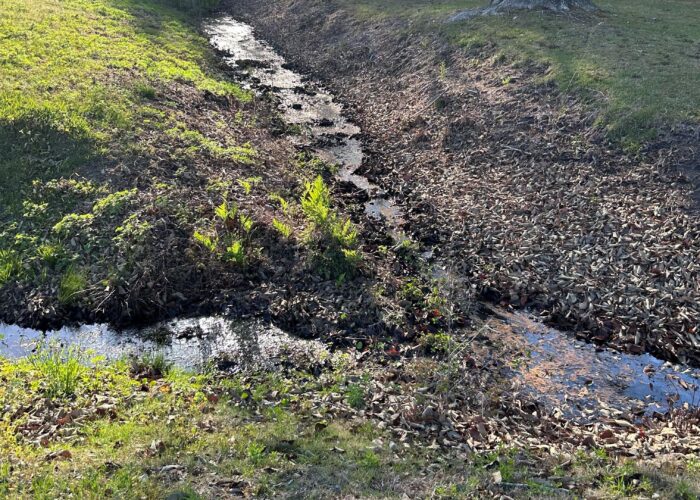
In April, the Gibblets collected water from a ditch connected to the drainage pipe between their house and McDaniel’s and had it tested by Atlantic Shores Environmental Services. It yielded a discovery of elevated concentrations of fecal coliform, a group of bacteria found in the waste of warm-blooded animals, and Enterococci — a genus of bacteria that normally live in the intestines of humans and animals.
While the levels found in the water do not exceed any threshold for stormwater drainage per state policy, it does violate county ordinance, which categorizes fecal matter as an “illegal discharge.” Atlantic Shores cited the county’s stormwater drainage and discharge code in its research and findings.
“The samples were collected from [a] non-moving water body, in a natural area. Wildlife fecal contamination could be the source or could have contributed to the elevated numbers,” Cheryl Moody, engineer with Atlantic Shores, wrote in an email to the town.
Now the town is in the process of filing a complaint with the court.
“The complaint has not been filed yet,” town spokesperson Jessica Jewell said. “The court will decide what action the Town can take regarding the animals. The Town will continue to seek compliance during this process.”
However, McDaniel explained he is in the process of moving the animals to a barn away from his house and has been since the ordinance passed. It’s also been an expensive endeavor.
McDaniel told Port City Daily all of his farm animals are actually rescues. The pigs were roaming around Leland when McDaniel and his wife set up a trap to catch them.
“We discovered that the two pigs we had rescued were already pregnant,” he wrote in an email to Port City Daily. “One gave birth just two days after arriving at our property, and the second gave birth about a week and a half later. What we believed would be a temporary rescue immediately became a much larger responsibility.”
He said the plan from the start was to relocate the pigs to a barn away from their home, but they were unable to do so immediately as the barn had to be refurbished. All the animals have been provided medical care, including vaccinations and neutering/spaying.
In total, the McDaniels have spent about $89,000 caring for and preparing to relocate the animals, including getting the new barn ready, setting up fencing, providing veterinary care, feeding the animals and other “unexpected expenses.”
“This has been an enormous and completely unexpected financial commitment that we willingly accepted because we made a commitment to these rescued animals,” McDaniel wrote.
As for the peacocks, the couple has housed them on their property since 2021, permitted per town ordinance.
“When the Town later updated its animal ordinance, we immediately began working toward relocating all of the animals,” he added. “We have done everything possible to move that process forward and are currently awaiting the installation of the new barn so the relocation can be completed. Like many construction projects, weather and contractor scheduling have affected the timeline despite our best efforts.”
McDaniel acknowledged the conversations happening on social media about his animals and noted the messages were largely inaccurate.
“Unfortunately, what began as a longstanding neighborhood dispute has now expanded into repeated social media posts about our family and our animals, including posts by Better Government for Leland,” he said.
For example, councilmember Frank Pendleton and Better Government for Leland Director Doug Field have called McDaniel’s pigs “feeder hogs,” but McDaniel said they are potbellied pigs.
Furthermore, Pendleton, who has consulted with the Gibblets on their grievances since September, argued the ordinance’s land size stipulation was problematic, suggesting the animals were maintained solely in McDaniel’s fenced-in yard.
“What they should have done is put some language in there that said: ‘A fenced-in yard is different than an open wooded field,’” Pendleton said to Port City Daily Monday. “Now what they’re gonna do is, they’re gonna count the area of woods behind this house as part of his property.”
McDaniel told Port City Daily this wasn’t true.
“The animals are not kept in a typical neighborhood backyard,” he clarified. “They are currently located on approximately an acre and a half of wooded property directly behind our home.”
Pendleton also told Port City Daily the new amendment doesn’t directly address fecal matter or animal feces, which he brought up as a concern during a council meeting earlier this year. He said he went unheard.
Pendleton did not believe the water contamination in the drainage ditch was caused by woodland animals, but rather McDaniels’ animals.
“Let’s use a little common sense here,” he said. “Do you really think all the animals in those woods behind the houses are gonna come use the bathroom in that little ditch?”
Field also told Port City Daily he didn’t think enforcement of the new amendment has been up to par, as he pointed to the animals still being on the land two months later despite the odor exuded. Field called the smell of the pigs an “industrial stench.”
However, McDaniel explained the stalls are cleaned typically three or four times a day — or twice at the bare minimum — by the two to three staff members he and his wife employ to care for the animals. They are also responsible for maintaining clean, dry bedding, applying odor-control treatments and monitoring the animals’ overall health and well-being.
“Our focus has always been on doing what is right for these rescued animals while completing their relocation as quickly and responsibly as possible,” McDaniel said. “We hope that once they are settled into their forever home, this matter can be put behind us so everyone involved can move forward.”
Have tips or suggestions for Emily Sawaked? Email [email protected]
At Port City Daily, we aim to keep locals informed on top-of-mind news facing the tri-county region. To support our work and help us reach more people in 2026, please, consider helping one of two ways: Subscribe here or make a one-time contribution here.
We appreciate your ongoing support.
