


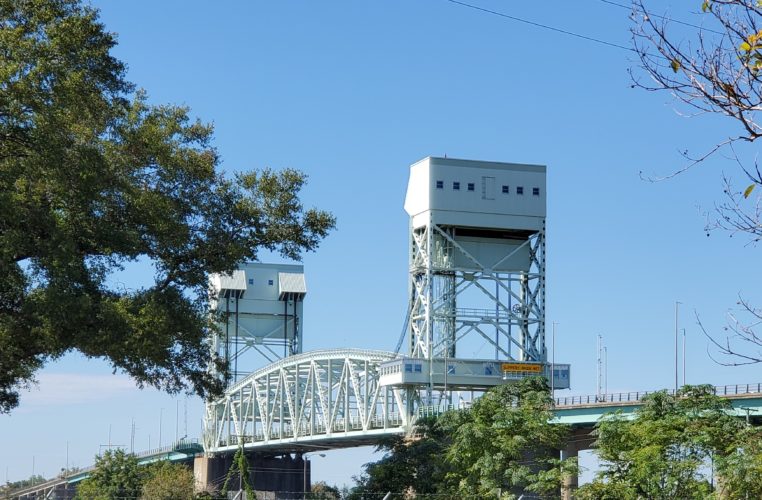
WILMINGTON — Criticism of one replacement option for the Cape Fear Memorial Bridge has prompted the North Carolina Department of Transportation to make a major modification and open a new public comment period on the updated version.
NCDOT Division 3 Engineer Trevor Caroll announced in a press conference Wednesday morning the agency has modified Alternative B, the 135-foot fixed-span bridge. As a result, the original design for the 135-foot bridge is no longer being considered.
The modified version features a corkscrew ramp along the river allowing the bridge to deposit cars onto Third Street instead of Fifth Avenue, as the original design included. Many critics of the original design were concerned about the significant impact the bridge’s expanded infrastructure would have on downtown Wilmington, including the city’s and Cape Fear Public Utility Authority’s $15.75-million contribution to Fifth Avenue improvements and other city investments.
“We received over 1,800 comments for this project in this previous open period,” Caroll said, referring to the public comment period that closed last month. “This modification should really show everyone how serious we are about those public comments and that they matter. What we have done is minimize a lot of those concerns.”
READ MORE: City submits 3 alternative CFM Bridge designs for NCDOT review, calls agency’s analysis ‘incomplete’
ALSO: Rouzer to seek extension of CFMB grant deadline, announced at transpo summit
According to NCDOT’s estimates, the new design will also cost $1.02 billion, less than both originals, which came in at $1.03 billion for the 135-foot and $1.11 billion for 65-foot fixed bridge with a movable span reaching 135 feet (Alternative A).
The replacement project’s design team has been evaluating two options since the U.S. Army Corps of Engineers and U.S. Coast Guard determined the replacement bridge should have a 135-foot clearance.
The original 135-foot bridge drew criticism from many local legislators, particularly the Wilmington City Council, the Historic Wilmington Foundation and other Wilmington stakeholders, due to the impact it would have on downtown. According to the project’s environmental assessment, a bridge reaching to Fifth Avenue would affect 63 parcels and potentially require the relocation of two homes and two businesses, compared to the 65-foot bridge’s impact on 22 parcels and potential relocation of three businesses.
Caroll said Wednesday the modified 135-foot bridge will impact 17 parcels instead of 63.
Port City Daily asked NCDOT why the modified design was not presented as the original option but did not receive a response by press.
NCDOT is opening a new public comment period on the new design and the 65-foot bridge. Feedback can be submitted until Dec. 4 either online or via mail; there will not be any in-person public comment sessions.
Project timeline, the toll question
Carroll said Wednesday the modification and its public comment period will not delay the replacement project’s timeline. NCDOT’s intention is to choose an alternative design in early 2027.
NCDOT and the other state and federal agencies on the project team are also being held to a federal grant timeline. The Cape Fear Memorial Bridge replacement was given $242 million from the U.S. Department of Transportation, though these funds need to be obligated by September 2027.
New Hanover County and Wilmington elected leaders have called for the federal government to either provide more funding for the project or extend the grant obligation deadline in an effort to avoid or reduce the project’s need for tolls. Right now, the remaining price tag for the bridge — aside from the federal $242 million and NCDOT’s $85 million contribution — would need to be paid for through tolling.
The Wilmington Urban Area Metropolitan Planning Organization, made up of representatives from the tri-counties and their municipalities, voted to submit the project with tolling included in January 2024. The WMPO could choose to rescind its approval, though this would need to happen in February.
On Wednesday, Carroll confirmed the tolling of the new Cape Fear Memorial Bridge could also be hindered in another way: The state legislature will need to approve the tolling of an existing facility.
State law currently allows NCDOT to toll new roadways. NCDOT’s position throughout the last few years of discussing the Cape Fear Memorial has been that the replacement bridge is a new facility, even though it is replacing an existing route.
Port City Daily asked NCDOT when its position changed and who made the determination that the replacement bridge would not be considered new. NCDOT did not respond by press.
Carroll said the North Carolina General Assembly will need to pass an authorization in February to keep the project on track to meet the federal grant’s deadline.
It is unclear what the path forward would look like without legislation approving the toll. An un-tolled version of the bridge has not scored high enough for inclusion in NCDOT’s State Transportation Improvement Program, meaning it would not receive the state’s $85 million in funding without the toll.
Carroll said NCDOT would need to determine next steps in the event of a toll prohibition.
At the press conference, Ben Schachtman of WHQR also asked the Division 3 engineer if NCDOT was considering the bridge replacement options submitted by the City of Wilmington in the last round of public comment.
“Our current path that we’re trying to deliver only considers these two alternatives at this time,” Carroll said. “Some of those options that the City of Wilmington presented are, I would say, welcome alternatives; however, constraints for this project, delivering this project on schedule, we do not have the opportunity to explore these options within this time frame.”
The city’s three options include two lift bridges side-by-side, one for incoming traffic and the other for outgoing. This would retain the current CFMB, with repairs, and cost around $585 million, according to the city’s consultants. Another option was revival of the “southern bridge” closer to the Port of Wilmington, though this would cost $6 billion.
The third option is replacing the CFMB with a bascule bridge, like the Isabel Holmes Bridge to the north. Under the consultant’s scenario, the bridge would be 65 feet and open to 135 feet, though it would need to be built across a 200-foot-wide channel to remain cost-effective.
The U.S. Coast Guard currently mandates a channel width of 400 feet at the Cape Fear Memorial Bridge, thus the channel width would need to be reduced to accommodate this type of bridge.
Carroll said NCDOT has been in talks with the U.S. Corps of Engineers about reducing the channel width.
“Those details have not been ironed out yet,” he said, adding if new pathways open up NCDOT would consider them.
