


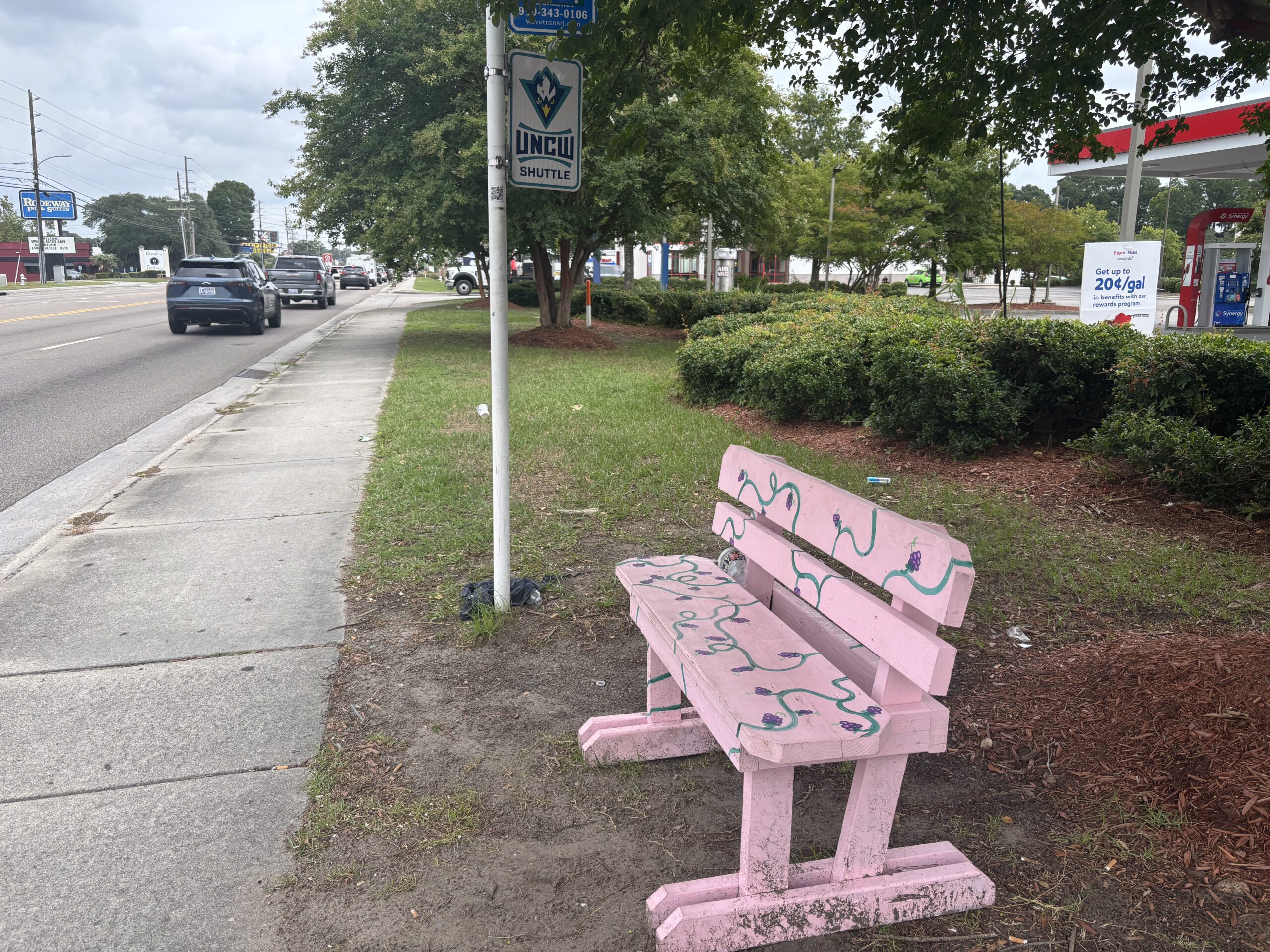
WILMINGTON — The handmade bus benches installed by the Wilmington Democratic Socialists of America have highlighted a problem nearly everyone agrees exists: most Wave bus stops have nowhere for riders to sit. But while officials debate how to handle the unauthorized benches, they still haven’t decided who will remove them or what comes next.
The Wilmington DSA began building benches from scrap wood last year after learning the majority of bus stops in the county were without seating of some kind; they have installed more than 30 thus far.
Out of Wave’s 400 bus stops, 98 currently have amenities; 62 have benches and 36 have both a bench and shelter, the transit authority said.
READ MORE: Wave needs $800K to deliver on-time performance, leaders react to proposed routes
ALSO: City to host its own World Cup watch party amid noise dispute with The Rift
“It doesn’t make sense that the city spends as much money on the police and development,” former co-chair of DSA David Braga told Port City Daily earlier this spring at the MayDay potluck in Long Leaf Park. “Where we don’t have a public transit system that has adequate seating and shelters, despite the city being routinely too hot or occasionally frozen.”
Email discussions among officials regarding the benches go back to the first week of July. Wave Executive Director Mark Hairr wrote on July 14 to the Cape Fear Public Transportation Authority board, inclusive of county and city officials, that DSA had not followed the city’s or NCDOT’s permitting process for installing street furniture in public rights-of-way and had not sought Wave’s approval before placing the benches.
Though DSA has been building and installing benches since 2025, recent criticisms about political messages painted on them captured the city’s attention. Attorney Meredith Everhart emailed city council July 6 to inform them Wave asked DSA to take away the benches.
Hairr wrote to county and CFPTA board members July 14 he requested their removal “as soon as possible.”
On Tuesday, Port City Daily asked if the group would be relocating the benches but did not receive a response by press. However, on Monday ILM-DSA said its “main goal is working with the community to improve conditions and as of now we are confident we can work with the City and WAVE to achieve this.”
The organization sent an email to its members on Monday as well, sharing recent news coverage from WHQR, adding they wanted to “address permitting and code compliance concerns” with the city. The group included a petition for people to sign in support, which has more than 2,400 signatures to date.
Everhart wrote in a July 6 email thread to officials: “Wave can give them the option of removing the benches themselves or having Wave remove them and store them until a decision on what to do with them can be reached.”
However, a spokesperson with Wave told Port City Daily Monday the transit authority would not be removing the benches, since it’s a city and state right-of-way infraction. The spokesperson said all questions about their removal should be referred to the city and state.
Port City Daily reached out to ask the city if it was looking to remove the benches, and inquired whether a notice of violation or fines were issued or going to be if the benches aren’t taken out. DSA has yet to receive either and the city did not answer any of Port City Daily’s questions.
Instead, spokesperson Amy Willis wrote: “The City continues to work with Wave to gather information and evaluate the situation before determining next steps.”
It also remains unclear how much it may cost if the city has to remove the benches and if it will land on taxpayers in the end.
Possible paths forward
Though nothing has been set in stone regarding the benches, a few ideas have been floated on merging the community efforts with Wave’s needs.
In an email sent to Hairr, the council and Everhart, city council member Salette Andrews pointed out the organization highlighted an important fact.
“If the current benches cannot remain in their present form because they were installed without authorization, I understand that. However, I would like us to find a path that preserves the community’s willingness to help while ensuring that future donations meet the appropriate standards,” she wrote.
She suggested Wave put together a formal “bench and shelter donation program” to allow organizations, even beyond DSA, to continue providing amenities for transit riders. The councilwoman is also a sitting board member on the Cape Fear Public Transportation Authority.
“Such a program could establish clear, content-neutral standards regarding design, ADA compliance, engineering review, placement, maintenance, and donor recognition,” Andrews wrote.
Wave must follow North Carolina Department of Transportation and federal government guidelines, especially as it relates to accessibility. Under the Americans with Disabilities Act, bus benches must be at least 42 inches long and between 20 to 24 inches deep. The top of the bench seat must measure between 17 and 19 inches above the ground or floor space and must include back support, also at least 42 inches long.
The DSA’s benches are 48 inches long, 31.5 inches tall, and the seating is roughly 13.25 inches deep.
NCDOT also mandates benches cannot be on streets whose speed limit exceeds 45 miles per hour. The bench or shelter must be behind the sidewalk; where there are no sidewalks, a concrete or asphalt pad needs to be installed. The distance between the bench and the edge of the pavement is 12 feet for 45 miles per hour, 10 feet for 35 miles per hour and 8 feet for 25 miles per hour.
Roads managed and owned by the NCDOT also need an easement or encroachment agreement, in order to place bus stop amenities, so if the benches placed are on a NCDOT road, the DSA is further out of compliance.
Hairr agreed to research the program proposed by Andrews and bring up the matter at the Cape Fear Public Transit Authority’s August meeting. Wave did not confirm concrete plans to create a donation program.
Other potential courses of action include a permitting process to allow street furniture in public rights-of-way or an official donation agreement between Wave and the Wilmington DSA chapter, according to an email from Everhart.
Hairr noted the transit authority has ordered 19 complete bus shelters — including benches, a bike rack, trash cans — and planned to purchase an additional 19 benches for other stops. The work will take a year or more to complete. The project would bring the number of stops with amenities to 136 out of more than 400 stops Wave manages.
The price tag is $5,000 for a bus stop bench and $20,000 for a complete shelter to be built at a bus stop, according to Wave spokesperson Brianna D’Itri. It would bring the total cost of the project to add amenities to 38 bus stops is $765,000, with $612,000 coming from federal funding and $153,000 in fund matching from the city and the county.
Wave further explained it had not received notice of its funding being in jeopardy due to the benches.
The transit authority intends to put out a request to find an engineering firm to help with installations.
“Adding amenities often includes the cost of engineering services, pouring a concrete pad, pouring concrete to connect with existing sidewalks, and the purchase and installation of a shelter, light, bench, bike rack, and trash receptacle,” D’Itri said.
How the controversy grew
Emails between the city, Wave and county indicate the benches came to the forefront of discussion after complaints were received about messages painted on the seating: “Let natives thrive,” “Liberation for all,” “No rent for slum lords” and “Rent freeze now,” for example. However, not all of the seating contains messaging.
Port City Daily asked the city how many complaints it received but did not receive a response.
One message obtained by Port City Daily from the county terminal — the city no longer provides the media or public a terminal to view internal emails among staff and officials — showed resident Duane Bell supported the community grassroots effort, calling the bench installations a good idea.
“However, these benches (according to my sources) continue political messages/propaganda,” Bell wrote. “Wave is subsidized in part by the taxpayer, all the taxpayers regardless of their political persuasion.”
State statute dictates partisan messaging and signage can only be placed in the public right-of-way during a brief period of time before and after elections; however, this primarily refers to campaigning. If they are on a state-owned bus route, an encroachment agreement with the North Carolina Department of Transportation is required.
DSA told Port City Daily while the benches highlight stances on varied issues, there is not support of any political party or candidate. It added the group would rather not remove the bench messages.
“Our purpose is to promote social welfare and engage politically to that end,” the DSA provided in a statement. “Therefore we believe this falls well within our First Amendment rights and our purpose as an organization. We would like to see a path forward that doesn’t involve the removal of messaging but no decision has been made about this by anyone, including our own membership.”
Port City Daily followed up with DSA to inquire how the current benches would be brought into compliance and how it envisions working with the city to continue its program if allowed. A response was not received by press, though Monday DSA said it would continue painting and building benches, while pausing placement on new ones.
Have tips or suggestions for Emily Sawaked? Email [email protected]
At Port City Daily, we aim to keep locals informed on top-of-mind news facing the tri-county region. To support our work and help us reach more people in 2026, please, consider helping one of two ways: Subscribe here or make a one-time contribution here.
We appreciate your ongoing support.
