


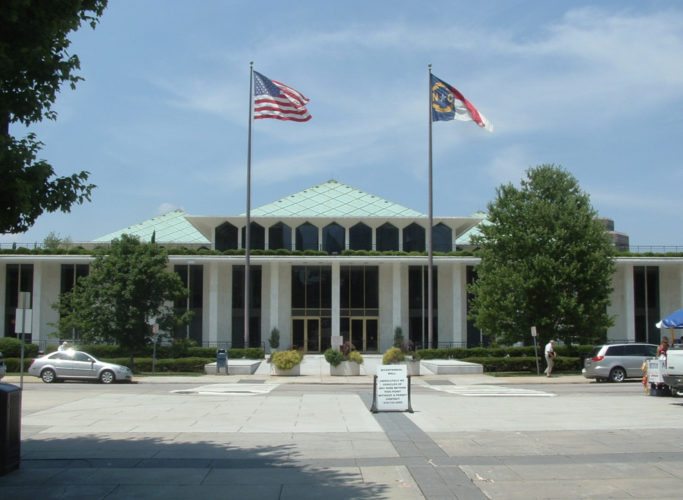
Two property tax bills have emerged from a North Carolina House of Representatives committee ahead of the state legislature’s short session, despite pushback from local leaders and some state legislators on the impact on local governments’ ability to govern.
On Wednesday, the House Select Committee on Property Tax Reduction and Reform put forth an amendment to the state constitution allowing the legislature to enact levy limits on property taxes. The goal is to alleviate increased costs on taxpayers associated with rising property tax bills across the state.
READ MORE: Local leaders wary of state’s search for property tax ‘reform’
Rep. Brian Echevarria (R-Cabarrus), the amendment’s sponsor, said at Wednesday’s committee meeting the amendment does not tread on locally elected leaders’ authority, but argued it is the state’s duty to put guardrails in place.
“Most of our local government officials have been responsible stewards of the public’s purse,”Echevarria (R-Cabarrus) said. “However, let’s imagine a day when they are not in office and others who may be less responsible are at the helm. Should your neighbors be protected in the future?”
The amendment would need a three-fifths vote from both the House and Senate, along with majority approval from the state’s voters. If passed by the legislature, the amendment would be placed on the Nov. 3 ballot.
The other bill endorsed by the committee is intended to close a loophole in the tax code that allows for-profit apartment complex owners to gain property tax exemptions aimed at nonprofits. North Carolina law allows nonprofits to avert the tax for property used as housing for low- or moderate-income individuals. The loophole was created in 2013, when the North Carolina Court of Appeals ruled that a low-income housing project owned by a for-profit limited liability company but controlled by a nonprofit, was entitled to the exemption.
Unlike a limit on property assessments or the local tax rate itself, a levy limit is essentially a cap on how much revenue a municipality could collect from the tax each year.
For example, this could look like a 2% limit on how much funding a municipality could collect over the prior year’s revenue; the proposed amendment does not set a numerical limit.
The committee has been meeting since January after House Speaker Destin Hall charged the committee with examining ways to “reform” state property tax law. Though its work is finished for now, the committee plans to meet after the election, should the amendment gain voter approval, to discuss how the levy limit would work and any exceptions to the rule.
States that have enacted levy limits tend to allow local governments to exceed the limit by posing the question to the voters in a referendum. Such was the recommendation from Air Mandal from the Tax Foundation, a nonprofit, conservative-leaning think tank when he presented his support for levy limits to the committee in February.
However, the voter approval workaround is complicated in North Carolina, which doesn’t allow special elections for voter referendums; the question on whether to allow a government to exceed the cap would need to be on a primary or general election ballot. As budgets are often developed in the spring ahead of a July 1 adoption, a primary ballot initiative would be most conducive to budget planning.
Even with addressing the intricacies of a levy limit, the move would still restrict local governments’ ability to raise revenue. Right now, locally elected leaders can raise taxes as they see fit based on the services they want to provide; if their constituents don’t like it, they can voice their opposition, but ultimately the only lever to stop the move would be to vote the leaders out, often after the disputed tax level goes into effect.
“We know there needs to be a solution; at the same time, property tax is a primary funding source for local services,” Rep. Maria Cervania (D-Wake) said at Wednesday’s committee meeting.
As North Carolina ranks the highest for state-to-state migration, the demand for housing, and thus, property values, increases. New Hanover County, in particular, experienced a 67% rise in average from 2021 to 2025.
Pender County’s revaluation this year, the first since 2019, saw an average increase between 105% and 110%, prompting shocked commissioners to pause the revaluation in a legally questionable move. The commissioners have vocalized their support for Senate President Phil Berger’s plan to bring forth a 12-month moratorium on property valuations to the Senate floor once session resumes April 21.
According to the Tax Foundation, however, 64 of the state’s 100 counties had revenue growth exceeding growth of its property values, indicating county commissioners were making policy choices in favor of increased spending.
Rep. Eric Ager (D-Buncombe) had a different opinion.
“Let’s be clear: the reason property taxes are going up in nearly every county in the state is that this body has not really done enough to pay the state share of necessary services, while at the same time continuing to pass unfunded mandates,” Ager said at the meeting.
He listed Medicaid administration as one example, though citizens have called on the state to do more in other areas, such as education funding. The Republican-controlled legislature failed to pass a budget last year as well.
Still, proponents of the amendment argued municipalities should learn to live within their means and reduce spending to keep impacts to homeowners low.
John Blust (R-Guilford) said he’s gotten many emails from municipalities opposing the levy limit likening the move to “Armageddon” and claiming critical government functions — public safety and schools — will go unfunded. He suggested this was because municipalities were spending too much on non-core services.
“We might need counties to focus on their critical priorities, rather than just you can do whatever you want in addition to these things,” Blust said. “We might need to limit it in some way, but that’s for going forward.”
Rep. Abe Jones (D-Wake) said he wanted legislators to be more specific when talking about core functions, calling on them to name the services they would like to see cut from budgets.
Jones and his Democratic colleagues on the committee urged the committee to continue exploring other options to unburden taxpayers, including more relief programs or eliminating tax exemptions for certain groups, such as hospitals.
At Port City Daily, we aim to keep locals informed on top-of-mind news facing the tri-county region. To support our work and help us reach more people in 2026, please, consider helping one of two ways: Subscribe here or make a one-time contribution here.
We appreciate your ongoing support.
