


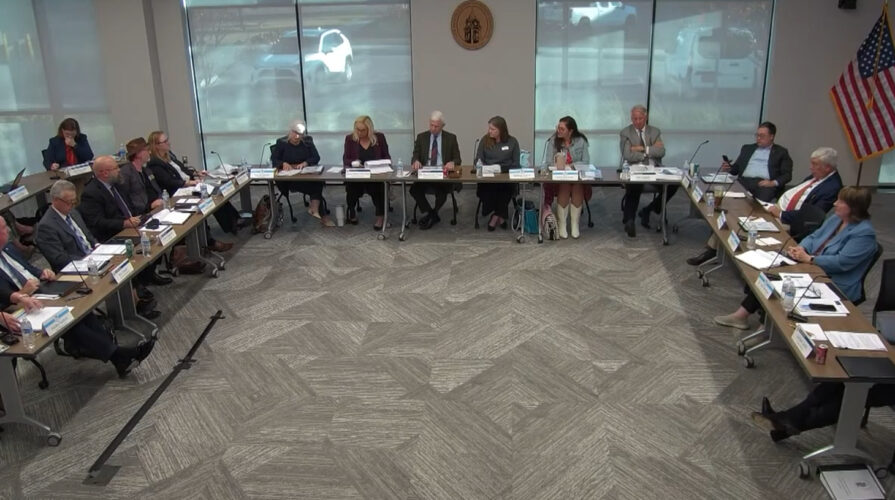
NEW HANOVER COUNTY — Two county boards came together in a joint meeting Monday to set a target amount and project list for a 2026 school bond.
New Hanover County’s board of commissioners and board of education agreed on $320.5 million bond inclusive of contingency funds and the following projects:
- Riverlights new elementary school ($53,855,851)
- Phase 1 of the proposed New Hanover High School master plan ($59,786,276)
- Replacing Pine Valley Elementary School ($56,332,402)
- Replacing Trask Middle School ($94,751,362)
- An addition to Porters Neck Elementary ($7,625,000)
- Districtwide system upgrades ($19,828,800)
- Districtwide technology upgrades ($10,000,000)
- Districtwide security upgrades ($10,000,000)
READ MORE: NHCSB bond projects: Williams and Riverlights combined, Trask relocated, Isaac Bear still a no
While the first five major school projects’ prices remained the same, estimations for the district-wide upgrades came into clearer focus since the last bond discussion. This resulted in an overall price increase from $300.5 million to $320.5 million, which will need to be approved by voters via ballot referendum in November 2026.
“We hear from our citizens every day; they want to see us improve our schools and expand the capacity of the schools and make them better for our county,” Commissioner LeAnne Pierce said at Monday’s meeting.
NHCS staff also gave a breakdown for the upgrades. The highest costing HVAC project is going to Laney High School to replace its cooling tower and all water source heat pumps at $2.06 million, along with $1.3 million to both Holly Shelter Middle and Wrightsville Elementary, though ultimately 27 schools will be affected by these upgrades.
The security updates will include building security vestibules, or a controlled entrance for school visitors, which were sidelined in the most recent budget cycles as funding for this effort was thin. The sequencing of the installations, each $1 million, are as follows:
- Roland Grise/Laney: 2027
- Ashley/Hoggard: 2028
- Alderman/Mosely: 2029
- Forest Hills/Murray: 2030
- Bradley Creek/Sunset Park: 2031
- Bellamy/Codington: 2032
- Noble/Wrightsboro: 2033
- Ogden/Myrtle Grove: 2034
- CRECC/Holly Tree: 2035
- Holley Shelter/Eaton: 2036
Fr the technology upgrades, the $10 million provided will put a dent in the school district’s cyclical replacements of classroom computers and iPads. In the past, county commissioners budgeted various amounts, usually around $1 million, every year for the district to make upgrades.
“If we were just spending a million a year, it would take us 19 years to complete the process,” Dawn Brinson, assistant superintendent of technology and digital learning, said, noting the district deems technology out of date around the five-year mark. “So with a $10 million from the bond, we’d get to then take care of our elementary schools and a couple of our high schools and central office.”
However, the district has nearly $8.5 million in additional upgrades it would need to find funding for elsewhere.
Brinson stressed the technology is not an accessory to classwork, but rather needed to satisfy computer science standards in the North Carolina course of study.
“I do want to let you know that we are constantly reviewing devices and trying to save money and get more affordable devices than what we currently are using,” she said.
No one at Monday’s meeting took issue with the project slate, though there was some conversation about what was not included: the subsequent phases of New Hanover High School’s renovations.
The 103-year-old school has been in need of significant renovations for years, with the county commissioners recently covering an $8-million repair to the building’s foundation and then commissioning a master plan to determine the extent of other work needed.
Three options emerged: a $280-million rebuild on 70 acres, a $137-million renovation, or a hybrid solution with renovations and new construction ranging from $195 to $230 million. The board has voted in favor of the hybrid solution, which could be built out over 10 years if each of its four phases were constructed in succession; the board voted for a 12-year build out, though there is no identified funding stream beyond the project’s first phase.
The hesitancy to fund all phases stemmed from worries over the large price tag and the county’s debt constraints. Essentially, the county can only issue debt of $541.4 million — inclusive of both school and other county needs — without exceeding its debt-per-capita cap. However, the $320.5 million will exceed the $2,200 cap for a brief period, requiring the county to suspend its policy; NHC Chief Financial Officer Credle said he approves of the measure with a clear plan to come back into compliance with the $2,200 amount.
Still, some elected leaders worried about embarking on renovations without an explicit directive and funding stream to finish the remaining phases (though each is intended to be standalone).
“We’ve got a puzzle,” Commissioner Stephanie Walker said. “We’re fitting the pieces in, and we’re spreading it around, and we really want to get the voters to say yes to this, but we can’t just leave New Hanover hanging.”
Commissioner Rob Zapple agreed.
“I hate to come to the break point of getting through phase one and have the feeling that we did not complete the job at New Hanover High School,” Zapple said. “Instead, we just went with the new construction.”
Phase one includes securing the perimeter of the school and bridge, along with a new auto shop, dining hall, band and orchestra room, student union and culinary arts area. Renovations to the existing campus would only occur in later phases.
Zapple indicated his willingness to add more money to the bond amount to further help NHHS, but he said he knew he was “pushing the rock up the hill” on that front.
School board member David Perry thought there should be an agreement between the commissioners and board of education committing to funding all phases of NHHS.
“The kids that go to New Hanover High School for the next 100 years deserve to have a place that’s just as high in quality as our other high schools,” he said.
However, his idea didn’t gain traction due to the worry about tying the hands of future boards. County manager Chris Coudriet also noted the bond would represent what the county could commit to NHCS over the course of 10 years and another bond to fund the other phases within that time wouldn’t be feasible.
School board member Josie Barnhart noted cost savings from other bond projects coming in under budget could be reallocated, potentially to another phase of NHHS. Her colleague Tim Merrick suggested the school board and county look to The Endowment to fund future phases.
“I don’t know what we can do with the three different budgets — county, the school board and The Endowment,” he said. “We should be able to get phase two done if we really want to.”
Elected leaders Monday emphasized the school bond would affect every corner of the county, not just nodes of growth (and because only phase one of NHHS is included, not just one school).
“The tech and the security, safety issues that seem like they’re tacked on to the end of this, are not completely tacked on to the end,” Merrick said. “What we’re really seeing is that every student, every community in New Hanover County, is being touched by this. We really are serving everyone.”
The next step in the bond’s progression is educating the public on what’s included, and though the boards can provide information on the bond, they can’t advocate for it. North Carolina law prevents public funds from being used for advocacy and the election of both people and referendums, thus the two boards discussed outsourcing the job to a third-party.
On Monday, the joint boards requested the Greater Wilmington Chamber of Commerce to take on the advocacy work. The chamber already conducted a survey on a school bond; out of 300 residents and likely voters surveyed, 70% said they would approve the bond referendum. CEO and President Natalie English said this was done before details of the bond had been hashed out, so she thought more people would be in support after learning more about the district’s bond needs.
“I do believe there is significant support in our business community to move forward with this bond issue, and we have done some research, and believe there’s a lot of voter support for it as well,” English said Monday.
Taking on the advocacy role would need approval from the chamber’s board, which meets Thursday.
Reach journalist Brenna Flanagan at [email protected] or text our tip line at 910-800-6397.
Want to read more from PCD? Subscribe now and then sign up for our morning newsletter, Wilmington Wire, and get the headlines delivered to your inbox every morning. You can also sign up for our text club and get updates straight to your phone; text JOIN to 910-800-6397.
