


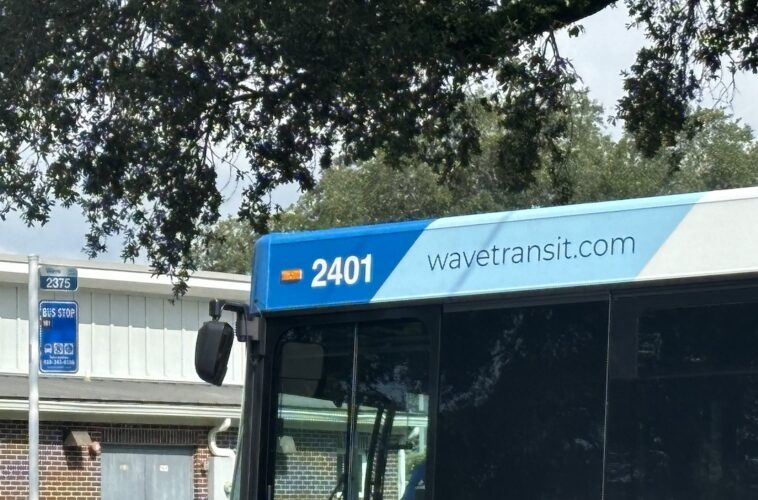
WILMINGTON — Wave Transit staff revealed to its board last week it will need an additional $800,000 — plus potentially $650,000 for another bus — to reach on-time performance in its Wave Reimagine plan implemented a year ago. Wilmington and New Hanover County elected leaders would need to fill in the gap.
The $800,000 would cover the cost of adding another bus to Route 107 servicing the College Road corridor. The money also covers the cost of operating the UNCW Teal route year round, whereas the route only now operates during the university’s spring and fall semesters.
READ MORE: Wave Transit facing deficit and performance quandary, tweaks to routes postponed again
ALSO: City, county misaligned on Wave Transit vision, delay vote on recommended performance shifts
The changes would be coupled with other adjustments to routes 105 (Randally Parkway to Medical Center), 109 (College Road to Medical Center) and 210 (Greenfield Street to 17th Street) that incur no additional cost. These routes are experiencing dismal on-time performance; the buses continue to be late 30% to 40% of the time, attributed to traffic congestion.
In December and January, not a single bus route reached Wave’s target on-time performance metric of 88%, despite Wave overhauling its route system in January 2025.
“I think the easiest way to encapsulate this is to maintain what we all thought was going to be a particular level of service; turns out, we are unable to do that with the current level of funding and how many buses it provides at what frequency,” Wave Transit board member and Wilmington City Manager Becky Hawke said at the Feb. 26 meeting. “And so in order to meet the schedule that we all thought we would be able to deliver into the community, it turns out that we need to make additional investments in order to have any chance of doing that.”
The changes need approval from the Wave Transit board, which includes staff members and elected leaders from New Hanover County and Wilmington.
However, staff members would need to convince respective elected leaders — some of whom are already deliberating facing a multi-cent tax increase — to agree to Wave’s needed funding.
Hawke agreed to present the findings to Wilmington City Council at one of its upcoming budget sessions.
County Manager Chris Coudriet also said he would recommend covering up to 50% of the $800,000 price tag. However, the $800,000 request could jeopardize any other operational increases, often done in response to inflation, in Wave’s budget this year.
“At some point, we’re going to have to accept there’s a finite set of changes, a finite amount of money,” Coudriet said.
Wave Transit’s staff has formally requested New Hanover County extend its operating subsidy by 6%, the same increase it requested in last year’s budget cycle. Wave Transit has not yet issued a formal budget request to the city. Wave is currently pulling from reserves to balance its budget annually, though this practice will deplete the system’s fund balance by the 2027-2028 fiscal year.
At that point, the system could be faced with a $4-million deficit if it didn’t reduce operations.
Still, Coudriet indicated he wouldn’t recommend the county commissioners provide much more than the $400,000 this year.
“I’ve already signaled to Mark 6% is probably not something that we’re willing to recommend,” Coudriet said.
The county manager, who chairs the Wave Transit board, has been resistant to increasing funding for Wave since the group began discussions over the proposed route changes in December.
Wave Transit implemented its Reimagine Wave plan in January 2025, deploying a redesigned network of bus routes; eight of nine routes underwent major changes and two new routes were added. As a result, both the buses and RideMicro, the point-to-point rideshare service, are experiencing higher ridership.
Coudriet’s view is that the system is bringing in more riders, and thus, questions if increased funding lines are necessary. But the system is not currently successful at picking up or getting riders to their destinations on time.
The route changes
In December, transit staff presented cost-neutral options to fix on-time performance, though they would have required a reduction in frequency and in some instances, removal of stops. When staff mentioned the option of adding more buses to maintain frequency, Wave Transit board asked to see how much funding it would take to implement.
Staff came back with a bundled deal for changing routes — tweaks to one would require them to all (available in full detail here). The two routes with costs associated are the Teal and Route 107; the former would need $360,000 to expand service year-round.
Currently, UNCW pays a portion of the operating fee for the Teal, which runs UNCW students to campus but also provides any bus rider with access to New Centre Drive. When school is not in session in the summer, this service goes away and riders have to rely on another route for New Centre Drive stops. In the original, cost-neutral plan, a New Centre Drive stop would have been eliminated, but the updated plan retains it.
Hawke asked if there was an opportunity to bring UNCW to the table to negotiate its cost-sharing agreement, should the Teal operate all-year in the future and serve UNCW’s summer semester students. Wave Transit Executive Director Mark Hairr said the contract is discussed annually and UNCW has been amenable to updates.
Making up the other portion of the $800,000 would be $436,000 to add another bus to Route 107. Because New Centre Drive would be covered by the Teal, this route would bypass New Centre Drive and take College Road instead. Frequency would be maintained by adding another route, so there would be a 30-minute frequency between Forden Station and Monkey Junction.
The additional bus would be pulled from Wave’s spare inventory; it currently has three. Wave would want to replace the spare at some point — buying another bus would incur an additional $650,000 — though this would not be necessary to begin implementation of the new plan.
The proposed changes also will extend RideMicro’s boundaries to supplement services between St. Andrews and Monkey Junction. Route 210 would continue south on Carolina Beach Road to serve Monkey Junction every 90 minutes on weekdays and every two hours on weekends. All other trips would terminate at Carolina Beach Road and St. Andrews Drive before returning to Padgett Station. Riders could use RideMicro in between frequencies.
Hawke questioned the reliability of requiring riders to transfer to RideMicro — at an additional $2 cost — and how far in advance they would need to do so.
“RideMicro will show up; we know that they don’t miss trips,” Deputy Director Jonathan Dodson said. “I can bring some metrics about the duration, the wait time.”
Dodson also said only 20 to 25 people take the 210 to Monkey Junction daily, so staff could reach them to educate them on the changes and timing needed to book RideMicro.
The board requested staff bring back an operational scheme of this action, as well as how riders could transfer for free, though the latter option would set the route apart from other RideMicro transfers, which cost money.
Dodson explained the adjustments to 210 could be launched outside the bundle of route changes; it doesn’t have costs associated with it and its overall changes are under the 20% threshold that would trigger a formal public hearing. Staff would need eight weeks of lead time to begin the updated route and said other route changes would need to happen in August, after the city and county’s new budget take effect July 1.
However, the board did not want to move forward on 210’s changes without its operational questions answered and rider feedback.
Servicing the orthopedic hospital
At the Wave Transit board’s Jan. 22 meeting, a rider requested the board to ensure a route service to the New Hanover County Orthopedic Hospital on Wrightsville Avenue. Route 103 used to stop at the facility, but the stop was removed in the Wave Reimagine plan. Now, the closest stop is on the 206, about a mile away.
The board asked staff to examine a way to service the facility using an existing route.
The cost-neutral plan staff presented last week would reroute the 206 on Oleander Drive, heading inbound toward College Road. The route would detour and stop at Hinton Avenue, drive down Park Avenue, take French Road up and stop at its intersection with Wrightsville Avenue, then drive down State Road 1411 to the hospital, where it would stop before returning down Hawthorne. It would stop at Hawthorne and Oleander before continuing on.
Wave Transit said the new route would lose riders slightly due to the lost stop at Oleander Drive and Adirondack Way, which services apartments near Tidal Creek.
“It’s taking away from a strong core of a bi-directional [route] to instead, we’re going to redirect it for somewhere that the data set didn’t demand it,” Coudriet said.
Dodson said that would be correct, though other transit board members noted more demand could be coming with Novant Health’s $1.1 billion planned expansions to the hospital.
Hawke asked staff to move the stop Wrightsville Avenue and French Road and move it south on French Road to be closer to the apartments. Staff said they would need to drive the route to understand its feasibility. No vote was taken on the changes to 206.
At Port City Daily, we aim to keep locals informed on top-of-mind news facing the tri-county region. To support our work and help us reach more people in 2026, please, consider helping one of two ways: Subscribe here or make a one-time contribution here.
We appreciate your ongoing support.
