


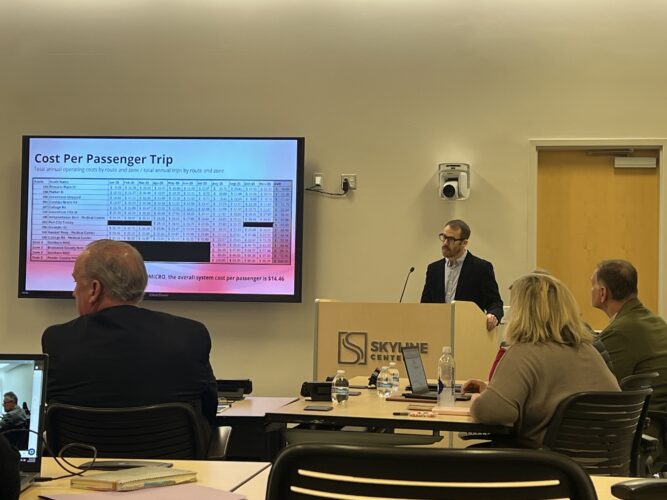
NEW HANOVER COUNTY — Earlier this month, what was intended to be a workshop on route changes in the Wave Transit system turned into a strained conversation on funding public transportation. It highlighted another potential fault line between New Hanover County and the City of Wilmington.
The Cape Fear Public Transportation Authority, which oversees the Wave Transit buses and RideMICRO program in the county, implemented its Reimagine Wave plan almost a year ago. The authority deployed a redesigned network of bus routes; eight of nine routes underwent major changes and two new routes were added.
READ MORE: Wave Transit to nab more local funding, improve bus service for thousands
On the plus side, Wave has seen an 8.6% increase in its fixed-route ridership and a 26% uptick in RideMICRO, a point-to-point rideshare service designed to reach areas the buses don’t.
Routes with the highest net changes included 210, up 36.9% over 2024 ridership after streamlining service to Monkey Junction and College Road’s Route 107 — which was up 50.9% after adding the NHC Senior Resource Center as a stop and traveling on New Centre Drive in both directions.
However, the system is struggling with its on-time performance. According to Wave leaders, all routes are more than 10 minutes late 20% of the time, though the problem routes are 107 (College Road), 109 (College Road to Medical Center Drive), and 210 (Greenfield Street to Monkey Junction). Wave reports these routes are late 33% to 40% of the time.
Wave attributes the problem mainly to traffic congestion, but particularly with Route 210; staff say the route is just too long.
More than an annoyance, late buses can impact commuters that need to transfer to a different bus and contribute to missed appointments. Both the 109 and 210 run on a 30-minute schedule, but a missed connection on the 107 could result in more than an hour wait until the next bus arrives.
“What I’ve been hearing from the people that have been coming and speaking to us is that they have had problems, and that people have lost jobs from not being able to show up on time,” Wilmington City Council member and Wave board member Salette Andrews said at the meeting.
Thus, Wave staff presented the board with three options for solving the problem. Any changes would be made to 105, 107 and 109, as these routes are grouped together as making tweaks to one would affect the others, and 210.
None of the recommendations passed after the Wave Transit board expressed displeasure with a reduction in service.
The first strategy would be to change the timing of some routes from 60-minute to 75-minute frequency. Though this would allow the buses to get there on time, it would make the timing of the routes and transfers more complicated.
“Routes 205 and 210, with that 15-minute spacing, gets basically blown up, so you lose that benefit for those services,” Wave Deputy Director Jonathan Dodson said. “The 205 being very productive, [I] would be wary of doing something that would compromise that service.”
Meredith Everhart, City of Wilmington attorney and Wave board member, said to change from 60- to 75-minute frequencies would essentially go back on a promise to riders that they’d get at least hourly service.
“That’s not actually doing anything to address the problem,” Everhart said. “That’s just kind of covering it up so it looks like we’re on time.”
Dodson resisted her narrative, reporting it would benefit patrons to have a schedule the bus system could actually adhere to. Still, Dodson was clear it wasn’t Wave’s recommended course of action.
A second option would be to deploy “tripper buses” during the days and times where the four problematic routes needed additional assistance. Dodson said this would be the preferred option if money were no object after being asked by Commissioner Stephanie Walker.
Wave’s recommended plan was to adjust the routes to improve efficiency, though the drawbacks would be the loss of 30-minute frequency on New Centre Drive and College Road between Forden Station and Oleander Drive. These roads are currently served by 107 and 109 but would be shifted to 105.
Additionally, the changes would require shuffling coverage on College Road to S. Kerr Avenue, a change Dodson said would reach more than 800 existing or planned households along the Kerr Avenue corridor.
Route 210’s daily trips would also decrease as a result.
Wave board, city and county officials debate frequencies, funding
Despite the cost-neutral benefit, Wave board chair and Wilmington City Manager Becky Hawke was displeased with losing frequency on some of the routes, describing it as a retreat rather than a step toward a reliable public transportation system.
“I’m one person on this board, but I do not want to see reduced frequency,” she said.
Hawke continued: “Congestion is not going to be getting better anytime soon, if ever,” she said. “So if we’re making these adjustments and having to reduce the times already, it feels like where they’re just kicking the can to then come back and say — in another year, two years, whenever — ‘Oh, now we can’t make that on time.’”
Dodson noted the affected New Centre Drive stretch only sees four riders on average daily. Wave also conducted surveys ahead of the proposed recommendation that showed the majority of surveyed existing riders were on board with the changes, though the Wave board questioned how representative the survey was with only 14% of overall ridership reached.
“To just cut back and cut back and cut back … if you’ve got frozen groceries from Walmart and it’s taking you two hours to get home, you know, your kids are never going to get ice cream again,” Hawke said. “It does not, in my opinion, meet the needs of the people who need it most by continuing to reduce service.”
Commissioner Walker noted the issue seemed to come down to funding. Though the best option would be to deploy tripper buses, according to Dodson, the deputy director noted Wave doesn’t have the labor or additional buses to follow through on it.
First, acquiring an additional bus would take around a year to do, if the funds were available.
Then, Wave would need to negotiate what the operation would look like with the local chapter of Amalgamated Transit Union, which represents Wave bus drivers. Wave can pay a driver to work 3.75 hours a day, though any time worked over that would require a full eight-hour payout.
Thus, deploying a single tripper bus at the 3.75 rate, which would give the bus a roughly two-hour operating window, would cost $113,000 annually, inclusive of labor, fuel and maintenance. An eight-hour contract would cost $241,000 annually. The Wave board discussed the potential of using a van-like vehicle until the system could obtain a bus, though the operating cost would be the same and an alternative vehicle could raise ADA compliance issues.
Hawke pushed for the board to be forward-thinking on the matter and potentially move on acquiring equipment and staff to operate tripper buses. Even if they couldn’t be deployed until a year from now, Hawke said it was better to acknowledge the need now instead of acquiescing in a year, with the potential to have a two-year wait for a bus.
However, Hawke’s counterpart at New Hanover County questioned the hastinesses to pour more funding into Wave.
“I’m not going to be in a position to support changes that necessarily drive up costs to the county commission, and unless the board gives a different directive in policy goal, we, administratively, aren’t going to buy into driving up county costs,” County Manager Chris Coudriet said.
Coudriet pointed to the county’s funding increases, also endured by the city, in recent years as indicative of the county’s support for Wave. Both governing entities provided $700,000 more to Wave in 2020 and have increased it the budget since, though county budget documents show the FY2025-2026 allocation was around $157,000 less than the previous fiscal year’s allotment.
“The data tells us ridership is going in the right direction,” Coudriet said, pointing to the increase in bus users.
Dodson noted Wave staff were upfront about having to reevaluate the Reimagine Wave plan after implementation.
Hawke said the issue comes down to what the Wave board’s vision for a well-functioning public transit system is, noting right now, the Wave buses are a “last resort” for the community instead of a “first choice.”
It’s been Wave’s goal to become a system for “choice riders,” meaning people who utilize public transportation,even if they have other modes of travel available to them. Going off of Coudriet’s point on ridership, Hawke questioned if ridership would increase even more if the governing authorities wanted to invest in making the system more frequent and reliable.
“It’s kind of if you build it, will they come — the chicken or the egg?” she said.
In contrast to Coudriet’s take on the county’s position, Hawke said there is an appetite at the city to see more service, not less.
“The elected bodies of each entity ultimately need to have these conversations and make their own decisions … we need to at least have a conversation of, what does a fully functioning transit system require and are we willing to fund it? And if we’re not, then what are we willing to settle for or sacrifice as a result?” she asked.
At the meeting, Commissioner Walker suggested more reliance on public transportation would become inevitable.
“At some point we’re not going to be able to handle all those cars,” Walker said. “Maybe it’s not going to be in the next year or two. I don’t know the answer, but I feel like that’s a frequent thing that people bring up — traffic’s bad, do something about it.”
She added every major public transportation system in the country had to start with elected leaders making an initial investment and commitment to seeing a better system come to fruition.
However, her commissioner colleague, Dane Scalise, echoed Coudriet’s feelings on the matter.
“Our current investment, combined with a recent, comprehensive overhaul of the routes, demonstrates our sincere, ongoing commitment to making Wave more successful and accessible to our citizens,” Scalise wrote in an email to Port City Daily. “Thankfully, the investment appears to be working as ridership is up. However, we are not even a year into the new funding and routes model, and we need to give it a chance to work before making further changes.”
Scalise also pointed out New Hanover County is the only county in the state that “invests operationally in a transit program like WAVE.”
“By simply being involved in its governance and investing in Wave, New Hanover County is already doing way more than any other county,” Scalise wrote.
Council members Salette Andrews and Cassidy Santaguida were the only other two elected leaders from both the city and county to respond to PCD by press. Both women confirmed an interest in an expanded Wave Transit.
Santaguida said she’d like to see the Wave board include more representatives from the public, more accessible and safe bus stops, investment in Wave via public-private/nonprofit partnerships, and regional routes to improve connectivity throughout the Cape Fear.
Council member Andrews wrote: “Over the next decade, I would like to see a public transportation system in Wilmington that is more frequent, more reliable, and better aligned with how and where people actually live and work today, not one that continues to contract in the face of growing need.”
Andrews, who is also campaigning for New Hanover County commissioner in 2026, spoke to traffic congestion as a highly cited issue among constituents and said governments have very few effective ways to mitigate it.
“Investing in transit is not just about serving those who rely on it today; it’s about managing growth, supporting our workforce, and improving mobility for everyone,” she wrote.
One idea she shared is a dedicated bus lane on College Road; she believes this could alleviate congestion concerns on one of the city’s busiest corridors and reduce overall traffic on the road should the bus system become more reliable as well.
Andrews said she’s open to investing significantly in a long-term vision for public transportation, but that it must be a shared strategy among funding partners.
“If the city and county are not currently aligned, I believe the next step is continued collaboration and transparent dialogue with city and county leaders, the WAVE board, and the public about what kind of system we want and what we are willing to support to get there,” she wrote. “A fragmented approach will not serve riders or taxpayers well. Transportation is a regional issue, and it requires regional commitment.”
The next meeting of the Wave Transit board is Jan. 22. At the meeting, staff will present cost estimates for improving timeliness without a reduction in serviced routes or frequency, as requested by the board.
Tips or comments? Reach out to journalist Brenna Flanagan here.
At Port City Daily, we aim to keep locals informed on top-of-mind news facing the tri-county region. To support our work and help us reach more people in 2026, please, consider helping one of two ways: Subscribe here or make a one-time contribution here.
We appreciate your ongoing support.
