


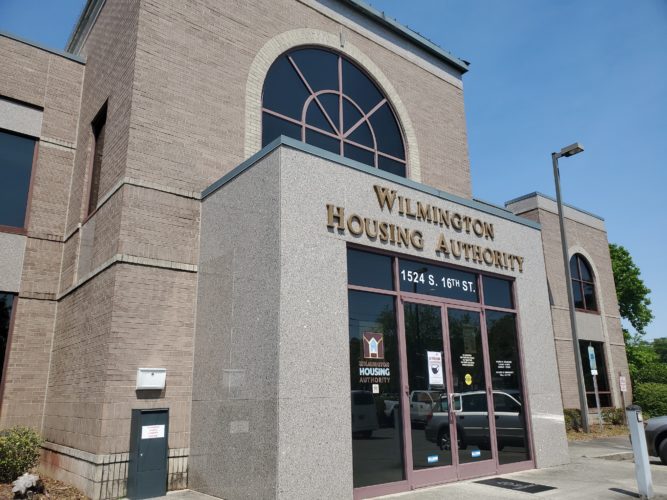
WILMINGTON — The Wilmington Housing Authority is reviewing more than 500 units after discovering it wasn’t charging rent correctly under the federal Low-Income Housing Tax Credit, a practice that potentially dates back more than a decade.
Some residents — WHA would not disclose how many — have already received notices their rents will increase. WHA CEO Tyrone Garrett said Thursday no resident will be pushed out of their housing due to the change, but relocations to other units within the WHA portfolio is to be expected.
READ MORE: After mold crisis and cash crunch, WHA plans a transformational decade
“Someone being displaced or being made homeless — that’s not going to take place,” Garrett said at the WHA finance committee’s meeting Thursday. “Everyone’s going to be housed, and they’re going to be housed in the appropriate unit that meets their qualifications.”
Before Christmas, WHQR reported tenants at Creekwood, one of WHA’s properties, received mailers notifying them of rents increasing.
At Thursday’s meeting, WHA board member Acquanetta McNeil said she thought sending out the letter was a “big mistake” because it caused residents to panic. Garrett responded he regretted making some tenants upset, but the notification was a requirement per federal rules.
The report stated the authority would now be basing rent price off Wilmington’s median income, a number set by the U.S Department of Housing and Urban Development, rather than tenant’s actual income.
On Wednesday, Port City Daily questioned WHA on the reasoning behind the switch. WHA Manager of Executive Operations Elena Camacho said the move wasn’t done at WHA’s discretion, but rather to correct “compliance issues” it found through internal review.
WHA has 525 units part of the Low-Income Housing Tax Credit across its properties; the IRS and North Carolina Housing Finance Agency stipulate rents for LIHTC units be set at 30% of the area median income and adjusted based on bedroom size — a one-bedroom being more expensive than a four-bedroom.
However, WHA has been charging rent based on 30% of the tenant’s income, which is $22,750 or less. Moving to the median income model would set the bar much higher, at $75,833. Thus, as WHA has already made known to some residents, correcting the error will generate higher rents for tenants, also compounded by the number of bedrooms in the unit.
It is unclear whether the error was made across all properties and units and how long it’s been occurring. Creekwood has had a portion of its units part of the program since 2011, though Jervay Place, The Pointe at Taylor Estates and Robert Taylor Senior Homes were only brought into the fold in 2024.
The housing authority told Port City Daily it has not received any penalties or notices of noncompliance from either the North Carolina Housing Finance Agency nor the federal government. Consequences for not complying with LIHTC rules could be having to pay the tax credit back or reductions in future credits.
Port City Daily reached out to the North Carolina Housing Finance Agency for an explanation of its oversight process and if it found LIHTC noncompliance within the WHA before but did not receive a response by press.
Upon questioning WHA how long the error had been occurring and why it had not been caught in prior years, as LIHTC units undergo annual recertification. Camacho wrote in an email: “WHA cannot speak to the actions or practices of prior administrations.”
WHA has a history of mismanagement. Years of deferred maintenance under prior WHA leadership led to the need for capital projects across almost all 15 properties, plus a mold crisis in 2022 that displaced more than 100 families. Garrett was brought in after the former CEO Katrina Redmon resigned amid the crisis; he remediated the properties to help correct the mold and had all families moved back in their homes by the following year.
Then in December 2024, Port City Daily and WHQR reported six apartments in the housing authority’s portfolio were found to have open code violations, most involving mold and water leaks, dating back months.
It was later revealed WHA inherited the problem after taking over property management of New Brooklyn Homes, a housing development on Wilmington Northside where five of the violations were located. Though WHA owned New Brooklyn Homes and was technically still responsible for maintaining the property, it had been outsourcing the task to Excel Management, which has a history of troubled management, particularly at the neighboring Robert Taylor Homes.
Port City Daily asked Camacho why the noncompliance persisted despite recertifications occurring in 2023, 2024 and 2025, when Garrett was administrator. According to her, the administration was too bogged down by stabilizing the agency and addressing the mold crisis.
Garrett echoed the sentiment Thursday, saying repairing all the damage from previous administrations couldn’t be instantaneous.
“When a cruise ship turns, when a battleship stops, it doesn’t just stop on a dime and they can’t make a U-turn, right?” he said. “It takes time.”
The CEO said he expected it to take 14 months to right the ship, as each affected tenant would need to be assisted on a case-by-case basis. If someone can no longer afford their rent, WHA will need to find a unit they can be relocated to, in what Garrett said will look a little like “musical chairs.”
Garrett explained the approach is to put lower-income tenants — for example those who may only contribute $50 to rent — in project-based voucher units where possible. Different from LIHTC, these units allow for tenants to base their rent of what they can pay, with the voucher filling the gap. Ideally, higher-income tenants would be put in the LIHTC units.
Additionally, if a family of three is in a four-bedroom, for example, and can no longer afford the unit, they could be moved to a LIHTC unit with fewer bedrooms.
“I know there’s people trying to make it a dramatic story — it is uncomfortable for residents, I know, because this is something that they’ve never experienced before and there is a lot of anxiety that probably is going through on individuals and with families. But the one thing I can say is, we’ll talk to the residents as a group, and we’re also talking individually about where they sit in all of this,” Garrett said.
WHA plans to host several town halls to explain changes and hear resident concerns — one a month until March. Garrett has also spoken with city council members about the issue, after City Manager Becky Hawke requested a meeting to discuss the changes and asked Garrett to speak at a council meeting on the subject.
Tips or comments? Reach out to journalist Brenna Flanagan here.
At Port City Daily, we aim to keep locals informed on top-of-mind news facing the tri-county region. To support our work and help us reach more people in 2026, please, consider helping one of two ways: Subscribe here or make a one-time contribution here.
We appreciate your ongoing support.
